
Jacqui Rhule-Dagher: Staying Out, Authentic & Proud
April 26, 2023Now that Jacqui Rhule-Dagher, an associate at Hogan Lovells International LLP, is out of the closet for good, she shares the importance of being that authentic, proud, and visible role model that she never had.

Finally, there are more open LGBTQ+ out leaders in the legal profession. “There are three out partners at Hogan Lovells,” shares Jacqui Rhule-Dagher, an associate in the firm’s corporate litigation, fraud, and investigations team. “But you’d be hard-pressed to find a Black, female LGBTQ+ leader in the legal profession in the UK, or anywhere else for that matter,” observes Jacqui. She is increasingly recognized in diversity, equity, and inclusion circles for championing the rights of all intersections of the LGBTQ+ community. And this week, during Lesbian Visibility Week, she is honored on the DIVA Power List.
Jacqui says she realized she was a lesbian when she was 17. “The hardest part was admitting it to myself,” shares Jacqui. “Back then, I was so deep in the closet that I could have been mistaken for Aslan from The Lion, the Witch and the Wardrobe – with hair to rival his!”
As a teen, she admits that despite being very happy at school, she felt different from her peers. “I seriously thought that I was the only Black, Catholic and lesbian teenager in the world. It did not help that the lesbians in the media had the life expectancy of a lettuce, or a strange obsession with vampires,” explains Jacqui. Today, however, she’s steadfast in her visibility as an out and proud lesbian. For many LGBTQ+ professionals, coming out at work is not an easy process, and this was also the case for Jacqui. She recalls spending Monday mornings rehearsing lines on the tube, going over what she’d done over the weekend, so she didn’t out herself. Although she was out at university, she returned to the closet when she joined the world of work.
This started in her first professional role as a paralegal. “I was hyperaware that I was one of a handful of Black people in the organization, and the only Black person in my department, so I really didn’t want to draw any additional attention to myself,” she explains.
Nevertheless, Jacqui came out in her second job, when she started training at the “Magic Circle” law firm, Clifford Chance. “Clifford Chance was a wonderful place to be LGBTQ+. This was also the first time that I had the pleasure of working with senior lesbian lawyers, which was such a life-affirming experience.”
Jacqui returned to the closet for the second time, however, when she joined a US law firm upon finishing her training. “I think it is important for people to remember that ‘coming out’ is not a one-time event. You often have to think: ‘How much can I share?’ ‘How might this impact my career?’ ‘Is this a psychologically safe space?’” she explains.
In fact, many senior LGBTQ+ women don’t come out, and are in fact unlikely to come out, as myGwork’s latest survey reveals. “I suspect that homophobia, misogyny, a lack of visible role models and fears concerning how being out might impact their career probably makes people reluctant to come out,” shares Jacqui. “Also, some senior women and non-binary professionals will have grown up around the time of Section 28. This banned local authorities and schools from intentionally ‘promoting’ homosexuality. It is not inconceivable to think that some people will still be carrying scars from that awful time. I want to add that simply because a person decides not to come out, or cannot come out, this does not mean they aren’t part a of the LGBTQ+ community.” But for Jacqui, it’s vital for her to be visible now.
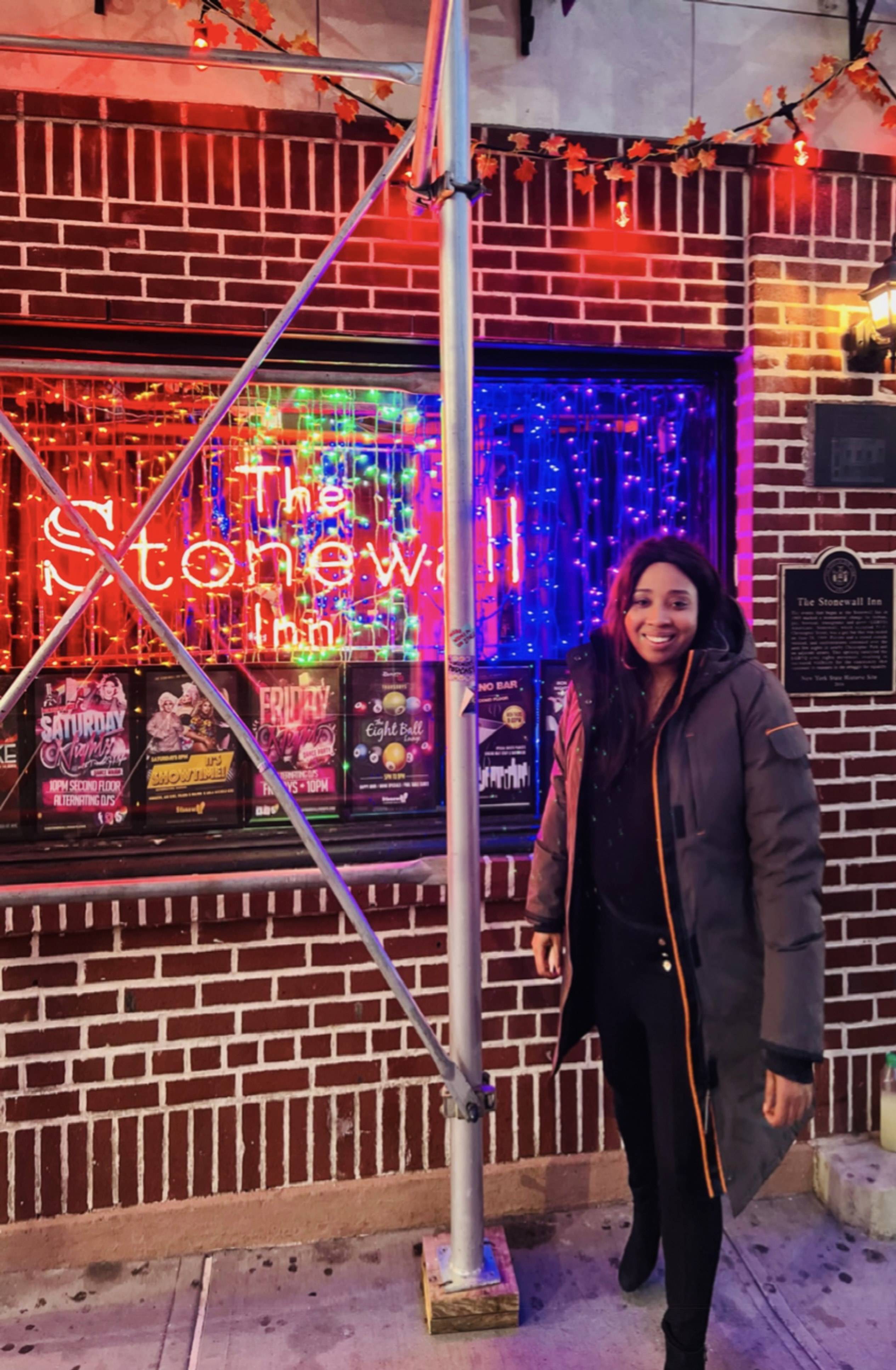
There is a stark difference in the hidden version of Jacqui that she reflects on, and who she is now, but what sparked this change? “Joining employee resource groups/networks really helped,” recalls Jacqui. “When I joined Clifford Chance, I immediately joined the LGBTQ+ & BME networks. Shortly after, I founded Carnival Comes to Clifford Chance. This was an annual summer party, jointly hosted by the LGBTQ+ and BME networks, which had a focus on intersectionality. One year, Channel 4 supported one of the events. I am really pleased that it is still running.”
Alongside her hectic job, Jacqui sits on the steering committees of the Hogan Lovells UK Pride Network, and of The Law Society’s LGBTQ+ Solicitors Network. “My firm is very good at articulating why inclusion matters. If people think your messaging is simply to ‘tick boxes’ they’re unlikely to engage with it. I am also extremely lucky that the Pride Network has two fantastic co-chairs and excellent partner engagement,” remarks Jacqui.
“I am also part of The Law Society’s LGBTQ+ Solicitors Network. We bring LGBTQ+ solicitors together to share best practice and address current issues and challenges,” explains Jacqui. She also finds time to volunteer with the LGBTQ+ charity Diversity Role Models and is a 2022 Stonewall LGBTQ+ Leadership Programme delegate.
Thanks to all these activities, Jacqui is well and truly out of the closet, and plans to stay out. “I hope that by being visible, I can dispel some of the misconceptions surrounding intersectionality, and increase the number of active allies for the LGBTQ+ community. Understanding intersectionality is key to inclusivity,” adds Jacqui. “The term intersectionality was coined by Professor Kimberlé Crenshaw in 1989. Crenshaw describes intersectionality as the complex, cumulative way in which the effects of multiple forms of discrimination combine, overlap, or intersect, especially in the experience of marginalized individuals by virtue of their race, gender and sexuality. Or in the words of Audre Lorde: ‘There is no such thing as a single-issue struggle because we do not live single-issue lives.’”
“I think it is important for allies to understand that individuals can have multiple intersecting identities. If an ally is only interested in championing one aspect of a person’s identity, while ignoring or denigrating other aspects, then this is not meaningful allyship,” explains Jacqui. “Allyship is a verb, and it is useless unless it includes ‘all’ members of the LGBTQ+ community. It is not about waving the rainbow flag and taking all the benefits without actually advocating for and uplifting LGBTQ+ people. If an ally removes their support the moment their allyship becomes inconvenient to them, then they’re displaying performative allyship, which I call ‘pallyship.’”
So, what can organizations do to support intersectionality so that the totality of every individual’s unique experience can be valued in the workplace? “My personal view is that data and education are of paramount importance when it comes to meaningfully engaging with intersectionality” shares Jacqui. “A functional DE&I database, where data is collated through anonymous surveys, one-to-one interviews, focus groups, etc., is key to generating a clearer picture about the experiences of individuals with multiple intersecting identities. A functional database, which charts trends, can also show, for example: Who is being hired? Who is being rejected? How long individuals are staying in an organisation? Whether equal opportunities exist for the advancement of all employees within an organization, or just some. Analysing data will help to show that underrepresented groups are not a monolith, because there can be a tendency to lump them together. Two Black LGBTQ+ people, for example, will not necessarily think the same way, or share a similar background or experiences, so it is important to analyse the nuances within marginalized groups in order to generate an accurate picture.”
Regular training sessions are also important, adds Jacqui: “One-off training sessions on microaggressions or unconscious bias are helpful, but they only scratch the surface. You would not expect to be able to run the London Marathon after an hour’s training. A more deliberate, considered programme of training sessions spanning the breadth of characteristics would be far more impactful.”
Finally, it is important to keep an “open mind”, she concludes. “Sometimes, we can be too quick to dismiss another person’s experiences because they do not resonate with our own experiences. My mantra, however, is that the words ‘silent’ and ‘listen’ contain the same letters. I think it is helpful to remember this when trying to cultivate an environment which welcomes people with multiple intersecting identities.”
Being that much needed out, authentic, proud and visible LGBTQ+ role model has resulted in Jacqui being recognized as one of the Top 10 Future Leaders by the British LGBT Awards, being shortlisted for the Diversity Champion of the Year Award by DIVA, and being shortlisted for the Financial Times Corporate LGBTQIA Champion of the Year by the Bank of London, Rainbow Honours Awards. In just a very short space since Covid 19, and coming out for the final time, Jacqui is already having a huge impact in the DE&I space – and she’s only just getting started.
LESBIAN VISIBILITY WEEK