
Candidate Experience Surveys: What to Ask and When
October 1, 2026
A candidate experience survey asks job applicants how your hiring process felt, at set points in the process, so you can fix what is slow, unclear or unfair. The recipe is short. Send a brief survey right after each stage, mix rating questions with a few open-ended ones, and act on the patterns you find. Add questions about respect and belonging if you want to know whether your process works for LGBTQ+ candidates and other groups.
This guide covers the timing, the questions, the metrics, and the step most guides skip: how to read the results through an inclusion lens.
Key Takeaways
- A candidate experience survey is a short, structured feedback form sent at specific touchpoints: after applying, after interviews, after a rejection and after an offer.
- Common timing guidance is 24 hours after an application, 48 hours after an interview, 3 to 5 days after a rejection and within a week of an offer.
- Keep it to five to ten questions, combine scales with one or two open comments, and survey rejected candidates too, not only hires.
- Track a score such as candidate Net Promoter Score over time, then tie each finding to one owner and one process change.
- To learn whether your process feels welcoming, add questions on respect, authenticity and psychological safety, and make every demographic question optional.
What a candidate experience survey is
A candidate experience survey is a structured feedback tool that collects input from applicants at specific touchpoints in the hiring journey, such as after the application, after interviews or after the final decision. It is not a satisfaction poll about your brand. It is a process check, and it works best when each question maps to something you can change.
The stages worth covering:
- Job description and application. Was the role described clearly? Was the application form easy to complete on a phone?
- Recruiter communication. Did candidates know what would happen next and when?
- Interviews. Did they feel fair, organized and relevant to the job? Did the interviewers seem prepared?
- Decision and feedback. Was the outcome communicated promptly and respectfully?
- Offer and onboarding handoff. Did the offer match what candidates were told earlier?
Surveys that cover these stages ask about job-description clarity, recruiter communication and whether interviews felt fair and organized. That is the core. Everything else is detail.
When to send each survey
Timing matters more than most teams expect. Memory fades, and candidates who were rejected a month ago have little reason to reply. The guidance we found suggests this rhythm:
| Stage | Suggested send time | What to focus on |
|---|---|---|
| After application | Within 24 hours | Clarity of the posting, ease of the form |
| After interview | Within 48 hours | Fairness, organization, interviewer conduct |
| After rejection | 3 to 5 days later | Respect, quality of communication, speed |
| After offer | Within one week | Accuracy of expectations, offer process |
These windows come from one published guide to candidate experience surveys. Treat them as sensible defaults and adjust to your hiring cycle. A company that takes six weeks to decide may want a check-in survey midway.
One practical point: a rejected candidate is the most honest respondent you have, and the one most companies never ask. If you only survey people who accepted offers, your scores will look better than your process deserves.
Questions to ask in a candidate experience survey
Keep the list short. Candidates are giving you time after a stressful process, and a long form will lose them. Employers should combine rating-scale and open-ended questions, so aim for mostly scales and one or two comment boxes.
Application stage
- The job description gave me a clear picture of the role. (Strongly disagree to strongly agree)
- The application took a reasonable amount of time to complete. (Scale)
- Is there anything that nearly stopped you from applying? (Open)
Interview stage
- I knew what to expect before each interview. (Scale)
- My interviewers were prepared and respectful. (Scale)
- The questions I was asked were relevant to the job. (Scale)
- The process felt fair. (Scale)
- What one thing would have improved your interview experience? (Open)
Communication throughout
- I received updates at a pace that felt reasonable. (Scale)
- The recruiter answered my questions clearly. (Scale)
- Did anyone tell you how long the process would take, and was that accurate? (Yes/No, then comment)
After a decision
- The way I was told the outcome was respectful. (Scale)
- How likely are you to recommend applying to our company to a friend or colleague? (0 to 10)
- Would you apply again for a different role? (Yes/Maybe/No)
The 0 to 10 recommendation question is the basis of the Candidate Net Promoter Score. Tracking cNPS lets you benchmark recruiting performance over time and see whether process changes moved the number.
Writing questions that get honest answers
- Ask one thing per question. “Was the recruiter timely and friendly?” is two questions.
- Use the same scale throughout so results can be compared.
- Avoid leading wording like “How great was your experience?”
- Make comment boxes optional.
- Tell candidates how the answers will be used and whether they are anonymous. If you cannot keep responses anonymous, say so plainly.
Measuring candidate experience beyond the survey
Survey scores tell you how candidates felt. Pair them with operational data to find out why.
- Time to first response after an application.
- Time between interview stages.
- Drop-off rate at each stage, including candidates who withdraw.
- Offer acceptance rate.
- Response rate to the survey itself. A very low rate usually means the survey is too long or arrives too late.
The point of this is to identify specific friction points, such as slow response times or unclear job descriptions, and then change recruitment workflows, interviewer training and communication. A score alone changes nothing. A score next to a slow-response metric tells you where to start.
A simple worked example: your interview-stage scores on “my interviewers were prepared” are low, and the comments mention interviewers asking questions that were already answered in the resume. The fix is not a new survey. It is a short interviewer briefing and a shared scorecard, followed by another round of the same questions to see whether the score moves.
Turning results into changes
Most candidate surveys fail after the data arrives. A workable routine:
- Review monthly or quarterly. Frequent enough to catch problems, slow enough to see patterns.
- Group comments by theme. Communication, speed, interview quality, clarity of the role.
- Pick one to three fixes. Trying to fix everything at once usually fixes nothing.
- Assign an owner and a date for each fix.
- Re-measure with the same questions so you can compare.
- Close the loop. Tell hiring managers and recruiters what candidates said, including the good parts.
Feedback can support targeted interviewer training and clearer communication, which are usually the cheapest improvements available.
Perspective: the survey only works if candidates feel safe answering
We talk to LGBTQ+ professionals and employers every day, and one thing is consistent: candidates read a hiring process for signals long before they read a values statement.
A candidate wonders whether the interviewer will react to a partner’s name, whether a form forces a choice that does not fit them, whether the team has any visible LGBTQ+ colleagues or allies. A standard candidate experience survey rarely asks about any of this, so the answers come back looking fine while some candidates quietly drop out.
That is why we think the best survey programs treat inclusion as part of the candidate experience, not a separate project. Ask whether the process felt respectful. Ask whether people felt they could be themselves. Make anything about identity optional and explain how the data is protected. Then look at the results by stage, because a process can be warm in the first call and awkward by the fourth interview.
Our own approach starts from the same idea. We curate jobs and networking opportunities with employers that are committed to LGBTQ+ inclusion, so candidates meet organizations that have already signalled that commitment. A survey is how an employer finds out whether the experience behind that signal is real.
Adrien
Adding inclusion to your surveys
Candidate surveys cover people who have not joined yet. Employee inclusion surveys cover those who have. Used together, they show whether the welcome you give candidates matches daily life inside the company.
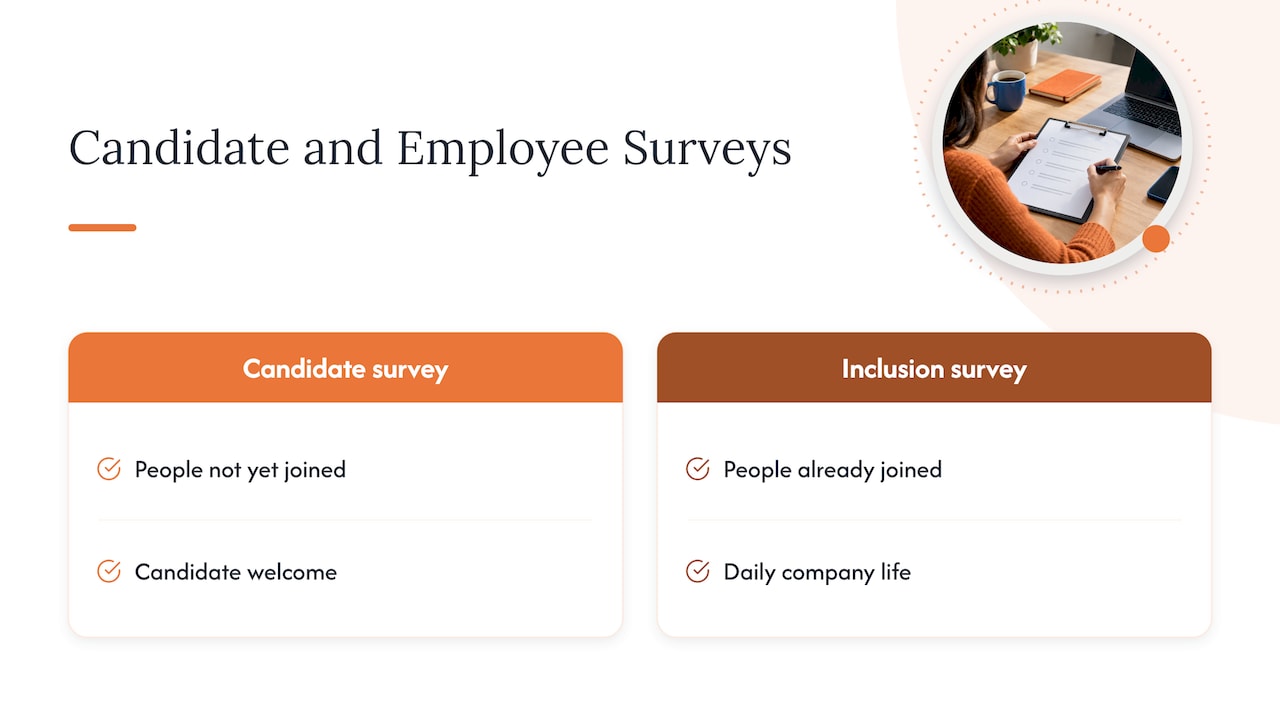
What an inclusion survey should measure
Workplace inclusion surveys should measure several constructs, including belonging, authenticity (being able to be one’s true self) and psychological safety (being able to speak up or take risks without fear of negative consequences). These are separate ideas, and an employee can score high on one and low on another.
Sample statements, rated from strongly disagree to strongly agree:
- I feel like I belong at this company.
- I can be myself at work.
- I feel safe to speak up when I disagree.
- I feel safe to challenge the status quo.
- People here treat each other with respect, whatever their background.
- I trust that I would be treated fairly if I raised a concern.
The “safe to take chances” and “safe to challenge the status quo” phrasings come from a published inclusion survey methodology, which notes they can capture the same sentiment without the word “risk,” a term that may carry negative connotations in some industries.
Asking about LGBTQ+ experience without pressure
Employees decide for themselves whether to be open about their sexual orientation or gender identity. A survey should never push them to disclose. Some principles that help:
- Make every demographic question optional, with a “prefer not to say” choice.
- Ask about the environment, not the person. “People at this company are respectful toward LGBTQ+ colleagues” can be answered by anyone, including allies, without revealing anything.
- Explain who sees the data and at what level it is reported.
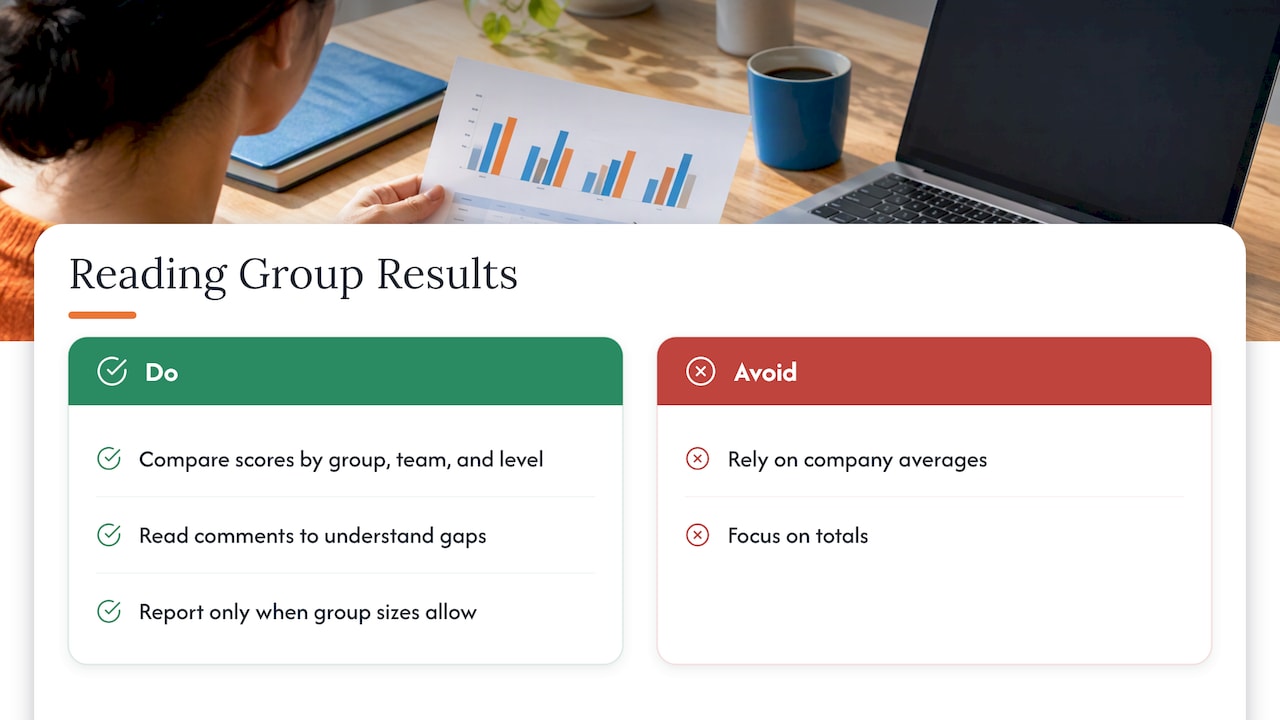
- Set a minimum group size before reporting results for any group, so that small groups cannot be identified from the numbers.
- Do not combine survey answers with HR records unless you have told respondents you will.
- Review the questions with an employee resource group before launch.
These are practical design choices rather than legal requirements. Your legal or privacy team should confirm how they fit with the rules where you operate, including state privacy and employment law.
Reading results across groups
An average score hides a lot. If the company average for “I can be myself at work” is high, but scores for one group are lower, the average is concealing the problem. When group sizes are large enough to report safely, compare scores by group, by team and by level. Look for gaps rather than totals, and read the comments for the reason behind the gap.
A simple measurement calendar
You do not need a complex program. A starting plan for a mid-sized employer:
| Survey | Who | Frequency |
|---|---|---|
| Candidate: application and interview | Active applicants | Continuous, after each stage |
| Candidate: rejection | Declined candidates | Continuous, 3 to 5 days after the decision |
| Candidate: offer | Offer recipients | Continuous, within a week |
| Employee inclusion | All employees | Once or twice a year |
| New hire check-in | Employees in their first 90 days | At 30 and 90 days |
The new-hire check-in is a bridge. It asks whether the company the candidate was shown is the company they joined, and it is where gaps between employer brand and reality show up first.
Where myGwork fits
If your surveys show that LGBTQ+ candidates are not finding you, or not staying in your process, the issue may be reach as well as experience. We help employers attract LGBTQ+ professionals through employer branding and talent attraction services, including an employer profile that shows candidates what your organization does for inclusion. Our corporate solutions plans range from Essentials to Platinum; contact us for details, as pricing is not published.
If the survey results point to a skills gap among interviewers or managers, our academy training on allyship and intersectionality is offered in person or virtually. You can also start from our homepage to see how the community and job listings work.
FAQ
How long should a candidate experience survey be?
Five to ten questions is a good range, taking under three minutes. Use mostly scale questions and one or two optional comment boxes. If you need more depth, run different short surveys at different stages instead of one long one.
Should we survey candidates we rejected?
Yes. Rejected candidates are the group least likely to be asked and often the most candid. A common suggestion is to send the survey 3 to 5 days after the rejection. Keep the tone respectful and make clear that responding does not affect future applications.
What is a good candidate Net Promoter Score?
There is no universal target, and benchmarks vary by industry and role. The more useful comparison is your own score over time. Tracking cNPS lets you see whether process changes are helping.
Can we ask candidates about sexual orientation or gender identity?
Only if it is optional, clearly explained and handled with care. In most cases it is better to ask about how respectful and welcoming the process felt, which every candidate can answer without disclosing anything. Check with your legal or privacy team before collecting demographic data.
What should an employee inclusion survey cover?
At minimum, belonging, authenticity and psychological safety, as described in published inclusion survey research. Add statements about fair treatment and trust in reporting channels, and review results by group when numbers are large enough to protect anonymity.