
Conversations that Matter: Black History Month
February 21, 2026February is Black History Month in the United States. It is a time set aside to recognize the history, achievements, and contributions of Black Americans, and to reflect on how that history shapes present-day experiences.
As part of our February Conversations That Matter webinar, several colleagues shared their lived experiences and perspectives on belonging, identity, and workplace culture.
Black History Month 2026 Theme
The theme, set by the Association for the Study of African American Life and History, is A Century of Black History Commemorations, marking 100 years since the first national observance in 1926. The theme invites reflection on a key question: How has the commemoration of Black history over the past century influenced the African American community today?
Our Reflection
Commemoration is more than remembrance. It helps pass on knowledge, build identity, and create opportunity. Around the world, communities preserve history through education, faith communities, cultural organizations, and local media. These spaces help people develop confidence, leadership, and a sense of belonging.
History does not stay in the past. It shapes how people are seen, heard, and treated today. For some employees, this includes the added pressure of feeling they must adjust how they speak, look, or behave in order to be accepted at work.
Conversations That Matter session
During the webinar, panellists discussed code switching, which means adjusting language, behaviour, appearance, or expression to align with dominant cultural expectations. This can happen consciously or unconsciously. While many people adapt their style across situations, research shows that code switching is more commonly reported by underrepresented groups, especially those who have experienced bias or exclusion.
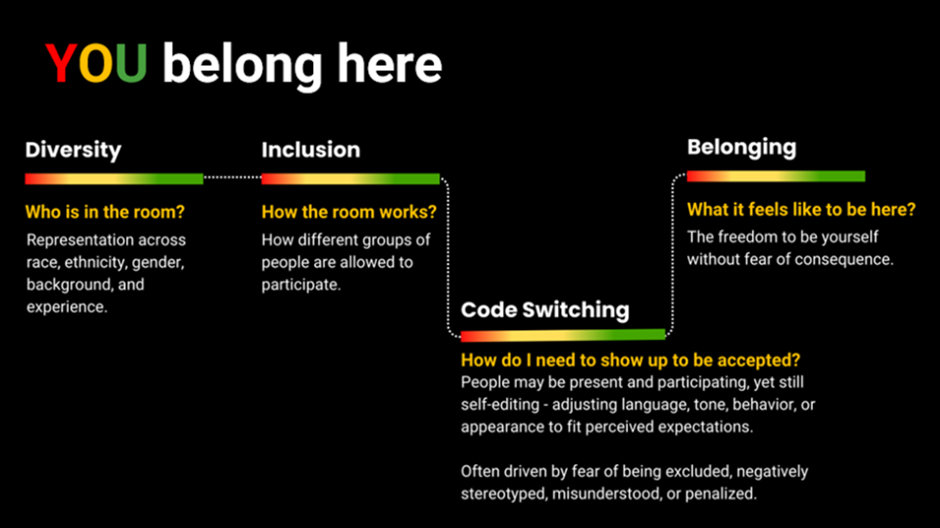
During the session, we described code switching as the space between inclusion and belonging.
- Diversity is the mix of people in an organization.
- Inclusion is how we create an environment where each person is heard, respected, and able to participate.
- Belonging is the outcome, where people feel safe to be their authentic selves and have a fair opportunity to contribute and perform at their best.
The gap between inclusion and belonging is where code switching often lives. It is the signal that someone still feels pressure to hide or adjust important parts of who they are to fit in.
Courtney Collins shared that early in her career she moved from a Historically Black College and University (HBCU), where she was surrounded by many other Black students, into corporate environments where she was often the only Black employee. That shift created internal pressure to code switch due to concerns about being negatively stereotyped as unpolished or not leadership ready based on her language or mannerisms. “I was wearing a mask all day, which was super exhausting,” Courtney said. “The Association was the first environment I’ve worked in where I consistently felt able to lower my guard.” Today, Courtney leads by example. Encouraging openness, she has helped create a team environment where others feel safer doing the same.
Sadasia Brookins also described how expectations around professional appearance influenced her early career experience. Before interviewing, she was advised by her mother to choose a more “professional” hairstyle.
“Historically, Black hairstyles were often judged in workplace settings. Natural styles or braids were sometimes labeled unprofessional,” she explained. “My family encouraged me to change my hair to appear more professional when starting my role."
"My natural and braided hairstyles are fully accepted and never questioned at the Association. I was never seen as unprofessional because of my hairstyle, and that meant a lot.”
Ja’Lisa Little shared the importance of recognizing that while some experiences may overlap, people are not one-dimensional. In previous workplaces, she found that Black identity was often treated as a monolith rather than as individual experience. She recalled a situation where a former manager questioned her interest in K-pop and anime, which made her feel she needed to hide parts of herself.
“Black doesn’t look one way. We all have different interests,” Ja’Lisa said. “When I joined the Association, I found a place where my interests are welcomed rather than scrutinized. I even met other team members who share some of my interests.”
Jori Nwachukwu reflected on the emotional toll of working in previous organizations where she was the only Black woman on her team. “I constantly felt the need to overperform and to closely monitor my tone, appearance, and presence,” she shared. She explained that representation in leadership made a meaningful difference in her experience.
Having a Black woman manager at the Association strengthened her sense of safety and confidence at work, and motivated her to aim higher in her own growth and leadership journey.
Crystal Cooke, Director of Diversity and Inclusion, spoke from the perspective of being “the one” in the room - the only Black woman or the only person from an underrepresented group in leadership spaces. She shared that while this can feel isolating, it can also create purpose and responsibility. “I’ve always held on to the phrase ‘lift as we climb’ and felt a responsibility to create space for others,” she said. “When people see themselves reflected in the workplace, they begin to believe, ‘I can do this. I can be that.’”
Crystal emphasized that representation in leadership is not only symbolic. It shapes confidence, expands ambition, and signals what is possible. Visibility helps others see a pathway forward. She also noted that inclusion is a shared responsibility, not only the work of diverse leaders or formal inclusion teams. When someone is the only one on a team, across any dimension of difference, others can help create belonging through simple actions such as welcoming them into conversations, making introductions, and showing genuine interest and respect.
Her message to employees, especially those who may feel they are carrying visibility for others, was simple and direct: your presence matters, and your example creates space for someone else to step forward.
Self-Reflection: Code Switching
While code switching is often discussed in the context of race and ethnicity, the experience is not limited to one group. Many people adjust how they speak, behave, or present themselves to fit expectations or avoid negative judgment. This makes code switching a useful reflection point for everyone, not only a diversity topic for some.
Do You Code Switch? Ask Yourself:
- Do I change how I speak with certain colleagues?
- Do I reshape my personality to be seen as more acceptable?
- Do I avoid sharing parts of my background, interests, or identity at work?
- Do I present a different version of myself in meetings than I do with trusted coworkers?
- Do I feel more relaxed and authentic with some groups at work than others?
If you answered yes to several of these, you may be code switching more than you realized. That does not mean you are doing anything wrong. Many people adapt to their environment over time.
You can take small, practical steps to reduce that pressure:
- Start with low risk authenticity
Share a bit more of your natural communication style or interests in settings where you already feel some trust. - Build belonging circles
Strengthen connections with colleagues or teams where you feel respected and understood. Familiarity increases comfort. - Connect beyond your immediate team
We are a global workforce. Look for opportunities to build relationships across regions and functions. Broader connections often increase perspective, support, and sense of belonging.