
Don't Be A Drag Just Be Queen: A Quick History of Drag
September 6, 2023Humanity has a long history of wearing
clothes; it takes particular social and political conditions to transform a dress
into drag. Drag itself is a form of arts
and entertainment, the precursors of which can be seen in various cultures
around the world, from ancient Greece to Japan.
In Shakespearean theater, the political climate demanded women to remain
off the stage due to perceived “indecency”, so all the roles were played by
men. This is in striking contrast to
today’s times, where women actors are commonplace and men performing as women
can be accused of “indecency”!
Molly Houses were clubs in London during
1690-1860 that were akin to today’s gay bars.
Within these houses, men would frequently take on the manners and dress
of women, and even have wedding and “mock-birth” ceremonies. This social behavior was largely a push-back
against the increasingly strict gender roles of the time. Molly Houses were subject to raids by the
police for violating sodomy laws, which developed the association between drag
and gay culture. [Exhibit 1]
During the Vaudeville era of 1880s-1920s,
impersonation acts were popular. Both
men and women would tour the US and England, such as female impersonator Julian
Eltinge and male impersonator Hetty King.
Shows were attended by a wide
variety of people, such that gay attendees had a safe space to express
themselves without being shut down by the police. American Prohibition of 1920-1933 coincided
with the Pansy Craze, a rise in popularity of drag queens known as “pansy
performers”. Various underground
communities came together at speakeasies where they could participate in
unlawful activity such as drinking alcohol, race-mixing, and drag. [Exhibit 2]
Drag balls became more popular as extravagant events modeled after the debutante
ball where a young woman would come out as eligible for marriage. Drag queens would play the role of the woman,
coming out as homosexual rather than marriageable.
Around this time, Womanless Weddings also
became popular among the general population.
Local charities and churches would hold fund-raising events where a
male-only cast would perform a wedding ceremony. The draw of womanless weddings was the
humorous spectacle of prominent men in the community acting the caricatures of
women. There are videos on YouTube of
womanless weddings being performed as recently as the 1990s, but the act has
largely dropped out of public interest now that same-sex marriages are
commonplace.
During World War II, the United Service
Organization began producing soldier shows to entertain the troops and increase
morale. In a case of history repeating
itself, women were not allowed on stage during these shows, because military
leadership thought it would be “too sexually risqué”. However, the women soldiers were allowed to
host workshops teaching the men how to wear makeup and dress as female
impersonators. The men would put on shows
with different acts, such as “pony ballets” where they would dress in tutus and
dance ballet in their combat boots. The
shows were also racially segregated, and even when they did finally integrate,
the portrayal of interracial relationships was not allowed. The musical This is the Army based on
these soldier shows opened on Broadway in 1942 with a movie version released
the following year, which can be found in its entirety online.
Not too long after this, the Lavender Scare
of the 1950s put gender impersonators and drag shows under heightened moral
scrutiny. Accusations of homosexuality
were levied against political opponents where accusations of communism wouldn’t
stick, and thousands of gays and lesbians lost their jobs in the US government. This pushed drag further underground along
with gay culture, creating the incendiary conditions that lead to the Los
Angeles Cooper Do-nuts Riot of 1959, when police arrested 5 gay men (including
2 drag queens) and attempted to shove all of them into a single police car. Onlookers threw coffee cups and donuts at
police until they fled, only to return with reinforcements to combat the crowds
of protesters who had gathered in the streets from nearby gay bars. Drag queens later protested in the San
Francisco Compton’s Cafeteria Riot of 1966 and the New York Stonewall Riot of
1969.
As early as the 1960s in Washington D.C., drag
balls developed into drag, which were centers of support for the entire gay and
lesbian community. Early drag
competitions centered around performances including lip-synching. The Ballroom scene was launched by Crystal
LaBeija in 1971 New York City, in a response to the racial discrimination in
the city’s drag balls. These new Balls
featured walks in various categories of dress, and even developed voguing, a
form of dance that mimicked catwalk and fashion magazine imagery. Ballroom music also left its mark on popular
culture with its mutual influences on house, disco, hip hop, R&B, and
Jersey club. Both the documentary Paris
is Burning and the historical fiction series Pose provide excellent depictions
of the richness of Ballroom culture.
Following centuries of drag in performance arts and entertainment at live venues, drag was brought into our homes in the form of RuPaul’s Drag Race. Since 2009, over 150 contestants have competed, with hundreds more in worldwide spin-offs. The show has introduced numerous aspects of drag and gay culture into the mainstream, such as “spilling the tea” and “serving realness”. It has also inspired a broader range of young performers, gay and straight, male and female, to participate in drag performance. There has been a recent wave of legislative backlash and moral indignation at this increased visibility, but history has proved that drag is here to stay.
Exhibit 1
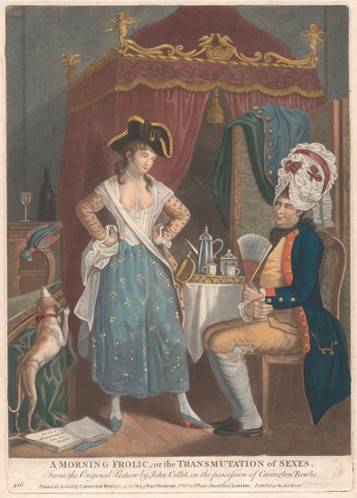
c. 1780
Exhibit 2
“Masculine Women, Feminine Men” (1925) https://www.youtube.com/watch?v=wBBKLd_qqCY