
Gender Pronouns: Building a culture of authentic identity expression
February 22, 2022We’re highlighting our pledge to ensure every member of Avalere Health can work in a safe, respectful environment where they are referred to by the pronouns they determine for themselves. Find out why we’re making this pledge and what it means to our team members.
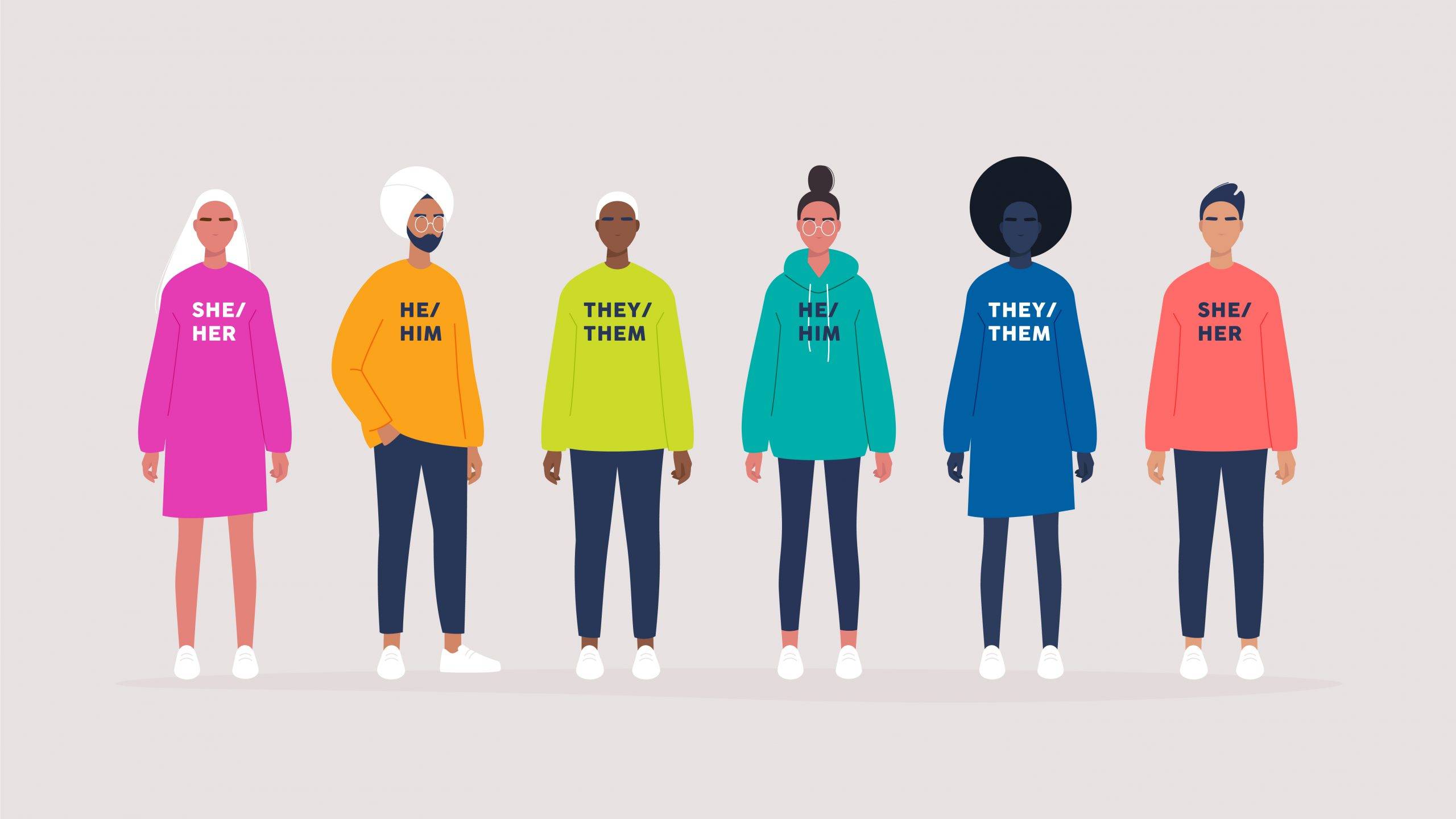
He, she, him, her, they, them, ze, zie, – these are
simple words, but they are integral to how we identify ourselves and others.
Under the surface, these words carry power: the power to enable a person to be
who they truly are and the power to trigger feelings of anxiety, depression,
and despair.
As a cis-gendered person – a person whose sense of personal
identity and gender corresponds with their sex at birth – it can be easy to
feel like pronouns aren’t that important. If your gender happens to match up to
the sex you were assigned to at birth, you may have never felt the trauma of
being misgendered. However, personal pronouns often imply gender, and assuming
an individual’s pronoun can be harmful – it sends the message that a name or
the way a person looks equates to their gender.
Research shows
that misgendering an individual leads to feelings of stigmatization and
psychological distress. When a person is misgendered repeatedly, it can impact
their mental health significantly.
Referring to a person using correct pronouns is easy to do.
It can make a real difference to ensuring the individual feels safe, secure,
seen, respected, and included.
Shige Sakurai, a transgender person of color, social justice
leader, professor, consultant, and creator of MyPronouns.org (an excellent
educational resource providing a wealth of information on pronouns), writes:
“Just as it can be offensive or even harassing to make up a nickname for someone
and call them that nickname against their will, it can be offensive or
harassing to guess at someone’s pronouns and refer to them using those pronouns
if that is not how that person wants to be known. Or, worse, actively choosing
to ignore the pronouns someone has stated that they go by could imply the
oppressive notion that intersex, transgender, nonbinary, and
gender-nonconforming people do not or should not exist.”
How we’re supporting our team members at Avalere Health
In the United States, a recent study revealed that 47% of
transgender employees experienced discriminatory behavior at work daily,
including transphobic remarks, being ignored, or feeling pressured to act in a
traditionally gendered way. As a result, those surveyed felt continuously ‘on
guard’ and were left regularly emotionally exhausted.
At Avalere Health, we are committed to building an
inclusive culture and creating an environment where all our employees feel safe
and thrive. Following our recent initiatives to educate our Avalere Health
community on gender expression, we are rolling out a tool that enables all our
team members to add their pronouns to their email signatures. The move comes as
part of our broader diversity and inclusion strategy, which also includes
continuing to provide space for further dialogues between our team members and
subject matter experts.
Rachel, Senior Project Manager and member of our
Diversity and Inclusion (D&I) team explains: “The world can be dangerous
for those who do not identify with the majority. To be an inclusive culture, we
must be diligent about providing a safe and welcoming workplace for everyone.
“The signature tool allows for fewer instances of
misgendering or using the wrong pronouns, especially as we are so virtual and
do more work cross-culturally. It’s part of creating a safe and inclusive
workplace that values all gender identities instead of assuming them.”
“Becoming a workplace that is more literate and educated on
issues facing the LGBTQ+ community will ultimately improve life for every
employee,” Imogen, Account Executive, continues.
“People will become more conscious of microaggressions and
assumptions or discrimination relating to gender. I personally include she/her
pronouns in my email signature. It’s important because you can signal that you
are an ally, and normalizes people being able to share their pronouns and for
them to be respected at work.”
“It’s a simple step for everyone to take that normalizes the
conversation about pronouns and gender identity,” adds Mike, Director
of Business Operations.
The goal of the signature tool is to remove any anxiety our
team members might feel about either declaring their pronouns or asking others
about their pronouns. Instead, we can all choose to easily tell people how to
refer to us in our email signatures. Although participation is not compulsory,
all employees will be given access to the tool to both normalize the
conversation and demonstrate allyship.
Consultant Leah leads our D&I educational
initiatives. She explains, “This is a topic that is relevant to every single
person. “The more we can build people’s understanding around these topics, the
more people can learn about and feel comfortable in themselves, and the more
people can understand each other. Intersectionality is critical, and gender is
one component that makes up a part of every person’s identity and can be the
subject of a lot of stigma and discrimination, so it cannot be forgotten.
“Sharing our pronouns can help to create an increasingly open
environment where team members feel that putting their identity out there is
not only acceptable but encouraged and supported by the people around them at
work. This can help to reduce the stigma around talking about pronouns and
gender identity more broadly, and overall should improve inclusiveness in our
culture.”
Teresa, Senior Project Manager, is leading our
pronouns project and rolling out the signature tool alongside Sally,
Senior Learning and Development Strategist. Teresa reveals: “I believe we as
colleagues do our best work when we come as our authentic selves. Creating an
environment of authenticity requires a safe community of compassion and trust.
Developing a deeper understanding of our fellow humans by educating ourselves on
gender identity and the sexual orientation spectrum helps build that community.
Sharing my pronouns is my small contribution towards the effort of normalizing
these conversations. I also hope that the inclusion of my pronouns in my
signature will serve as a small public indicator that I am an ally if someone
needs one.”