
Inclusive Referral Programs: How to Build One That Widens Your Talent Pool
October 1, 2026
An inclusive referral program is one that brings in candidates from outside your employees’ own circles, treats every referred person by the same criteria, and tracks who actually gets hired. Left on autopilot, referrals tend to copy the workforce you already have. Built with intent, they can reach LGBTQ+ professionals and other underrepresented candidates that job boards miss. This guide covers the design, the legal backdrop in the US, the privacy questions specific to LGBTQ+ employees, and the numbers to watch.
Key Takeaways
- Referrals favor people who resemble the referrer, so a program that relies only on word of mouth can narrow your pool. The EEOC says so directly for non-diverse workforces.
- Make the program proactive: ask employees and employee resource groups for referrals to specific roles, and pair referrals with outside sources of diverse talent.
- Evaluate every referred candidate on the same criteria, keep rewards uniform, and never ask anyone to disclose their sexual orientation or gender identity.
- Track the source and outcome of every referral, and compare referral hires with your overall applicant pool at least once a year.
- Signaling that you are an identity-conscious employer matters to LGBTQ+ candidates, so pair the program with visible inclusion work.
What makes a referral program inclusive
A standard referral program asks employees to send in people they know and pays a bonus if the person is hired. An inclusive one keeps that mechanism but changes three things:
- Who is reached. Outreach goes beyond each employee’s personal network to communities, networks and institutions where underrepresented talent already gathers.
- How candidates are judged. Referred people go through the same screening, interviews and scoring as everyone else. A referral opens a door; it does not replace the evaluation.
- How results are checked. The program is measured by who it brings in and who gets hired, not only by how many referrals come in.
The LGBTQ+ angle adds a layer. Many LGBTQ+ professionals judge an employer before they apply, asking whether they could be themselves there. Research on this is fairly consistent. A 2024 set of three pre-registered studies with 1,318 participants, published in the Journal of Business and Psychology, found that organizations that openly recognize identity (rather than treating it as irrelevant) were more attractive to prospective LGBTQ+ workers, and that current LGBTQ+ employees had lower turnover intentions. The effect ran through a sense of identity safety.
For referrals, that means a bonus alone does not make a program inclusive. A referred LGBTQ+ candidate also needs to see an employer that is visibly safe to join, such as an active employee resource group, inclusive benefits and policies, and leaders who talk about it.
Why referrals can narrow or widen your pool
Referrals are popular for good reasons: they are fast, cheap and often produce strong hires. But the same trait that makes them work, trust within a network, is also their main risk for diversity.
The risk: networks resemble the people in them
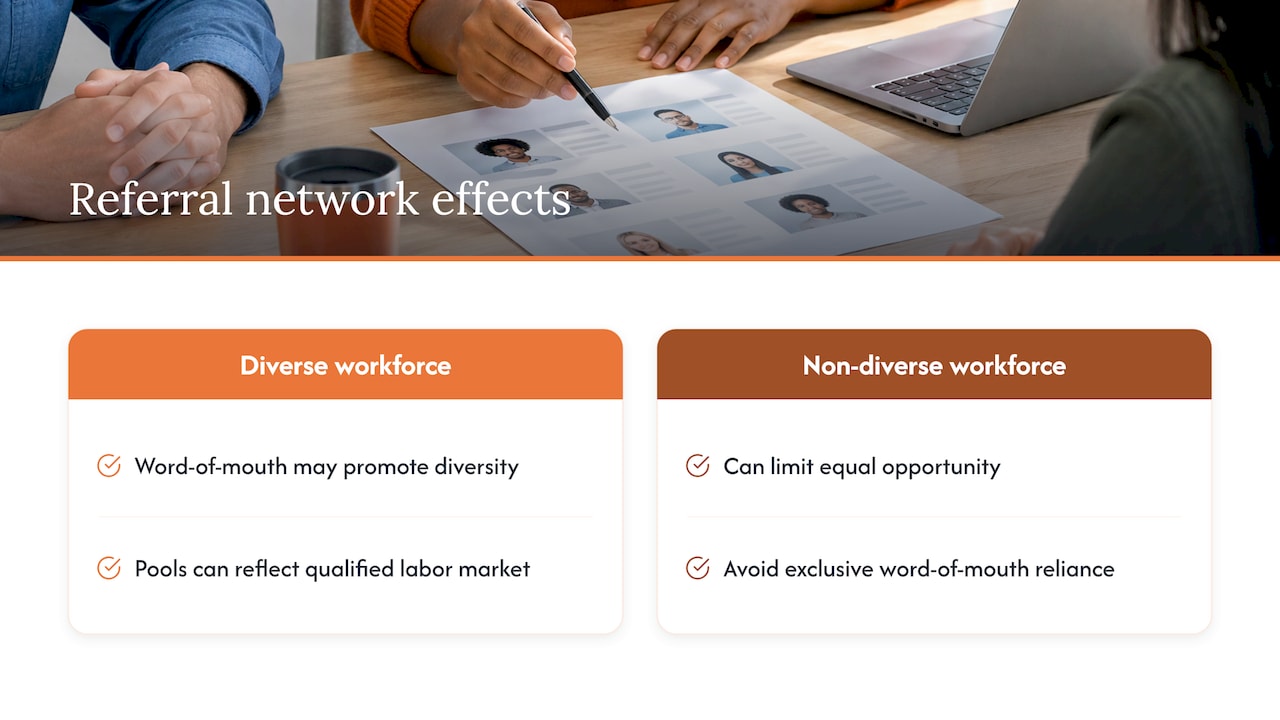
The EEOC’s guidance on race and color discrimination explains that word-of-mouth recruiting in a racially diverse workforce can promote diversity, but in a non-diverse workforce it becomes a barrier to equal opportunity if it does not produce applicant pools that reflect the qualified labor market. The same guidance notes that recruiting practices can create legal exposure under Title VII when they disproportionately limit opportunities and are not tied to job requirements or business needs. The agency’s question-and-answer document goes further and advises avoiding exclusive reliance on word-of-mouth referrals unless the workforce is already diverse.
Those documents address race and color, and they are the clearest US federal statements on referral practices. The underlying logic applies to any group a network might leave out, and the EEOC separately treats sexual orientation and gender identity as part of sex discrimination under Title VII.
Academic work points the same way. A 2024 paper from St. John’s University on sustainable talent acquisition notes that personal networks tend to include people from the same ethnic group, race or social class. It also reports an experiment in which discrimination increased when employee referrals were present.
The opportunity: a referral can be a vouch
Referrals are not inherently exclusionary. Research by Sterling and Merluzzi, covered by Stanford GSB, found that Black employees hired through a referral at a US sales organization were 1.2 times more likely to be promoted than non-referred Black colleagues. Sterling’s explanation is that a referrer can add context behind the numbers when a candidate is otherwise screened heavily on measurable criteria. The effect did not hold for women, which is a reminder that one design rarely fits every group.
The takeaway is practical. The question is not whether to use referrals. It is whether your program sends them to the right places and whether the rest of your hiring process treats referred candidates fairly.
How to build an inclusive referral program, step by step
1. Start from your data
Before changing anything, look at who your current referral program produces. Compare the makeup of referred applicants and referred hires with your overall applicant pool and your workforce. The EEOC’s best practices for employers recommend widening and diversifying the pool of candidates considered, including for upper-level openings, and running self-analyses to see whether current practices disadvantage people of color. Apply the same habit to every group you care about.
If you do not collect demographic data, do not start by guessing. See the privacy section below for how to gather it voluntarily and safely.
2. Name the roles and the goal
A generic “refer a friend” banner produces generic results. Pick specific open roles, especially ones where your team is least diverse, and state plainly that you want a broader pool. Employees cannot help if they do not know what you are looking for.
3. Ask people, do not just wait for them
Most programs are passive: a page on the intranet and an occasional email. Reach out directly to employees, to your LGBTQ+ and other employee resource groups, and to managers in the target teams. The EEOC’s HIRE initiative key takeaways recommend inviting employees to help develop recruiting and referral strategies, which tends to produce better ideas than a policy handed down from HR.
4. Extend referrals beyond personal networks
An employee with a homogeneous circle cannot refer people they do not know. Give them somewhere else to send people. The same EEOC takeaways suggest advertising jobs with trade groups, minority-serving academic institutions, churches and other community institutions, using social media creatively to reach diverse audiences, and using technology to reach a more geographically diverse applicant pool.
For LGBTQ+ talent, that means professional networks and job platforms built for the community, LGBTQ+ student and alumni groups, and industry events. Our overview of diversity recruiting strategies covers how these channels fit alongside referrals, and our comparison of diversity hiring platforms helps if you are choosing among them.
5. Make it easy to refer
Friction kills participation. A February 2025 SHRM report found that 55% of referrals were sent by email, 30% shared over social media and only 10% sent by text. It also lists ease of use, a mix of incentives, regular promotion and result tracking as features of effective programs. Give employees a one-click way to share a role by email and social, and let them refer someone with a link instead of a long form.
6. Put every referred candidate through the same process
Write it into policy: referrals are assessed on the same criteria as any applicant, with structured interviews and a scoring rubric. Train hiring managers so that a referral never becomes a shortcut or a veto. The St. John’s authors also warn about a culture of favor exchange, where people hired through referrals feel indebted to the person who referred them. Clear, uniform evaluation is the best protection against that.
7. Assign ownership
The St. John’s study recommends formalizing referral use under a senior leader with equity responsibilities who ensures the policy is followed, not just written. In a smaller company that might be the head of HR or talent acquisition. What matters is that one named person owns the numbers.
Incentives and fairness
Should you pay for referrals at all? The St. John’s findings suggest that the existence of an incentive carries more weight than its size, so a modest, well-publicized reward may do as much as a large one. Mixing cash with other recognition, as the SHRM article suggests, also works.
For inclusive programs, the safest approach is a uniform reward structure: the same payout for every successful referral, paid on the same milestones, regardless of the candidate’s identity. Some employers consider higher payouts for referrals from particular groups. That creates real legal exposure, because the EEOC states that it is illegal to take into account characteristics including sex (which covers transgender status and sexual orientation) when making decisions about job referrals. Talk to employment counsel before tying any money to a candidate’s protected characteristics.
You can reward inclusion outcomes without that risk:
- Recognize employees who bring in referrals for hard-to-fill roles.
- Reward referrals from outside the referrer’s own team or function.
- Offer team-level recognition when the overall applicant pool becomes broader.
Also consider the wider benefit. A large grocery-chain field experiment published as an NBER working paper found that having a referral program reduced attrition by 15%, and that most of the gains came from retaining workers who were not themselves referred. The authors’ most-supported explanation is that workers value being involved in hiring. Letting employees take part in building a more open referral program may carry the same engagement benefit.
Protecting LGBTQ+ employees’ privacy and choice
An inclusive program must never force anyone to out themselves. Three rules keep it safe.
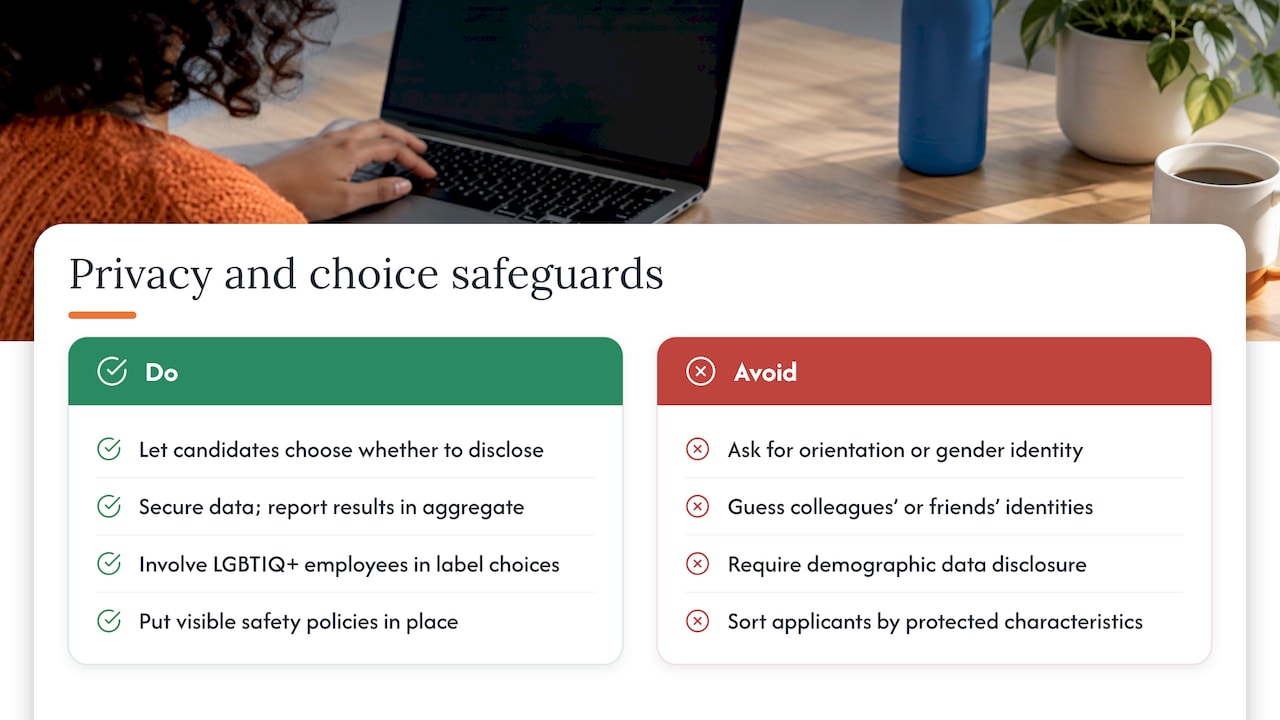
Never ask referrers or candidates to identify orientation or gender identity as part of the referral. Employees should not be asked to “refer an LGBTQ+ person” by guessing at colleagues’ or friends’ identities. Instead, ask them to share roles with communities and networks, and let candidates choose whether to disclose.
Keep any demographic data voluntary. A 2024 article in the Journal of Social Issues argues that participation in sexual orientation and gender identity data collection at work should be voluntary at all times, that people should be able to withdraw or change their answers, and that strong security and careful anonymization should protect the data. Use self-identification forms that are separate from the application review, and report results only in aggregate.
Involve the people affected. The same research, citing International Labour Organization guidance, suggests involving LGBTIQ+ employees and employee resource groups so that the labels used are inclusive and people control their own answers. The authors summarize the principle as “nothing about us without us.”
There is also a legal point if you use outside recruiters or agencies for referrals. The EEOC’s guidance on employment agencies says agencies may not honor discriminatory employer preferences, nor sort applicants on a prohibited basis and refer them accordingly. Brief your partners that you want broader pools, not filtered ones.
Finally, mind the signal. Transgender participants in the Journal of Business and Psychology research generally reported more negative workplace experiences and expectations than cisgender participants. If you want transgender candidates to respond to a referral, your visible policies, from inclusive benefits to respectful use of names and pronouns, have to be in place first. Our essential guide to HR in LGBTQ+ inclusion is a good checklist for that groundwork.
What to measure
A referral program that is never audited is a program you are trusting on faith. Track these at minimum:
| Metric | What it tells you |
|---|---|
| Source of every hire (referral, job board, community channel, campus) | Whether referrals dominate and where else talent comes from |
| Referral share at each stage: applied, interviewed, offered, hired | Whether referred candidates move through at similar rates to others |
| Composition of referred applicants vs. overall applicant pool | Whether referrals are narrowing or widening the pool |
| Participation: share of employees who refer, and across which teams | Whether the program reaches beyond a few enthusiastic groups |
| Retention and promotion of referred vs. non-referred hires | Whether the program supports long-term results |
| Candidate experience feedback | Whether people feel the process was fair and welcoming |
Run a comparison of referral hires against the full applicant pool at least once a year, ideally with legal or HR analytics support. If referrals bring in a narrower mix than your other sources, do not simply scrap the program. Add and promote other channels until the combined pool looks like the qualified labor market, and revisit the outreach in step 3.
Keep the measurement honest in both directions. Demographic data about LGBTQ+ staff is often incomplete because disclosure is voluntary, so look at trends and employee feedback, not only headcounts.
Our perspective
We see the same pattern from both sides of the hiring table. Employers tell us referrals are their best source of hires, and LGBTQ+ professionals tell us they are rarely in the networks where those referrals travel. Both are true at once.
Our view is that the answer is not to abandon referrals but to give them a wider starting point. If your employees’ circles do not include the talent you want, the most useful thing you can offer them is somewhere else to send people: a community where LGBTQ+ professionals and allies are already looking for employers committed to inclusion.
That is why we curate jobs and networking exclusively with organizations actively committed to LGBTQ+ inclusion. Candidates arrive knowing the employer has made that commitment, and employers meet people they might never have reached through personal networks. Pair that with a referral program that is open, uniform in how it evaluates people and honest about its numbers, and referrals stop being a closed loop.
The strongest programs we see treat inclusion as visible, not implied. Candidates read your employer profile, your events and your ERG activity long before they read a job description. Make those signals easy to find, and every referral you send has a better chance of landing.
Adrien
Reach LGBTQ+ talent beyond your employees’ networks
If your referral program needs a wider pool, we can help. myGwork connects employers with LGBTQ+ professionals, students and allies through job listings, an employer profile, networking events and sponsored content. You can see how our tiers work on our corporate solutions page, or learn how an employer profile shows candidates what working with you is like. Pricing is not published, so contact us for details.
If you are building inclusion skills inside your teams first, our academy training on allyship and intersectionality is available in person or virtually.
FAQ
Are employee referral programs legal for diversity goals?
Referral programs are legal, but how you run them matters. The EEOC warns that relying only on word of mouth in a non-diverse workforce can create a barrier to equal opportunity and may raise disparate impact concerns under Title VII. Keep the program open, evaluate everyone on the same criteria and review outcomes regularly with legal counsel.
Can we pay a bigger bonus for referring an LGBTQ+ candidate?
We would not advise it. The EEOC says it is illegal to take sex, which includes sexual orientation and transgender status, into account when making decisions about job referrals. It would also push employees to guess at people’s identities. Use uniform rewards and broaden your outreach instead, and ask employment counsel before you design any incentive linked to identity.
How do we get more LGBTQ+ referrals without asking people to out themselves?
Share open roles with LGBTQ+ employee resource groups, community networks, student groups and platforms where LGBTQ+ professionals look for inclusive employers. Make your inclusion work visible so candidates can judge for themselves. Keep any self-identification voluntary, separate from application review and reported only in aggregate.
What should we track to know the program is working?
Track the source of every hire, how referred candidates progress at each stage compared with other candidates, and the makeup of referred applicants compared with your overall pool. Add participation across teams, retention of referred hires and candidate feedback. Review the results at least annually.
Do referrals help or hurt diversity?
Both outcomes are possible. Research shows that most referral flows follow similarity in networks, which can narrow a pool, yet a referral can also help a candidate who is otherwise screened harshly on numbers alone. The outcome depends on whom you ask, where you send the roles and whether your process treats referred candidates the same as everyone else.
Sources
- Celebrating the “Invisible”: The Role of Organizational Identity Consciousness (Journal of Business and Psychology, 2024)
- EEOC, Section 15: Race and Color Discrimination
- EEOC, Questions and Answers about Race and Color Discrimination in Employment
- Stanford GSB, Can Job Referrals Improve Employee Diversity?
- St. John’s University, Sustainable Talent Acquisition: Five Best Practices
- EEOC, Best Practices for Employers and HR/EEO Professionals
- EEOC, HIRE Key Takeaways
- SHRM, Majority of Employee Referrals Made During Work Hours
- EEOC, Prohibited Employment Policies/Practices
- NBER Working Paper 25920 on employee referral programs
- Journal of Social Issues, Inclusion and protection in tension
- EEOC, CM-631: Employment Agencies