
Jess Skaare on embracing her journey at Pfizer
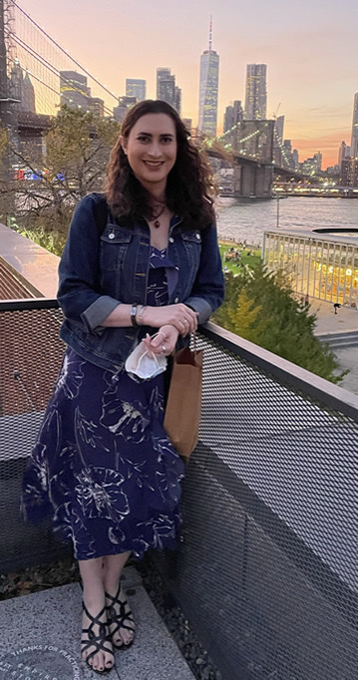
November 1, 2024My name is Jess Skaare (she/her), and I am a 16 year veteran of Pfizer, where I serve as the business owner of Pfizer.com, partnering with the dozens of content creators within the company to create an engaging experience for our many audiences. The team I oversee is also responsible for the design and experience of our 70+ regional sites around the world, and the operation of our corporate social channels.
But beyond my usual business introduction, I’m also an ever-evolving collection of other attributes: I’m a nerd, a gamer, an avid LEGO builder, and more recently an out trans woman.
Can you please tell us about your experience transitioning? Did you get the support you expected?
I have been incredibly blessed in my transition journey. I grappled with my gender for decades, but several years ago I finally realized I needed to face it. There were a lot of things I worried about, like how things would go with my family and with people from my church, where I continue to do a lot of work. Thankfully I have been met with love and care beyond my greatest hopes, which I recognize can be a sadly rare privilege.
But one aspect of my transition that stood out was my experience sharing my whole self in the work environment. While I’m in a different division now, my first 14 years at the company were within the Corporate Affairs department, where the senior-most leader has been an out LGBTQ+ leader in C-suites since the 90s. Having that representation reassured me that I would have a safe environment to be the real “me,” and indeed the first two people I came out to were fellow colleagues. Later when I was ready to share with the whole company in the Fall of 2023, that same senior leader filmed an interview with me, which was shared on our intranet for the whole company (as well as externally!).
I know my experiences were undoubtedly influenced by being in New York City located in our corporate headquarters, and that the surrounding cultural environment at our various facilities around the world can be radically different. It’s hard to imagine a more inclusive and welcoming beginning for my journey, and I know the company is striving to make that true no matter where our trans, non-binary and gender-nonconforming colleagues are located.
Who was your role model growing up? Who is your corporate role model now and why?
I’ve always had a difficult time answering this question. I think the reason why I have spent 40-some years struggling to come up with a meaningful answer to “who is my role model” is closely connected to part of why it took me several decades to come out: a lack of positive trans representation as I grew up.
Growing up and entering the business world, there were always aspects of authority figures I found impressive. But no single role model resonated for all of me.
Growing up in the 80s and 90s, if you saw a trans person, it was as a part of a joke. A punchline on a sitcom or an object of ridicule on a talk show. Being trans really wasn't something I saw presented as aspirational.
It's not that I wanted all role models of mine to be trans per se - or even transfeminine like me. It's that consciously and subconsciously I wasn’t encountering any figures in my life that came even close to reflecting that part of me back, and so the notion of a true role model never felt real or valid. When asked growing up, I would always default to super basic answers like “George Washington” without any real reflection on why. I never had a serious answer to this question until recently.
Now as I've started to figure myself out, I finally can start naming a few people as role models: particularly individuals I have personally seen or met. For example, speakers I’ve been in the audience listening to like Sarah McBride, the first trans person in the State Senate in Delaware, and who is now running at the federal level, or my dear friend Gina Chua, who came out as trans a couple years ago during her tenure as Executive Editor at Reuters news agency (now executive editor for the startup Semafor and on the Pulitzer Board).
Publicly seeing people like that - who have so successfully navigated some of the challenges and opportunities I hope are ahead for me - is why I'm able to finally start thinking seriously about role models.
What is your advice for organizations to be (more) trans inclusive?
Because I know there are people like me who wrestled internally long before they shared externally, I think organizations have an opportunity to demonstrate the role models and hold up representation that can be a beacon to those of us who were navigating in the dark. I know not every trans person is comfortable being vocal about their identity, which is entirely valid. But for those who are willing to be visible, the positive example they can set will amazing ramifications both seen and unseen, It is part of why I’m not only happy but excited to contribute in small ways like this piece, hoping that I can be that bit encouragement that a younger me wishes she had encountered.