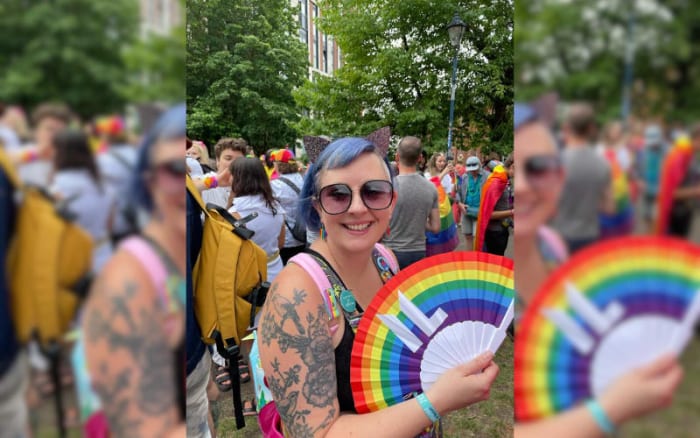
Pamela Smith on Coming Out as Bisexual: “I’ve Never Been More Comfortable With Who I Am”
September 8, 2023This month marks Bisexual Visibility Month and we want to use this to challenge many of the stereotypes and misinformation that still cloud the identity. We all need to show up as allies to the bisexual community, and that starts with listening to bi people, hearing their lived experiences and asking how we can best support them. We spoke to Pamela Smith, Senior User Researcher at Immersive Labs, who told us about her coming out story and why bisexual awareness is important to her.
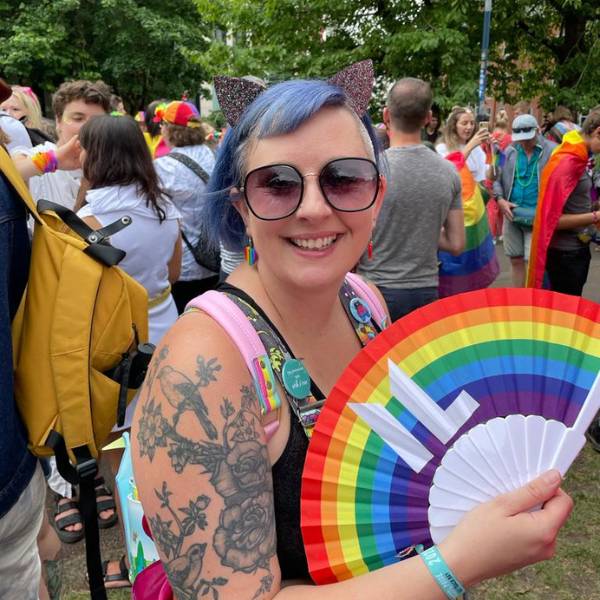
Hello Pamela! Thank you for your time today. Could you tell us a bit about yourself?
I’m Pamela (she/her), and I am a Senior User Researcher at Immersive Labs, a platform that helps organisations continuously assess, build, and prove their cyber workforce resilience.
User Experience is at the heart of what I do. I work with people across our organisation to carry out research with our customers to understand their needs and how we can improve their experience of using our product.
"All the time, I had thought that coming out was just for other people. Now I realise that it was for myself more than anything. I’ve never been more comfortable with who I am."
Can you tell us a bit about your coming out journey?
As a neurodiverse person, I have always felt a bit different and just accepted feeling that way. That included my attraction to people of other genders, which wasn’t something I ever felt the need to discuss with people because it felt like my business.
I wasn’t ashamed of being bisexual, nor was I scared of what people would think of me. I’ve just always been quite private about my relationships.
But then, in my late 30s, I had a conversation with a friend about him coming out as bi and the amount of backlash and abuse he faced. This made me think about how hard it can be for people to come out and how having these conversations can make it easier for the next person to do so.
I have two nieces, and I wanted to set an example for them. I wanted them to know that families come in all shapes and sizes and for them to hear queer voices and stories without them being ‘other’.
So I spent ages typing up a detailed wall of text to send to family and friends, officially coming out as bi. I waited, suddenly nervous of reactions.
I am clearly not as subtle or as private as I thought, as all I received were replies along the lines of ‘yes, we know’ and a whole lot of support. I then sent a message to my team at work, who were supportive and kind and didn’t bat an eyelid.
And while no one changed their behaviour towards me, the biggest change was in me. I realised that I hadn’t allowed myself to be part of the LGBTQIA+ community, so I dove in. I joined the LGBTQIA+ group at work, helped organise our first involvement in Bristol Pride, started going to queer events, and made so many friends.
All the time, I had thought that coming out was just for other people. Now I realise that it was for myself more than anything. I’ve never been more comfortable with who I am.
"A prevalent and damaging myth is that bisexuality is a ‘phase’ or just a pit stop before someone comes out as gay."
Why is Bisexual Visibility Month important to you?
I am lucky enough to have never experienced any issues with my sexuality in the workplace. However, a close friend of mine experienced some biphobic abuse at his job, which was rooted in a truly misinformed view that because he was bi, it meant that he must want to be a woman.
This was something he thought he couldn’t and shouldn’t make a complaint about, but I encouraged him to do so while also insisting that he shouldn't feel the need to minimise himself at work. The more we challenge these misconceptions, the more that people can learn.
Having this awareness month and sharing content and posts means it will reach people who otherwise wouldn’t see it. They can hear real stories, expand their knowledge and, most importantly, have their own opportunity to find their place in the community, especially as allies.
What are some of the common myths and misconceptions around
bisexuality?
A prevalent and damaging myth is that bisexuality is a ‘phase’ or just a pit stop before someone comes out as gay. It’s so damaging and dismissive and a real contributor to bi-erasure.
The idea is that being bi means you are equally attracted to all genders without any preference. That if, as a bi woman, you date a man, you must be straight now.
Another is that being bisexual means that you are attracted only to those identifying as male and female, when in fact bi means to be attracted to your own gender and others.
What advice would you give to someone wanting to come out as
bisexual in the workplace?
Only come out if and when you feel safe and supported to do so. There is absolutely no requirement for you to speak about your sexuality if you don’t want to, but know that if you can be free to speak about your experiences, it may just be creating a safe space for others who are afraid to come out.