
Recruitment Case Studies: What LGBTQ+ Hiring Teams Can Learn
October 1, 2026
The most useful recruitment case studies show a specific change, a number attached to it and the way the result was measured. The U.S. employers below changed how they write job posts, collect applicant data, show up at events and treat candidates. Their results point to one conclusion: you hire LGBTQ+ talent when you go where that talent looks and show you are serious before the first interview. That is the idea behind myGwork, where jobs and networking come only from organizations committed to LGBTQ+ inclusion.
Key Takeaways
- Strong case studies name the practice, the metric and the time frame. Press releases that only announce an award do not.
- Employers such as Goldman Sachs, Gannett, IGT and T-Mobile combine outreach, self-identification data, inclusive wording and employee groups.
- Peer-reviewed research links an explicit, identity-conscious approach to higher attraction and lower turnover intentions among LGBTQ+ workers.
- Most of the barriers are about trust: candidates leave or never apply when a workplace does not feel affirming.
- You can copy the playbook at the end of this article, step by step, whatever your company size.
What makes a recruitment case study worth reading
Search for this topic and you find three kinds of pages. Some are agency portfolios that show how a firm filled roles for clients. Some are academic exercises, such as a fictionalized school recruitment scenario. Some are real employer stories with data. Only the last kind helps a team that wants to hire more LGBTQ+ professionals.
A useful case study passes four tests:
- It names the practice. “We care about inclusion” is not a practice. “We removed LGBT data from resumes and interviews” is.
- It gives a number and a baseline. A percentage without a starting point tells you little.
- It says who measured it. A figure from an employer’s own report is a claim about that employer. A figure from a peer-reviewed study is evidence about a pattern.
- It shows the obstacle. Hiring teams learn most from what got in the way.
The examples below are screened against those four tests. They are all U.S. employers, so legal and cultural context is American.
Recruitment case studies from U.S. employers
Goldman Sachs: asking, protecting and checking
In 2017, Fortune reported that Goldman Sachs asks applicants to self-identify their sexual orientation and transgender status. The bank removes that data from resumes and interviews, and it checks whether the representation among applicants carries through to hires. It also reaches out to LGBT groups on university campuses.
The design is worth studying. The data is collected so the company can hold itself accountable, and it is kept away from the people making the hiring decision. The bank’s chief diversity officer said that without outreach, the best candidate may be left on the table.
Gannett: inclusion across the whole funnel
Gannett’s 2021 Inclusion Report describes inclusive practices across sourcing, interviewing, screening and onboarding. It also publishes data from employees who voluntarily self-identify. In that survey, 8% of participating employees identified as LGBTQ+ and fewer than 1% as non-binary. Gannett also reports a perfect 100 on the Corporate Equality Index for the fourth year in a row.
The lesson is coverage. Candidates meet a company in stages, and a gap at any stage can undo the work done at another.
IGT: job boards, an employee group and career fairs
In a January 2025 press release, IGT said it earned a score of 100 on the HRC Corporate Equality Index. The company lists three recruiting-relevant moves: posting positions on LGBTQ+ job boards, creating an executive-sponsored LGBTQ+ employee impact group, and hosting career resource fairs for the LGBTQ+ community.
The pattern is simple. The company goes to a channel built for the audience, then gives candidates a visible group to connect with.
T-Mobile: fixing the words in the job post
T-Mobile’s 2023 case study with Textio describes using the tool across job posts, recruiting emails and employer brand content, with a direct integration into Workday. The company reports that a gender-neutral tone attracted 17% more women candidates. Posts with a Textio Score of 90 or higher filled an average of five days faster. Recruiting-event activity through employee resource groups grew twelvefold in 2022.
These are the company’s figures about its own program, and the study centers on gender-neutral language rather than LGBTQ+ candidates specifically. The transferable idea is that wording is measurable. You can test it, change it and compare the results.
Zillow Group: relationships first, then wording
Zillow’s recruiting team built long-term relationships with organizations including Lesbians Who Tech, Tech Inclusion, AnitaB.org and the National Society of Black Engineers. After it adopted Textio, Textio reported in 2018 that jobs with the highest scores (75 to 100) received 1.5 times as many candidates qualified enough for hiring-manager review. It also reported a 12% rise in applicants who identified as women and 2.5 weeks saved per hire.
The case shows that community partnerships and good job copy work as a pair. One builds trust over years, the other converts interest into applications.
BenchPrep: pronouns and a conversation
BenchPrep makes sharing pronouns an optional part of its application process. In a company blog interview, its first openly trans employee, Shannon Kelly, said it made a difference to be asked how the company could improve the application process for trans people. She added that the questions must not be invasive. It is a small company example, with no hiring metrics, but it shows what a candidate notices.
What the numbers show
The table gathers the measurable results above, with who reported each one. Treat employer-reported results as indicators from one company, not as promises.
| Employer | Practice | Reported result | Reported by |
|---|---|---|---|
| T-Mobile | Gender-neutral job post tone | 17% more women candidates | T-Mobile case study, 2023 |
| T-Mobile | Textio Score of 90+ | Average of 5 days faster to fill | T-Mobile case study, 2023 |
| T-Mobile | ERG-driven recruiting events | 12x activity in 2022 | T-Mobile case study, 2023 |
| Zillow Group | Highest-scoring job posts | 1.5x candidates qualified for review; 2.5 weeks saved per hire | Textio blog, 2018 |
| Gannett | Inclusive practices across the funnel | 8% of survey participants self-identified as LGBTQ+ | Inclusion Report, 2021 |
The broader picture comes from HRC’s 2025 Corporate Equality Index. It included a record 1,449 participants, and 765 companies earned a perfect score. A total of 991 businesses engaged in recruitment at CEI events, a 62% increase from the 2023-2024 cycle. More employers are competing for the same candidates, so showing up matters more each year.
Why candidates respond: the research behind the stories
Case studies tell you what happened at one company. Research tells you whether it is likely to happen at yours.
A peer-reviewed set of three pre-registered studies by Mor, Gündemir and van der Toorn, with 1,318 participants in total, found that identity consciousness is associated with more attraction to an organization among prospective LGBTQ+ workers. It is also associated with lower turnover intentions among current LGBTQ+ workers, with a sense of identity safety explaining the link. Identity consciousness means acknowledging identities and valuing them, as opposed to claiming not to notice them.
The retention side matters because recruiting costs are wasted if people leave. In EY’s 2024 U.S. LGBTQ+ Workplace Barometer, which surveyed 500 LGBTQ+ employees at organizations with 2,500 or more staff:
- 36% of millennial and 40% of Gen Z LGBTQ+ employees who left their jobs were leaving companies that were not welcoming.
- Among employees with a high sense of psychological safety, 89% saw their company as a place to advance to a more senior level. Among those with a low sense, only 48% did.
- The report says the community includes nearly 14 million U.S. adults. It warns that missing the mark with Gen Z could cost access to up to 10 million workers by 2030.
The barriers these employers had to work around
The obstacles show up in every case, and they are mostly about trust.
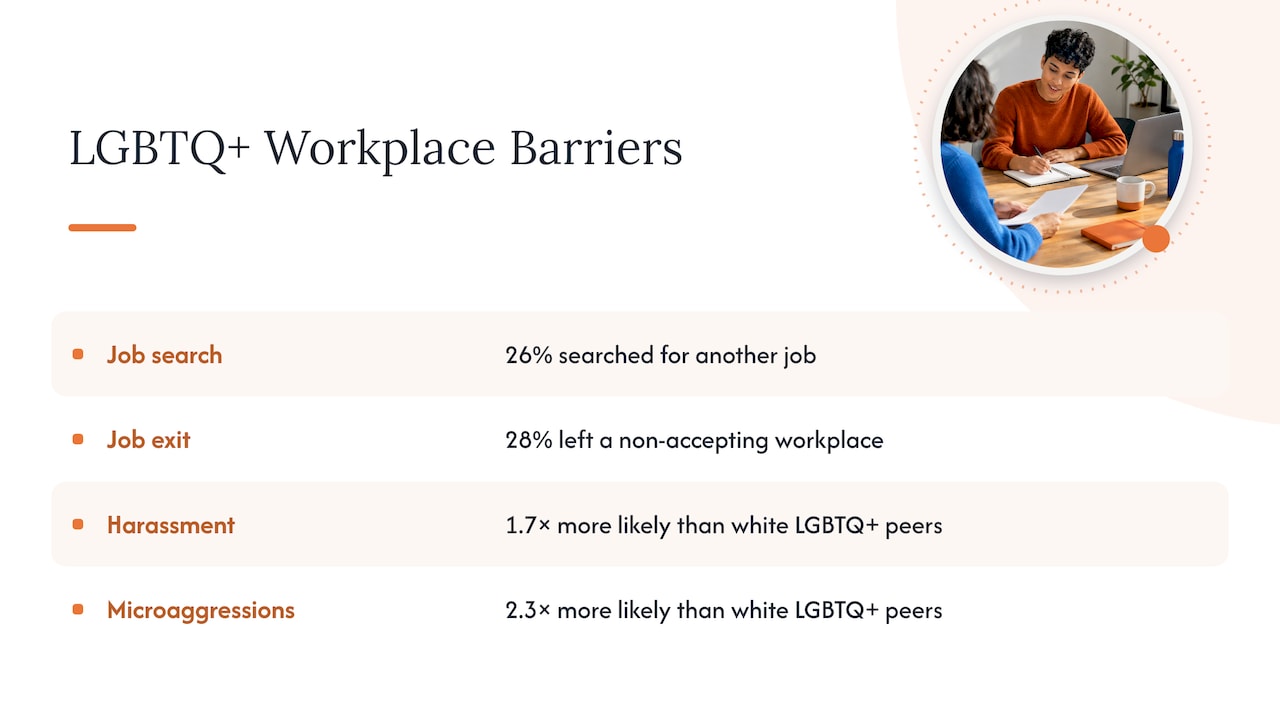
Candidates are wary. HRC’s Equality Rising findings, cited in the CEI report, say 26% of LGBTQ+ workers have searched for a different job because the environment was not affirming. Another 28% have left a job because the workplace was not accepting. A job post is the first evidence a candidate sees, and a generic one proves nothing.
Experiences differ within the community. EY found that LGBTQ+ employees who are racially or ethnically diverse were 1.7 times more likely than white LGBTQ+ peers to have faced harassment in a previous workplace. They were 2.3 times more likely to have faced microaggressions. In the peer-reviewed study, transgender participants reported significantly higher turnover intentions and lower authenticity, belonging and justice than cisgender peers. A single “LGBTQ+ friendly” message does not reach everyone equally.
Data collection can feel risky. Goldman Sachs answered this by separating the data from the people deciding. Gannett did it by making the survey voluntary. Both treat the data as a way to check the process, not to judge individuals.
Outreach takes time. Zillow’s list of partner organizations reflects relationships built over a long period. A one-off job post rarely produces the same result.
A playbook you can copy
The steps below follow the pattern across the cases. Our own guides go deeper on the full LGBTQ+ recruitment workflow and on launching LGBTQ hiring initiatives.
- Write the commitment into the job post. EY recommends explicit statements in job descriptions that you are an inclusive employer. Then check the wording, as T-Mobile and Zillow did. Where it goes wrong: a banner statement on a post whose requirements read as exclusionary.
- Post where the audience already looks. IGT used LGBTQ+ job boards. On myGwork, listings sit alongside other employers that have committed to inclusion, so a candidate can read your post as part of that context. Where it goes wrong: posting everywhere and measuring nothing about which channel reached whom.
- Make self-identification optional and protected. Follow the Goldman Sachs and Gannett model: voluntary, kept out of resumes and interviews, used to check whether applicant representation survives to hire. Where it goes wrong: collecting data with no explanation of who sees it.
- Ask about pronouns, and ask how to improve. BenchPrep makes pronouns optional. Its employee stressed openness without invasive questions. Where it goes wrong: making disclosure feel mandatory.
- Build a diverse interview panel. EY lists this alongside an inclusive recruitment strategy. Candidates read the panel as a preview of the team.
- Show up in person and virtually. HRC says employer presence at recruiting events signals that LGBTQ+ candidates are valued. Campus outreach, as at Goldman Sachs, feeds the early-career pipeline. Our WorkFair event for students and recent graduates is one example of that format.
- Carry the promise into onboarding. A candidate who joins and finds a different culture leaves. See our onboarding steps for inclusive workplaces.
- Measure at each stage. Track applicants, interviews, offers and hires, and retention at 12 months. Compare against the baseline before the change. This is the part most weak case studies skip.
What job seekers and allies can take from this
If you are a candidate, the same cases give you a checklist for reading employers. Look at whether the job post names inclusion in plain terms, whether the application asks about pronouns as an option, whether the company has an employee group, and whether it publishes workforce data. Recognition such as a 100 score on the HRC index is a published signal. Exelon and New Relic, for example, each announced a 2025 score of 100 and described the supports behind it, such as an LGBTQ+ ERG and gender-affirming care coverage in New Relic’s case.
Allies in HR and talent acquisition can use the cases to make the business argument internally. The attraction and retention numbers above are the ones that tend to persuade a budget holder. Our guide to HR and LGBTQ+ inclusion lays out where to start.
Our perspective
Most case studies we read stop at the announcement. A company says it hired more people or earned a score, but not how a candidate found the role or why that candidate trusted the post.
We built myGwork around that moment. Jobs and networking opportunities on the platform come exclusively from corporations actively committed to LGBTQ+ inclusion. A candidate can apply knowing the employer has chosen to be there.
For employers, the cases above point the same way. Wording, data practices and events all matter. They work best when the candidate also has a place to find you that signals the commitment before they read a word of your job post. That is why we offer employer profiles, job listings, events, sponsored content and training in one place, so the story you tell candidates is consistent from first impression to onboarding.
Our success stories, from recruiting thousands of candidates to reducing recruitment costs for participating organizations, come from that approach.
Adrien
Put these cases to work with myGwork
If you want to reach LGBTQ+ professionals, students and allies who are looking specifically for inclusive employers, start with our corporate solutions. They are offered as ESSENTIALS, BRONZE, SILVER, GOLD and PLATINUM plans. You can also build a GEO Employer Profile to show candidates what working with you looks like. Beyond listings, we offer talent attraction, employer engagement, event promotion, video production, branded newsletters and LGBTQ+ inclusive certification for business. Our academy provides in-person or virtual training on allyship and intersectionality. Prices are not published, so ask us for a quote.
FAQ
What should a recruitment case study include?
It should name the practice, give a metric with a baseline, say who measured it and describe the obstacles. Without those four elements it is a press release. Look for the time frame too, since a result from one hiring season may not repeat.
Do LGBTQ+ inclusive hiring practices really affect who applies?
Research points that way. A set of three pre-registered studies with 1,318 participants found that an identity-conscious approach is associated with greater attraction to an organization among prospective LGBTQ+ workers. Employer case studies, such as T-Mobile’s on gender-neutral wording, report similar effects on applicant mix, though these are company-reported.
Is it legal to ask applicants about sexual orientation or gender identity?
Goldman Sachs and Gannett both use voluntary self-identification, and Goldman Sachs removes the data from resumes and interviews. Rules vary by state and employer type, so confirm your approach with your employment counsel before you add the question to an application.
How can a small company use these examples?
Start with what costs little: explicit inclusive language in job posts, optional pronoun fields, a diverse interview panel and posting on channels built for LGBTQ+ candidates. Then measure applicants and hires against your own baseline. Larger programs such as employee groups and campus outreach can follow as you grow.
How do I know if an employer is genuinely inclusive?
Look for published signals: an HRC Corporate Equality Index score, workforce data shared voluntarily, employee groups and benefits that cover gender-affirming care. On myGwork, employers on the platform have committed to LGBTQ+ inclusion, which narrows the search before you apply.
Sources
- Goldman Sachs Wants to Know if Job Seekers Are Gay or LGBT (Fortune, 2017)
- Gannett Inclusion Report 2021
- IGT earns top score in HRC Corporate Equality Index 2025
- T-Mobile Textio case study 2023
- Zillow Group drives inclusion with augmented writing (Textio blog, 2018)
- Pride at BenchPrep: An Interview with Shannon Kelly
- HRC Corporate Equality Index 2025
- 2024 EY US LGBTQ+ Workplace Barometer
- Celebrating the Invisible: The Role of Organizational Identity Consciousness (PMC, 2024)