
Safety Is Still Not a Given: What the 2026 Kantar-DIVA-Curve Report Reveals About LGBTQIA+ Women's Wellbeing at Work and Beyond
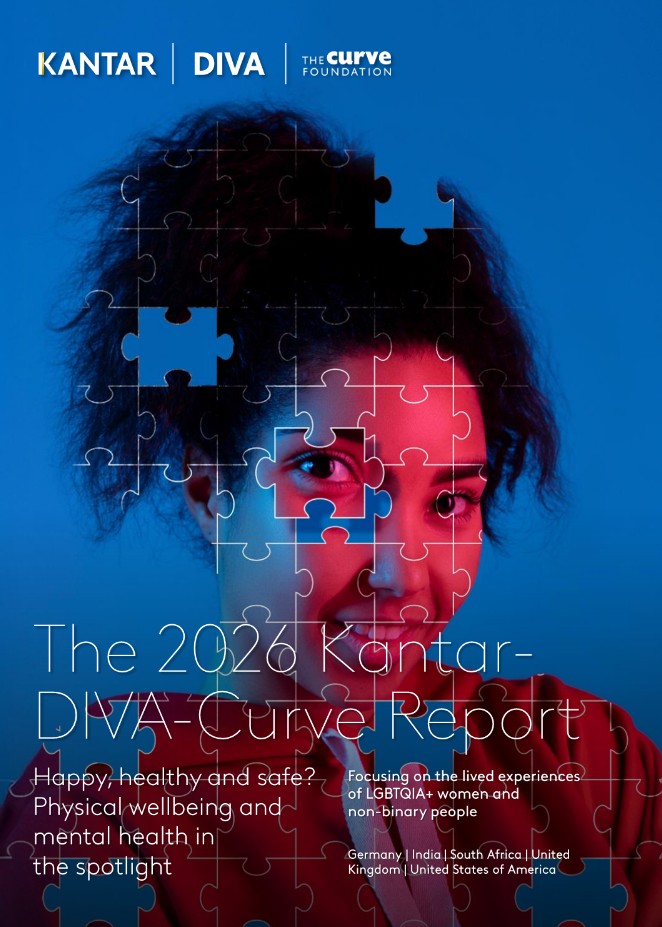
April 27, 2026The sixth annual Kantar-DIVA-Curve Report has landed - and the picture it paints is one that every employer, brand leader, and HR professional needs to sit with.
Surveying more than 3,200 LGBTQIA+ women and non-binary people across five countries — Germany, India, South Africa, the United Kingdom, and the United States — the 2026 report focuses squarely on physical wellbeing, mental health, and the persistent gap between visibility and genuine safety. The findings make clear that while representation is growing, the lived experience of this community remains shaped by conditional acceptance, structural barriers, and the everyday toll of navigating systems that were not designed with them in mind.
The Headline Numbers
Across every market surveyed, discrimination in healthcare settings continues to drive avoidance and delay. A third of all respondents reported having delayed or avoided healthcare altogether, and 40–46% said they still leave medical settings when they feel dismissed or not taken seriously. In India, 58% of respondents reported delaying care — the highest figure across the five countries.
The workplace tells a similar story. Sixty-one per cent of LGBTQIA+ women reported experiencing discrimination in business environments, a figure that rises to 68% among those with disabilities. Thirty per cent said they face career disadvantages due to their sexual orientation, and a quarter reported outright social exclusion at work.
Meanwhile, the sense of safety remains highly situational. While 64% of respondents feel very safe at home, that figure drops sharply in public spaces — cafes, restaurants, public transport, bars, and nightclubs were highlighted as environments where just 25% feel safe. On social media, 49% of South African respondents reported witnessing or experiencing abuse linked to sexual orientation.
Healthcare: A System That Demands Compromise
One of the report's most striking themes is the extent to which LGBTQIA+ women and non-binary people are forced to compromise their dignity just to access care. In the UK, only 45% feel the healthcare system adequately meets their needs, and 38% have felt dismissed or misunderstood by a provider because of their identity. Transgender respondents in the UK face particularly acute barriers, with 49% reporting negative experiences with healthcare providers and 43% delaying treatment.
In the United States, the landscape is increasingly hostile. Over 600 anti-LGBTQIA+ bills were introduced in state legislatures in 2025 alone, and more than half of states now restrict or ban gender-affirming healthcare. Forty per cent of US respondents said they had been dismissed by a provider because of their identity, and 36% had avoided or delayed care out of fear.
The consequences are real. Respondents across all five countries described postponing necessary treatment, concealing their identity in medical contexts, and enduring misgendering and heteronormative assumptions during routine appointments. Twenty per cent of respondents protectively conceal their identity even in medical settings — a statistic that should alarm every healthcare provider and insurer.
What This Means For Employers
For those of us working in the professional LGBTQ+ space, these findings underscore something we already know but too often see deprioritised: workplace inclusion cannot exist in isolation from the wider systems that shape employees' lives.
When a third of your LGBTQIA+ workforce is avoiding healthcare, when a quarter experience social exclusion at work, and when safety feels conditional rather than structural, the impact on productivity, retention, and wellbeing is enormous. Employee health benefits that fail to account for inclusive providers, mental health support that doesn't understand the specific pressures facing this community, and DEI programmes that stop at visibility — all of these fall short.
The report's Germany section puts it plainly: leadership, HR, and customer experience teams all bear responsibility for psychological safety. Authentic representation must be tangible across the entire employee and customer journey, not confined to a Pride Month campaign.
Brands Have Power — And Responsibility
The report also makes a compelling business case for deeper inclusion. Kantar's Brand Inclusion Index highlights the commercial risk of under-representing or misrepresenting diverse populations — in the UK alone, the cost of the LGBTQIA+ inclusion gap is estimated at £33 billion. Research from Unstereotype Alliance and Saïd Business School found that inclusive advertising delivers measurably higher short- and long-term sales, alongside stronger customer loyalty.
Yet the community's experience of brands remains uneven. While 80% of respondents feel brands want their business, 60% in the UK have experienced a negative brand interaction linked to their identity — rising to 80% among transgender respondents. One in five still feels that representation in media and advertising is insufficient or rare, and 12% felt they were not wanted as customers by a brand.
The message is clear: performative gestures are not just ineffective — they actively erode trust.
Small Acts, Structural Change
If there is hope in these pages, it lies in the consistency with which respondents point to the same solutions. Correct pronoun use. Respectful language. Non-judgemental listening. Inclusive intake forms. Staff training that goes beyond compliance. These are not expensive or complex interventions, but they require intentionality and sustained commitment.
As the report concludes, the shift required is from conditional safety to structural safety — environments where inclusion is embedded in systems, practices, and everyday experiences rather than depending on which individual happens to be on duty.
For employers, brands, healthcare providers, and anyone with influence over the environments where LGBTQIA+ women and non-binary people live, work, and seek care, the question posed by this report is direct: what are you doing about it?
The 2026 Kantar-DIVA-Curve Report was conducted in February 2026, surveying 3,212 LGBTQIA+ women and non-binary respondents across Germany, India, South Africa, the United Kingdom, and the United States. The report is a partnership between Kantar, the DIVA Charitable Trust, and The Curve Foundation.