
Spain takes top spot on Europe’s 2026 Rainbow Map
May 12, 2026Spain has claimed first place in Europe’s leading ranking of LGBTI equality laws and policies, ending Malta’s decade at the top of ILGA-Europe’s Rainbow Map and sending a strong signal that ambitious legal reforms are still possible amid rising authoritarian pressure across the continent.
Published today in Brussels, the 18th annual Rainbow Map evaluates 49 European countries on the legal and policy framework affecting the human rights of lesbian, gay, bisexual, trans and intersex people. Spain scored 89%, edging ahead of Malta on 88% and Iceland on 86%. Belgium and Denmark followed with 85% each, rounding out a top five dominated by western and northern European states.
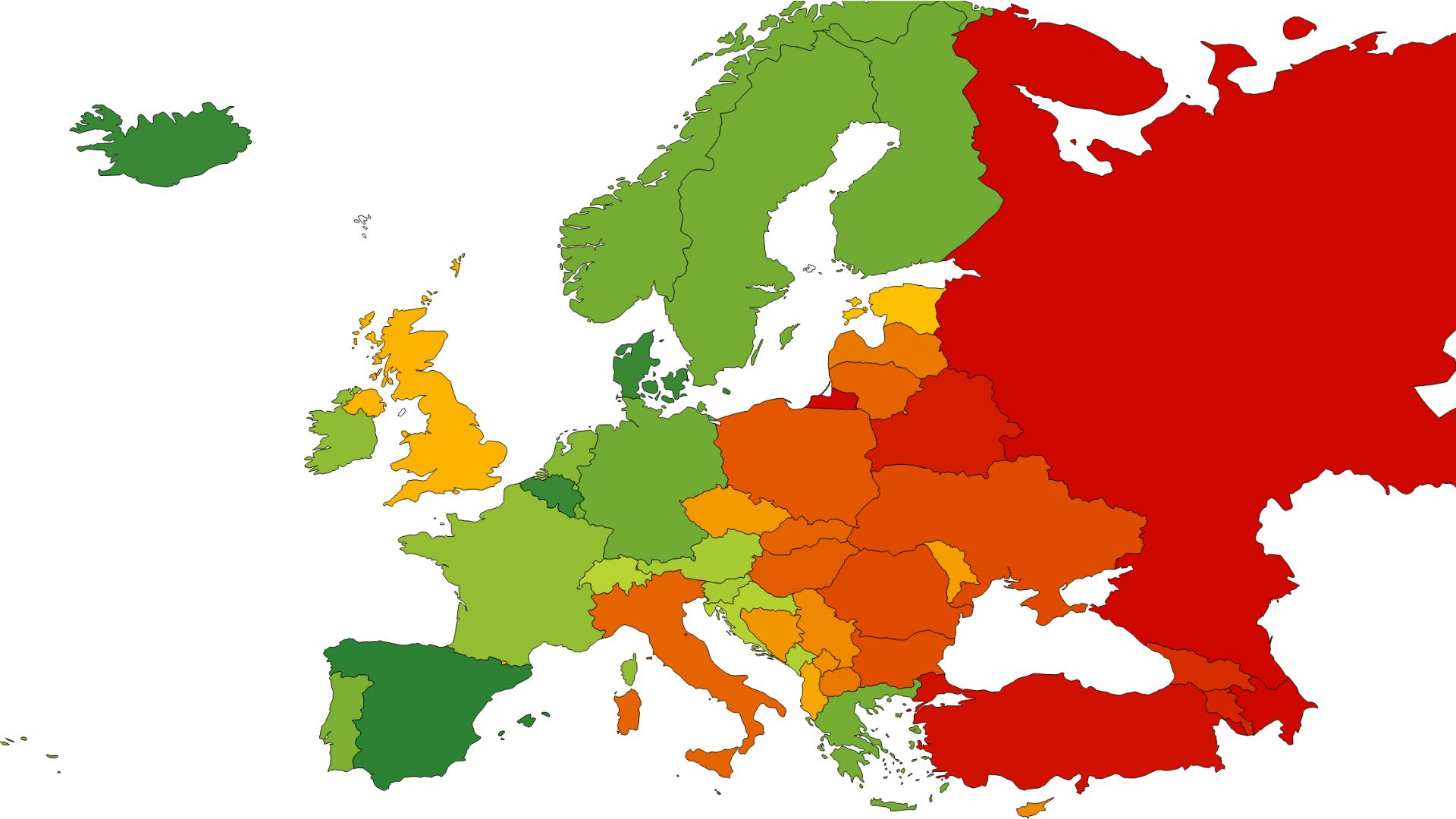
ILGA-Europe credits Spain’s leap to first place to a series of reforms and institutional changes over the past year. These include fully operational depathologisation of trans identities in healthcare, new legal protections, the adoption of national LGBTI and trans strategies, and the establishment of an independent equal treatment and non-discrimination authority. Crucially, Spanish authorities have also resisted organised far-right efforts to dismantle trans protections.
“Spain’s number one ranking is a strong example of what becomes possible when a government makes a deliberate choice to advance equality rather than retreat from it,” said ILGA-Europe’s Deputy Director, Katrin Hugendubel. “Of course more needs to be done in Spain, but this is a reminder that political courage is a choice, and that governments who make it can effectively push back.”
Spain’s ascent comes at a time when democracy and the rules-based international order are under strain in both eastern and western Europe, and when LGBTI communities have been routinely targeted in political campaigns. Against that backdrop, advocates say the Rainbow Map shows that states can still move decisively to protect rights, even as others attempt to roll them back.
However, ILGA-Europe stresses that the ranking measures laws and policies, not daily life. In Spain, significant gaps remain between legal standards and people’s experiences. A recent report from the LGTBI+ Spanish Federation found that assaults against LGBTI people have risen by 15% since 2024, driven by a surge in hate speech and online incitement.
While the top 10 includes long-standing equality leaders such as Malta, Belgium, Denmark, Iceland, Finland (70%), Norway (69%) and Sweden (68%), many countries remain far behind or are moving backwards.
Portugal (67%), the Netherlands (64%) and Ireland (61%) sit in the upper middle of the ranking, followed by France (60%), Austria (55%), Slovenia (54%), Montenegro (53%) and Croatia (51%). Switzerland reaches 50%, with Estonia (46%) and the United Kingdom (44%) now in the mid-range. The UK’s continued decline in the ranking reflects stalled reforms and growing hostility towards trans people in particular.
At the lower end, several EU and neighbouring states present serious concerns. Italy scores just 24%, Hungary 23%, Poland 22% and Bulgaria 20%. Ukraine registers 19%, reflecting both legal gaps and the impact of war. Georgia stands at 12%, Armenia at 9%, Belarus at 7%, Turkey at 5%, and both Azerbaijan and Russia at 2%, with Russia at the bottom due to escalating repression.
ILGA-Europe reports that in Russia, LGBTI organisations are now being designated “extremist”, exposing staff, volunteers and even beneficiaries to the risk of criminal prosecution. Belarus has adopted a new “anti-LGBTI propaganda” law, following the Russian model and adding criminal penalties.
Elsewhere, governments are advancing legislation that could erode hard-won protections. Italy’s new security law includes provisions that may restrict freedom of assembly, including Pride marches. In Portugal, draft laws threaten to weaken protections for trans and intersex people. Slovakia has introduced constitutional amendments declaring sex to be immutable and assigned at birth, blocking legal gender recognition and limiting legal parenthood to a mother and a father. In Turkey, authorities are moving to roll back access to trans-specific healthcare, have dissolved an LGBTI youth organisation, and have increased criminal cases against activists.
In Albania (41%, up two places to 24), a referendum seeks to overturn new gender equality legislation, with opponents framing protections based on gender identity and sexual orientation as an attack on “traditional family values”.
Against a backdrop of virulent anti-trans rhetoric in many countries, ILGA-Europe identifies limited but meaningful progress. Albania’s new gender equality law explicitly covers discrimination based on gender identity, gender expression and sexual orientation. In Czechia (37%, up four places to 26) and Latvia (30%, up two places to 32), people can now change legal gender markers without undergoing sterilisation.
Austria (55%, stable at 16) has introduced alternative gender markers for non-binary people, while Croatia (51%, up to 19) and Poland (22%, remaining at 39) have improved administrative procedures for legal gender recognition, even as broader political climates remain hostile. Sweden has adopted new legislation on legal gender recognition, but the reform still falls short of a self-determination model and retains elements that pathologise trans identities.
Beyond national laws, courts and regional institutions have played a key role. The Court of Justice of the European Union has issued landmark rulings on trans rights and the recognition of same-sex marriages across member states. Last month it held that Hungary’s 2021 “anti-LGBTI propaganda” law violates Article 2 of the Treaty on European Union and multiple EU directives, reinforcing that LGBTI rights are part of the Union’s foundational values.