
The largest group in the room nobody sees: a history of bisexuality
September 22, 2026Every September, and particularly on 23 September, Bi Visibility Day, bisexual people and their allies gather to celebrate an identity that has existed for as long as human desire itself. The word bisexual is relatively new. The experience is ancient.
For much of the last century and a half, bisexual people have fought two battles at once: one against the laws and prejudices aimed at anyone who loves someone of the same sex, and another against the persistent suggestion that bisexuality itself is a phase, a cover story or a myth.
Before the word 'bisexual' existed
For most of recorded history, nobody described themselves as bisexual, because the category did not exist. What did exist, across many cultures, was a widespread understanding that a person might desire both men and women over the course of a life.
In classical Athens, relationships between older men and younger men sat alongside marriage to women as a recognised part of elite male life. Roman emperors such as Hadrian were married while openly grieving male lovers. The Greek poet Sappho of Lesbos wrote of longing for women and, according to later tradition, of men as well. In Han dynasty China, the story of Emperor Ai cutting off his sleeve rather than wake his sleeping male companion Dong Xian gave rise to "the passion of the cut sleeve," a poetic phrase for love between men, used about rulers who also had wives and heirs. In pre-modern Japan, the tradition of shudo among the samurai class coexisted with heterosexual marriage.
Historians rightly caution against projecting modern identities backwards. These societies organised desire around age, class and social role far more than around the gender of one's partners. Still, the record makes one thing plain: attraction to more than one gender is a constant in human history, however it has been named.
The birth of a word
The term "bisexual" entered English in the early nineteenth century as a botanical and biological term meaning an organism with both male and female reproductive organs. Its shift to describing sexual attraction came through the new science of sexology in the late 1800s. Richard von Krafft-Ebing's Psychopathia Sexualis, first published in 1886, discussed "psychical hermaphroditism," and Charles Gilbert Chaddock's 1892 English translation is generally credited with introducing "bisexual" in its modern sense to the English-speaking world.
Sigmund Freud went further, arguing in the early 1900s that all humans were innately bisexual and that exclusive heterosexuality or homosexuality developed later. His theory was influential and deeply ambivalent: it normalised bisexuality as a universal starting point while treating adult bisexuality as a kind of arrested development. That double edge would follow the identity for decades.
Living under the law
The laws that criminalised same-sex activity never distinguished between gay and bisexual people. Anyone caught could be prosecuted, and many of those prosecuted had wives, husbands and children.
England's Buggery Act of 1533 made anal sex a capital offence, a penalty removed only in 1861. The Labouchere Amendment of 1885 criminalised "gross indecency" between men, and it was under this law that Oscar Wilde, a married father of two who had relationships with men, was sentenced to two years' hard labour in 1895.
Germany's Paragraph 175 criminalised sex between men from 1871 until its final repeal in 1994, and was used by the Nazi regime to send thousands of men to concentration camps. In the United States, sodomy laws remained on the books in many states until the Supreme Court struck them down in Lawrence v. Texas in 2003. Britain began decriminalisation in England and Wales with the Sexual Offences Act 1967, following the 1957 Wolfenden Report, with Scotland following in 1980 and Northern Ireland in 1982.
Decriminalisation did not end legal hostility. Section 28 of the UK's Local Government Act 1988, which banned local authorities from "promoting homosexuality," stayed in force until 2000 in Scotland and 2003 in England and Wales. Bisexual people faced an additional problem in legal settings: disbelief. Asylum claimants who described attraction to more than one gender were, and in some jurisdictions still are, told they could simply choose a heterosexual relationship and go home.
Explicit legal recognition arrived slowly. The UK's Equality Act 2010 defines sexual orientation to include orientation "towards persons of the same sex and of the opposite sex," one of the first major pieces of legislation to name bisexuality as a protected characteristic in its own right.
A movement finds its voice
Bisexual people were present at the founding moments of the modern LGBTQ+ movement. Brenda Howard, a bisexual activist often called the "Mother of Pride," helped organise the Christopher Street Liberation Day march in 1970, the first anniversary of the Stonewall uprising and the ancestor of every Pride parade since.
Organised bisexual activism emerged in the early 1970s. In 1972, a Quaker group published the "Ithaca Statement on Bisexuality" in The Advocate, and Don Fass founded the National Bisexual Liberation Group in New York. The San Francisco Bisexual Center opened in 1976. The 1980s saw the founding of BiPOL in San Francisco (1983), the Boston Bisexual Women's Network (1983), and in Britain the London Bisexual Group (1981) and the first BiCon in 1984, a gathering that continues annually today.
The AIDS crisis brought a cruel new form of stigma. Bisexual men were singled out in the media as a supposed "bridge" carrying HIV into the heterosexual population, a framing that reached its peak with a 1987 Newsweek cover on "Bisexuals and AIDS." Activists responded with organising rather than retreat. At the 1987 National March on Washington, a bisexual contingent marched openly for the first time. In 1990, BiNet USA was founded as a national organisation, and the San Francisco magazine Anything That Moves published the Bisexual Manifesto, which declared: "Do not assume that bisexuality is binary or duogamous in nature: that we have 'two' sides or that we must be involved simultaneously with both genders to be fulfilled human beings."
In 1993, Lani Ka'ahumanu became the first openly bisexual person to address a national march from the stage in Washington. The same year, the march's official title included "Bi" for the first time.
Flags, days and a month
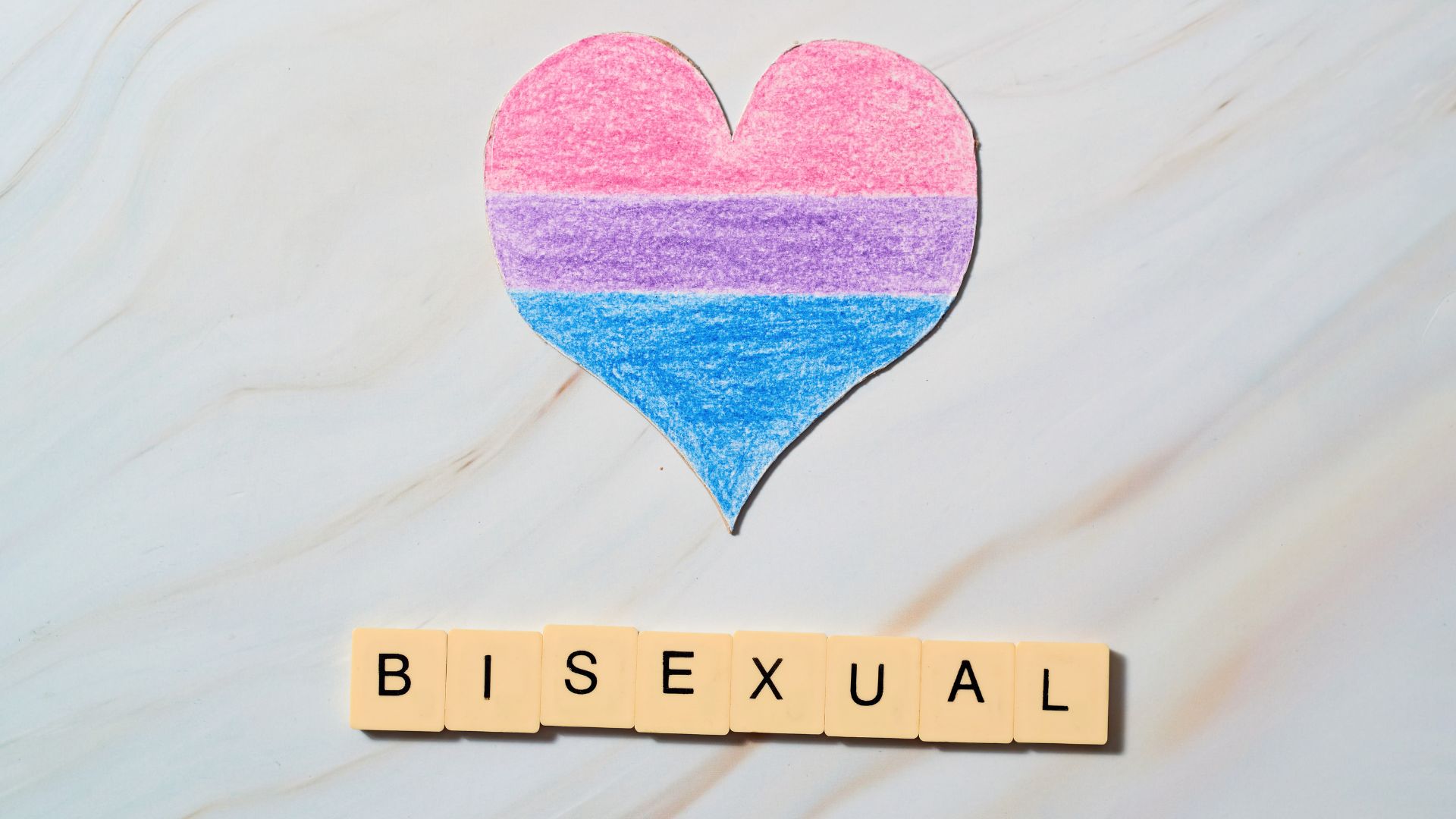
Symbols followed. On 5 December 1998, Michael Page unveiled the bisexual pride flag: magenta for same-sex attraction, blue for attraction to a different gender, and a purple stripe where they overlap. Page has said the purple blends into both colours "just as in the real world, where bi people blend unnoticeably into both the gay/lesbian and straight communities."
A year later, in 1999, three American activists, Wendy Curry, Michael Page and Gigi Raven Wilbur, launched Celebrate Bisexuality Day on 23 September. It has grown into Bi Visibility Day, observed worldwide. In 2014, GLAAD and BiNet USA extended the celebration into Bisexual Awareness Week, and many organisations now recognise the whole of September as Bisexual Visibility Month.
The largest, least visible group
Here is the paradox at the centre of this history. Bisexual people are the largest single group within the LGBTQ+ population, and among the least visible.
Gallup polling in the United States has consistently found that more than half of LGBTQ+ adults identify as bisexual. The 2021 census of England and Wales recorded around 624,000 people, or 1.3 per cent of the population aged 16 and over, identifying as bisexual, close to the number identifying as gay or lesbian, with far higher proportions among younger adults.
Yet research from the Pew Research Center has found that only around a fifth of bisexual adults say most of the important people in their lives know about their orientation, compared with roughly three-quarters of gay men and lesbians. Bisexual people report higher rates of depression and anxiety than gay, lesbian or heterosexual people. US data from the Centers for Disease Control and Prevention found that bisexual women experience intimate partner violence at markedly higher rates than lesbian or heterosexual women. Bisexual people are also more likely to live in poverty than their gay and lesbian peers.
Many of these disparities trace back to the same root: the assumption, from every direction, that bisexuality is either invisible or invalid. Visibility, in other words, is a matter of health, safety and economics as much as of pride.

The invisibility problem is sharpest at work. Stonewall's research into LGBT people in Britain found that 38 per cent of bisexual people were out to nobody at work, compared with 7 per cent of gay men and 4 per cent of lesbians. Bisexual employees frequently describe being assumed straight if they have a different-gender partner and assumed gay if they have a same-gender one, so that every new colleague requires a fresh decision about whether to correct the record.
For employers, this has practical consequences:
- Inclusion programmes may be missing their largest audience. If LGBTQ+ networks and policies are designed around gay and lesbian experience, the majority of LGBTQ+ staff may quietly conclude they are for someone else.
- Concealment carries a cost. Employees who hide part of their identity report lower engagement, higher stress and greater intention to leave. Given that bisexual people are the group most likely to conceal, they are the group where this cost is concentrated.
- Data hides the gap. Companies that collect diversity data under a single "LGBTQ+" heading cannot see whether bisexual staff are being promoted, retained or heard.
The remedies are straightforward. Name bisexuality explicitly in policies, training and communications. Make sure partner benefits and family leave are described in ways that do not assume the gender of anyone's partner. Give bisexual employees a visible place in networks and events, especially during September. Ask, in engagement surveys, about orientation in enough detail to see where the differences lie. And when a senior leader is bisexual, make it easy for them to say so, because a single visible example does more than any policy document.
Joining the next chapter
The history of bisexuality is a history of people insisting on being counted: on the census, on the march, on the screen, and in the office. The next chapter is being written in workplaces that decide whether their bisexual employees can be seen.
If you want to be part of that, one practical step is to join myGwork, the global business community for LGBTQ+ professionals, graduates and inclusive employers.
Individual membership is free and connects you with employers who have committed to inclusion, with job opportunities, mentoring and events, and with a network of people, bisexual and otherwise, who understand exactly why visibility matters.
For employers, partnering with myGwork is a way to make that commitment visible to the talent you hope to attract. This Bisexual Visibility Month, sign up, and help make sure the largest group in the LGBTQ+ community is finally seen.
Interested in becoming a corporate member? Click here for more info.