Top 10 tips for writing a standout CV that gets past AI in today’s competitive job market
September 22, 2025In today’s competitive and tough job market – where layoffs, hiring freezes, and global competition are becoming the norm – your CV (or resume) needs to do more than just list your experience. It must speak to both humans and machines.
With over 90% of large companies using Applicant Tracking Systems (ATS) to screen applications, your CV must be crafted to pass automated filters and quickly impress recruiters. Here's are our top 10 tips on how to write one that gets through both stages, and stands out from the crowd.
1. Write for the algorithm and the human
ATS software scans CVs for specific keywords, structure, and relevance. If your CV doesn’t match what it’s looking for, it may never reach a hiring manager. Here are a few pointers:
Mirror the job description. Use exact phrases from the ad (e.g. “CRM systems” instead of “client databases”).
- Use clear, commonly accepted job titles. If your title was “Digital Wizard,” reword it as “Digital Marketing Specialist.”
- Avoid graphics, tables, and columns – many ATS systems can’t read them properly.
- Save your CV as a .docx or, if allowed, a simple PDF. Always check employer preferences.
2. Lead with a keyword-rich personal statement
This is your first opportunity to show alignment with the role, to both the software and the recruiter. Include role-relevant keywords, your core tools or platforms, and measurable impact.
For example:
Detail-oriented Financial Analyst with 6+ years of experience in budget forecasting, cost analysis, and financial modelling using Excel, SAP, and Power BI. Proven track record of reducing operating costs and improving reporting accuracy in fast-paced environments.
3. Include a skills section with strategic keywords
ATS software often scans for specific hard skills and tools. Make it easy by including a dedicated section. For example:
Key Skills & Technologies:
- Data Analysis | SQL | Excel | Tableau
- Budget Forecasting | Financial Modeling | Variance Analysis
- ERP Systems: SAP, Oracle
- Communication | Stakeholder Management | Cross-Functional Teams
Use bullet points or pipe separators (|) to improve readability for both software and humans.
4. Focus on achievements, not just responsibilities
ATS might get you into the pile, but impact is what gets you hired. Avoid listing duties, and show what you achieved.
For example, instead of: “Responsible for social media management. Try: “Increased Instagram engagement by 75% in three months by launching a targeted content calendar and using performance data to refine strategy.”
Use metrics wherever possible: percentages, timeframes, cost savings, or growth figures.
5. Structure your work experience for clarity
Use a simple, consistent format that hiring managers can scan easily. For example:
Operations Manager — ABC Logistics, London, UK
Jan 2020 – June 2023
Reduced average delivery times by 22% through route optimization software (Fleetio).
Managed a team of 15 drivers and implemented a performance-tracking system that improved on-time deliveries by 18%.
6. Avoid common CV pitfalls
Try to avoid the following pitfalls to get your CV get past the algorithm:
- Skip images, icons, or charts – most ATS software can’t read them.
- Don’t put key information in headers or footers.
- Stick to standard section headers like “Work Experience,” “Education,” “Skills.”
- Avoid unusual fonts. Use Arial, Calibri, or Times New Roman.
- Always spell out terms before abbreviating (e.g., Key Performance Indicators (KPIs)).
7. Highlight certifications and tools early
Certifications and tools are often used as ATS filters, so don’t bury them at the bottom of your CV. Instead, highlight them under an appropriate heading. For example:
Certifications:
- Google Data Analytics Certificate, Coursera (2023)
- Certified ScrumMaster (CSM), Scrum Alliance (2022)
Better yet, incorporate them into your experience. For example:
Analyzed customer trends using Google Analytics, increasing campaign ROI by 28%.
8. Provide links to your online presence
AI might not follow links, but hiring managers do. So add them at the top of your CV. For example:
LinkedIn: linkedin.com/in/yourname
Portfolio: yourname.dev or yourname.myportfolio.com
Make sure your profiles match your CV and are updated with keywords and accomplishments.
9. Ensure it’s scannable, and ATS-friendly
The best CVs are simple, scannable and ATS-friendly. Here are some design tips:
- Use a left-aligned, reverse-chronological layout.
- Stick to one page (early career) or two max (experienced).
- Use consistent, clear headings like “Professional Summary,” “Skills,” “Experience,” “Education.”
- Avoid photos, logos, icons, or multiple columns.
10. Use AI tools carefully to audit your CV
Some tools can help simulate ATS screening and suggest improvements to your CV. Paste your CV and a job description to get keyword match scores and formatting advice. Top tools include:
- Jobscan
- Resume Worded
- Teal Resume Builder
Free CV writing workshop
A standout CV doesn’t just list what you’ve done, it shows how you can solve an employer’s problems. That takes precision, clarity, and a little strategy.
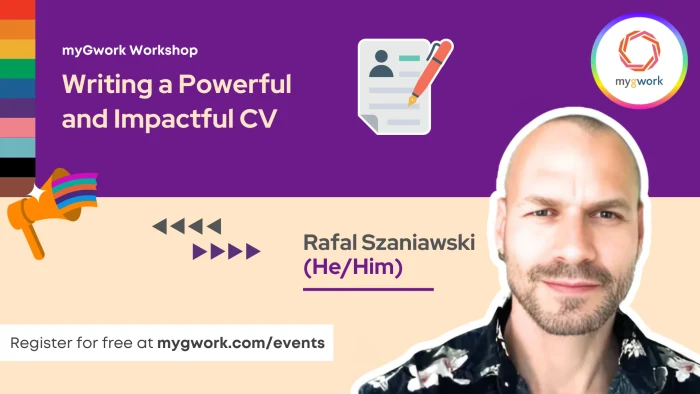
To help you sharpen your approach, join myGwork’s free workshop, “Writing a Powerful and Impactful CV,” on August 13 at 4pm BST. This short, practical session will cover:
- What makes a CV successful in today’s job market.
- How to tailor your CV for impact.
- Techniques to highlight your relevant and transferable experience.
Click here to register for free.