
Trans marathon runner calls for all sports to create nonbinary divisions
April 23, 2025Cal Calamia expresses that during his upcoming historic run at the London Marathon this weekend, he will be "racing for all trans people across the globe.” He suggests that it is time for every sport to genuinely embrace inclusion by considering the establishment of a nonbinary division.
This Sunday, the 28-year-old will make history as the first trans person to participate in the nonbinary category across all World Marathon Majors, according to ‘Out Sports’. Athletes who complete all six original WMM marathons (Tokyo, Boston, London, Berlin, Chicago, and New York) are awarded the “Six Star Medal.”]
Through his achievements and increased visibility over recent years, Calamia—who uses they/he pronouns—has emerged as a significant LGBTQ+ figure in distance running. With over 150,000 followers on social media and recognition with ‘Trailblazer Awards’ from San Francisco and California last year, his activism is effecting real change.
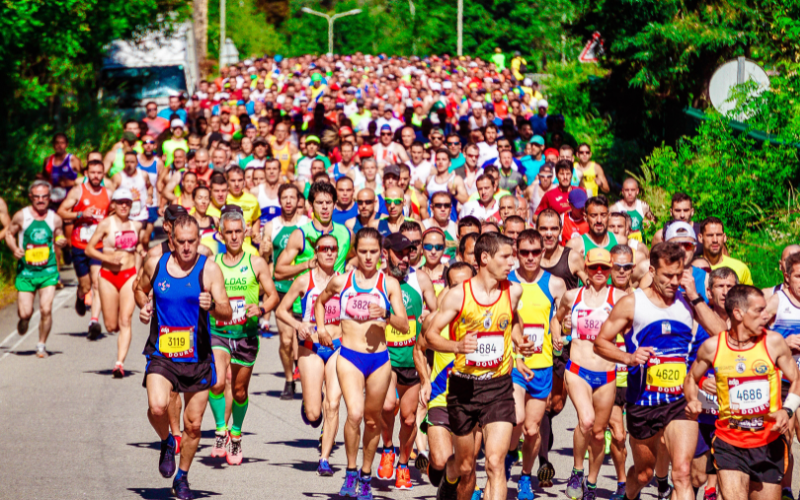
In March, he made history by becoming the first winner of the Tokyo Marathon’s nonbinary division, following his advocacy for its introduction. This marathon was the final Major (Sydney is joining this year) to adopt this category.
Calamia has emphasised the importance of having nonbinary divisions in races to promote gender diversity and ensure runners do not have to compromise any part of themselves by choosing between traditional binary options.
Out of more than 30,000 participants, the Boston Marathon website noted that 70 runners completed the race in the nonbinary division (or 0.2% of all registrants) on Monday, up from 48 in 2024. This was Boston’s third consecutive year offering this category.
Calamia now urges all sports to adopt similar measures. On the KQED Political Breakdown podcast, he remarked, “I think nonbinary divisions need to exist in every sport, eventually. I think it’s harder with team sports due to the need for sufficient numbers, but I’ve also seen that if you build it, they will come.”
He clarifies that he is not suggesting all trans athletes in every sport be placed in a third category. “Advocating for a nonbinary division doesn’t mean every transmasculine and transfeminine person needs to participate in that division. Trans people should be able to join binary divisions if they feel they align more with those.”
In an Instagram post promoting the podcast and his upcoming London Marathon, Calamia criticised the UK Supreme Court’s recent ruling on the definitions of “woman” and “sex.” This decision risks excluding trans women from “single-sex spaces” like sports and changing rooms, contrary to earlier interpretations that favoured inclusion.
“This hateful and devastating act is linked to similar political movements in the US, raising concerns for trans residents and visitors in both countries regarding government documents, travel, and participation in athletics and public life,” Calamia wrote.
Amid increasing calls for restrictions, some sports organisations have begun creating additional categories, though not all responses have been positive. Concerns include the visibility assigned to athletes in these categories and whether there is equal prize money compared to traditional divisions. Current WMM races do not offer monetary awards for nonbinary divisions, though cash prizes were once available for the New York Marathon.
The “open category” by World Aquatics at the 2023 Berlin World Cup saw no participants. However, rowing’s Royal St John’s Regatta in Canada plans to introduce an “open” category in July, welcomed by trans nonbinary rower Émile Sopkowe.
When trans individuals and allies have been involved in crafting these divisions, as Calamia has in marathon running, they see greater promotion and participation. However, team sports face challenges like insufficient local athlete numbers, and existing women’s leagues accommodating nonbinary individuals and trans women under certain conditions. Consequently, momentum to establish new divisions has been lacking.
During the controversy surrounding the Boston Marathon, Calamia partnered with trans athlete Schuyler Bailar on Instagram to respond. Bailar, a former Harvard swimmer named to the LGBTQ Sports Hall of Fame, is also preparing for his first marathon in London.
In the lead-up to Monday’s Boston Marathon, some media outlets known for critical coverage of trans people targeted a trans woman competing in the women’s division. An op-ed in the New York Post titled “Boston Marathon’s trans runner tramples women athletes” was circulated among others similarly critical of the runner and race organisers.
Counteracting these claims, Calamia stated in an Instagram reel, “Here are some facts: the Boston Marathon has allowed trans women in the women’s division since at least 2018.” Bailar added, “And there has been no trans women domination that everybody’s afraid of.”
The runner who faced criticism finished just within the top 9,000 overall in the women's division and was outside the top 600 in her age group but continued to face social media scrutiny post-race.
Nonbinary Olympian Nikki Hiltz, also speaking out against the Boston controversy, joined those commending Calamia and Bailar’s informative video. Bailar concluded the reel with the statement: “Don’t get tricked into thinking that trans athletes threaten sports when transphobia is really the threat.”