
What Is Diversity Index? Meaning for Workplace Equity
January 20, 2026Feeling unseen or underrepresented in your workplace is an experience many LGBTQ+ professionals know well. The push for truly inclusive hiring practices starts with understanding how organizations measure diversity. A Diversity Index provides a clear, data-driven picture of workforce representation across groups including gender, ethnicity, age, ability, and neurodiversity. Discover how this metric can empower you to advocate for equity, identify gaps, and drive sustainable change within corporate environments.

Defining Diversity Index in the Workplace
A Diversity Index represents a quantitative measurement that evaluates workforce representation across various demographic groups. This data-driven metric helps organizations understand how effectively they are including different populations within their professional environment.
At its core, the Diversity Index examines multiple dimensions of human identity, including gender, race, ethnicity, age, ability, and neurodiversity. Organizations use these measurements to assess their current workforce composition and identify potential representation gaps. The index goes beyond simple headcounts, providing nuanced insights into how different demographic groups are integrated within corporate structures.
Companies calculate their Diversity Index by analyzing the proportional representation of various groups compared to their overall workforce. A higher index indicates more balanced representation, suggesting that an organization has successfully created an inclusive environment where multiple perspectives are valued. Conversely, a lower index might signal the need for targeted recruitment, mentorship, and professional development strategies to support underrepresented communities.
Pro tip: Request your company’s Diversity Index report during performance reviews to understand how your organization is progressing toward meaningful workplace inclusion.
Common Types and How They Are Calculated
Diversity indices come in several sophisticated statistical models, each offering unique insights into workforce representation. The Gini-Simpson Diversity Index stands out as a powerful analytical tool that quantifies demographic variation through advanced mathematical principles. This statistical metric calculates the probability of two randomly selected employees belonging to different demographic groups, providing a nuanced view of organizational diversity.
Organizations typically employ multiple diversity index types to capture comprehensive workforce insights. These include:
- Simpson Diversity Index: Measures the likelihood of two randomly selected employees being from different groups
- Shannon Diversity Index: Evaluates diversity by considering both group representation and evenness of distribution
- Blau Index: Calculates diversity based on the probability of two employees being from different demographic categories
- Entropy Index: Examines the randomness and distribution of groups within an organization
Calculating these indices requires detailed workforce demographic data. Researchers gather information on various characteristics such as gender, race, ethnicity, age, and professional background. The calculation typically involves complex mathematical formulas that transform raw demographic numbers into meaningful diversity measurements. By tracking these indices over time, companies can monitor their progress in creating more inclusive work environments and identify areas requiring targeted recruitment and development strategies.
Pro tip: Request a breakdown of your organization’s diversity index calculations to understand the specific methodological approach used in measuring workforce representation.
Here’s a summary comparing major workplace diversity index models and their unique applications:
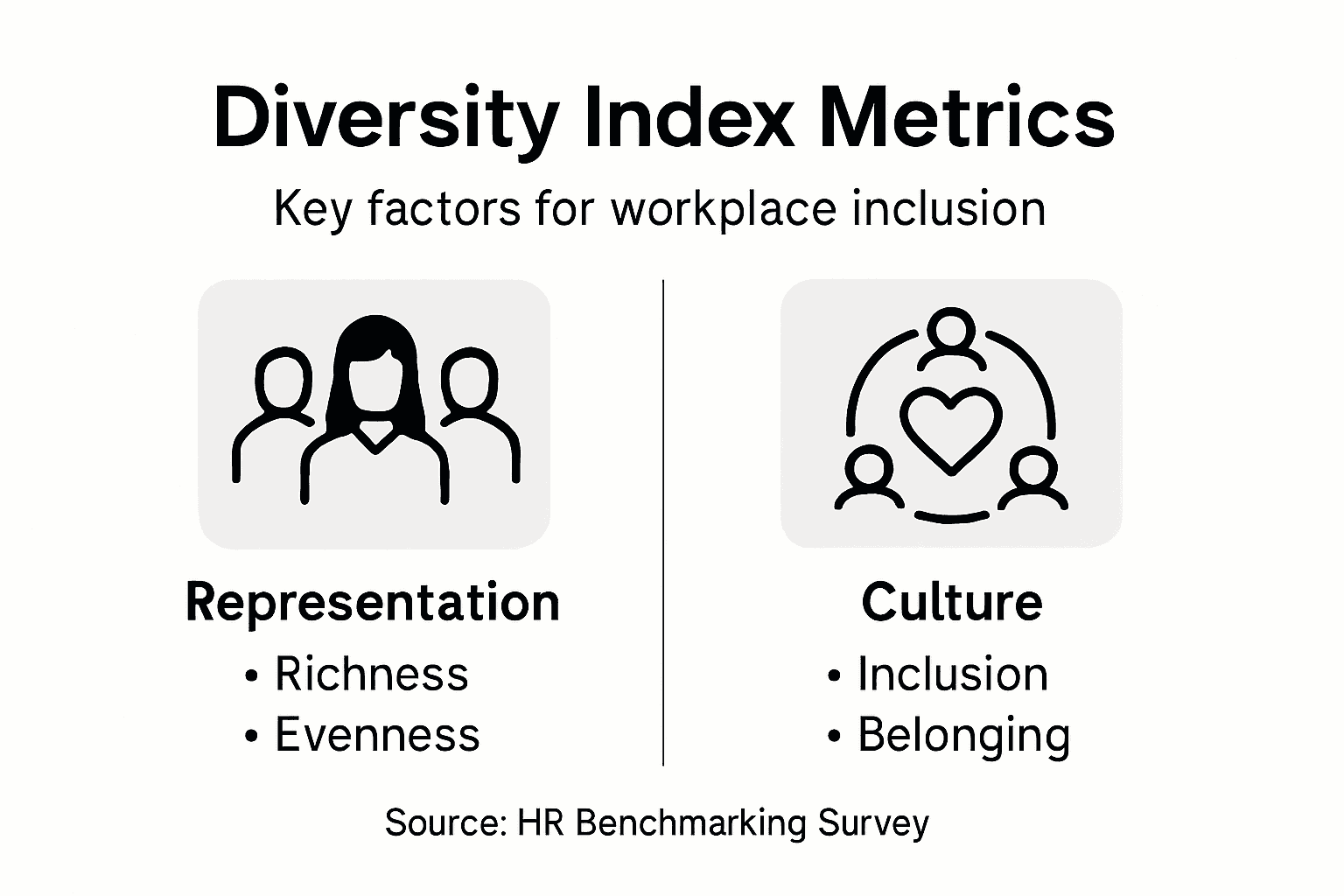
Key Metrics: Richness, Evenness, Inclusion
Comprehensive workplace diversity measurement relies on three critical metrics that provide a holistic understanding of organizational diversity: richness, evenness, and inclusion. These interconnected dimensions go beyond simple demographic counting, offering nuanced insights into how diverse groups are represented and integrated within professional environments.
Richness represents the total number of different demographic groups present in an organization. This metric captures the breadth of representation, counting distinct categories such as gender, race, ethnicity, age, disability status, and professional background. A high richness score indicates a workforce with multiple perspectives and identities, suggesting potential for enhanced creativity and innovation.

Evenness examines how proportionally these different groups are distributed across organizational levels and departments. Unlike raw representation numbers, evenness reveals whether diversity is genuinely integrated or confined to specific roles or hierarchical levels. Organizations track inclusion metrics through detailed analysis of hiring, promotion, compensation, and leadership representation to ensure equitable opportunities for all demographic groups.
Inclusion moves beyond numerical representation to assess the qualitative experience of employees. This metric evaluates psychological safety, sense of belonging, and opportunities for meaningful contribution. Measuring inclusion involves employee surveys, feedback mechanisms, and analyzing workplace culture to determine whether diverse employees feel genuinely welcomed, respected, and empowered to bring their authentic selves to work.
Pro tip: Request comprehensive diversity reports that include richness, evenness, and inclusion metrics to gain a true understanding of your organization’s commitment to workplace equity.
To clarify key diversity measurement metrics and their business impact:
Workforce Applications and Case Examples
Workplace diversity surveys reveal growing organizational commitment to understanding and improving workforce representation through strategic diversity index applications. Companies across various industries now use these sophisticated metrics to transform recruitment, promotion, and retention strategies, moving beyond traditional demographic tracking to create more inclusive environments.
In tech sectors, diversity indices have become particularly transformative. Companies like Google and Microsoft use complex measurement tools to analyze representation across engineering, leadership, and technical roles. These organizations track not just overall percentages, but granular data showing representation at different organizational levels, identifying precise intervention points for improving equity. For instance, a technology company might discover that while entry-level positions demonstrate strong demographic diversity, leadership roles remain significantly less representative.
Financial services and consulting firms have also embraced diversity index methodologies to reshape workplace dynamics. Investment banks and professional service firms now use these metrics to design targeted recruitment programs, create mentorship initiatives, and develop leadership development strategies that actively support underrepresented professionals. By quantifying representation challenges, these organizations can create data-driven approaches to building more inclusive workplace cultures that recognize and value diverse talent.
Healthcare and academic institutions provide particularly compelling case studies of diversity index applications. Medical schools and research centers use these metrics to track representation among faculty, researchers, and administrative leadership, helping identify systemic barriers that prevent equitable professional advancement. These insights enable targeted interventions, scholarship programs, and mentorship initiatives designed to support diverse talent throughout their professional journeys.
Pro tip: Request your organization’s diversity index report and analyze the underlying data to understand specific representation challenges and opportunities for meaningful workplace equity initiatives.
Challenges, Limitations, and Pitfalls to Avoid
Diversity initiatives face complex challenges that extend far beyond simple numerical representation. Organizations often encounter significant obstacles when attempting to implement meaningful diversity index measurements, including data collection complexities, interpretation challenges, and potential unintended consequences of metric-driven approaches.
One primary limitation involves the potential for oversimplification. Diversity indices can reduce complex human experiences to numerical representations, potentially overlooking nuanced individual identities and intersectional experiences. While quantitative metrics provide valuable insights, they cannot fully capture the qualitative aspects of workplace inclusion. For example, a high diversity score might mask underlying cultural challenges such as microaggressions, unequal opportunities, or systemic barriers that prevent meaningful professional advancement for underrepresented groups.
Methodological challenges also emerge in data collection and interpretation. Many organizations struggle with inconsistent definitions, incomplete demographic reporting, and concerns about privacy and voluntary self-identification. Employees might hesitate to disclose personal identity information, leading to incomplete or inaccurate diversity measurements. Additionally, intersectional identities often get flattened into binary or limited categorical choices, failing to represent the full complexity of human diversity.
Furthermore, organizations risk developing a checkbox mentality, treating diversity indices as performance metrics rather than tools for genuine cultural transformation. This approach can lead to superficial efforts focused on meeting numerical targets instead of creating substantive, systemic changes that foster true inclusion and equity. Successful diversity strategies require moving beyond statistical measurements to create environments of psychological safety, genuine respect, and meaningful opportunity.
Pro tip: Approach diversity indices as diagnostic tools for improvement, not as definitive measures of organizational success, and continuously contextualize numerical data with qualitative insights.
Unlock True Workplace Inclusion by Understanding Your Diversity Index
Measuring diversity is only the first step toward creating an equitable workplace. This article highlights the challenges organizations face when interpreting complex metrics like richness, evenness, and inclusion. If you want to move beyond numbers to foster genuine belonging for LGBTQ+ professionals and other underrepresented groups, mygwork.com offers a trusted platform built to support your goals.
Join a community where diversity indexes translate into action. Connect with inclusive employers, explore specialized job opportunities, and access resources designed to help you advance in workplaces that value more than just statistics. Start making meaningful changes today by visiting mygwork.com and take part in building truly diverse and inclusive professional environments.
Frequently Asked Questions
What is the Diversity Index in the workplace?
The Diversity Index is a quantitative measurement that evaluates workforce representation across various demographic groups, helping organizations understand their effectiveness in including different populations within their professional environment.
How is the Diversity Index calculated?
The Diversity Index is calculated by analyzing the proportional representation of various demographic groups within an organization compared to the overall workforce, using sophisticated statistical models like the Gini-Simpson or Shannon diversity indices.
Why is the Diversity Index important for workplace equity?
The Diversity Index is important for workplace equity because it provides organizations with insights into their representation gaps, enabling them to implement targeted recruitment, mentorship, and professional development strategies for underrepresented communities.
What metrics are measured along with the Diversity Index?
Along with the Diversity Index, key metrics like richness (total demographic groups), evenness (distribution of these groups), and inclusion (employees’ sense of belonging) are measured to create a comprehensive understanding of organizational diversity.