What to Say When a Comment Lands: Ally Scripts for the Two-Second Gap
September 7, 2026Someone says something in a meeting. The room goes slightly quiet. You have about two seconds before the moment closes and the agenda moves on — and in those two seconds most people say nothing at all. Not because they agree. Because they cannot think of a sentence short enough to say out loud.
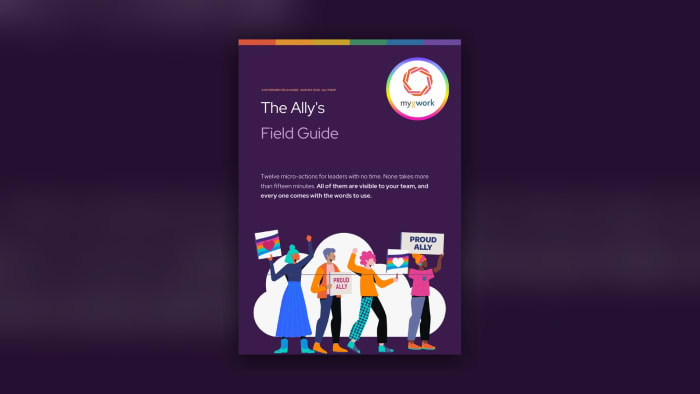
That is the whole problem, and it is not a problem of values. It is a problem of not having the words ready. Below are the ones worth having ready, taken from The Ally's Field Guide, myGwork's download for leaders with no time — twelve micro-actions, none of which takes longer than fifteen minutes.
Why awareness training does not help in that moment
Senior people do not fail at allyship because they disagree with it. They fail because the two things standing in the way are the two things nobody addresses: there is no room in the diary, and there is a real fear of doing it clumsily in front of an audience.
Awareness training solves neither. It adds to the diary and it raises the stakes, which is why the most common outcome of a well-received session is a manager who now cares more and acts exactly the same. What closes that gap is not more conviction. It is a script you have read often enough that it arrives on its own.
Start by being honest about what it costs you
What you should say depends on what saying it would cost you, and admitting that cost is not cowardice — it is what makes the response usable. There are three situations, and they need three different sentences.
Low risk — a peer, a small meeting, no client present. Say: "That one landed badly. Let's not." Short, flat, no eye contact held. You are marking the line, not opening a debate, so move to the next agenda item within about five seconds.
Medium risk — someone more senior than you, or a room with clients or partners in it. Say: "Can I pick that up with you after? I don't want to derail us." You have registered publicly that something was said without forcing a confrontation in front of an audience. Then actually do it afterwards, because otherwise you have taught the room that the deferral was the whole intervention.
High risk — the person holds power over your role, or the setting makes any challenge unsafe. Say: "I want to come back to that." Then follow up later, in writing. Written follow-up is not weakness; it is the only version that survives. And if you genuinely cannot say anything at all, tell the person affected privately that you heard it and were not comfortable with it.
The one response that is never right
Saying nothing in the room and nothing afterwards. Every other response above is recoverable, including the clumsy ones. Complete silence from everyone present is the response that teaches the room what is acceptable, and it is the one your LGBTQ+ colleague will remember.
Eight sentences worth memorising
These are the scripts from the guide's pocket card. The point is not to read them in the meeting. It is to have read them before the meeting, often enough that the words arrive without being searched for.
- Interrupt — "Say that again?" or "That lands badly. Let's leave it."
- Correct — "She. Sorry, carry on." Three seconds, no speech about why pronouns matter. A correction that becomes an event makes people avoid the name altogether.
- Attribute — "That was Sam's idea. Sam, do you want to take it?" Said in the room, not by email afterwards; the value of attribution is entirely in who hears it.
- Ask first — "How do you want me to describe this if it comes up?" Being out to you is not being out to the client.
- Defer up — "I'd rather Priya took this one. It's her work." You will know it worked when she gets invited back next time without you.
- Widen — "Who isn't in this room who should be?" or "What does this look like for someone who isn't out at work?"
- Admit — "I don't have the full answer. I'll find out and come back to you." Performing certainty you do not have is the recoverable mistake; being caught doing it is not.
- Escalate — "Can I pick that up with you after?" Then actually do it.
The highest-leverage action is not a sentence at all
Of the twelve actions in the guide, the one that changes the most is the least dramatic: put it in writing where it counts. When performance review season, promotion papers or a succession conversation comes round, write the sentence down. "She led the network through a restructure. That's leadership; I'm writing it up as such." Or: "This work goes in the evidence section, not the interests section."
The failure mode here is praising the work warmly in conversation and then omitting it from the document. The document is the only part that travels. You will know it worked when network leadership starts appearing in promotion cases.
What the allies themselves say
The guide draws on allies myGwork interviewed during 2026 at Novartis Ireland, Jabil, Organon Canada, Box and VF Corporation. What is striking is that not one of them describes a moment of decision.
"The most effective allies are not those who speak the loudest. They are the people who consistently show up, listen and stand alongside others."
Caroline Johnston, People Partner, Novartis Ireland
"Be curious, be humble, and be brave enough to ask questions. You don't need to be an expert to be an ally, you just need to be willing to learn, and sometimes unlearn."
Valerie Comeau-Caissy, Quality Assurance Specialist, Organon Canada
Waiting to feel qualified is not a stage of allyship. It is a way of postponing the first action, and every person quoted in the guide started before they felt ready.
Download The Ally's Field Guide
All twelve actions are in the guide below, each with when it applies, the words to use, the specific thing not to say and how you will know it worked — plus the pocket card, designed to be printed and folded once.
One caveat worth stating plainly: this guide changes what an individual does. It does not change whether your organisation is built to produce that behaviour in four thousand other people, which is the harder problem. If that is the question you are actually facing, start instead with how to measure allyship at work, or look at LGBTQ+ inclusive employers by industry and country to see who is already doing it.
The Ally's Field Guide is published by myGwork, the global business community for LGBTQ+ professionals, graduates, inclusive employers and anyone who believes in workplace equality.