
Workplace Belonging: What It Is and How to Build It
October 1, 2026
Workplace belonging is the felt experience of being accepted, respected and supported at work, not just present. Inclusion opens the door. Belonging is whether you feel you can walk through it as yourself. For LGBTQ+ employees, that feeling depends on daily signals: who you can talk to about your weekend, whether a joke goes unchallenged, whether your manager knows you. This guide covers what belonging means, what gets in its way, and what employers, managers and allies can do about it.
Key Takeaways
- Belonging is the felt result of inclusion. Policies create access, but people build belonging through everyday interactions over time.
- Many LGBTQ+ workers still manage their identity at work: 58% report covering behaviors to avoid harassment or discrimination.
- Supportive climates are linked to more disclosure and higher job satisfaction. Hostile ones are linked to more distress.
- Employers can start with explicit non-discrimination policies, inclusive benefits, employee resource groups, mentoring and manager training.
- Measure belonging with short, frequent surveys segmented by identity, then act visibly on what you hear.
What workplace belonging actually means
Researchers at the California Management Review define belonging as the degree to which a person feels personally accepted, respected, included and supported by others in an organization. The same piece makes the key point: someone can be included and still not feel they belong.
That is why belonging is a different target from a headcount goal. You can hire a diverse team and still have people who edit themselves in every meeting.
Belonging versus inclusion
The Center for Creative Leadership separates the two cleanly. Inclusion is structural access, meaning people have a seat at the table. Belonging is the experience of being valued once they are there. CCL adds that policies and systems can support inclusion, while belonging is built mostly through the quality of human interactions over time.
SHRM puts it another way: belonging is the umbrella over inclusion, equity and diversity. Harvard Business Publishing’s 2021 pulse report makes the same observation: you can have diversity without inclusion, and inclusion without universal belonging.
| Concept | Question it answers | Typical lever |
|---|---|---|
| Diversity | Who is here? | Recruiting, sourcing |
| Equity | Is access fair? | Pay, promotion, benefits review |
| Inclusion | Are people invited in and treated fairly? | Policies, meeting norms, ERGs |
| Belonging | Do people feel they can be themselves here? | Manager behavior, relationships, follow-through |
Why belonging matters for LGBTQ+ employees
For LGBTQ+ professionals, belonging is tied to a practical question: how much of yourself do you have to hide? EY’s 2024 US LGBTQ+ Workplace Barometer reports that psychological safety and belonging are strong, direct predictors of retaining LGBTQ+ employees. It defines psychological safety as including a sense of belonging and the belief that you can be authentic without fear of negative treatment.
The same barometer found that 42% of LGBTQ employees say their professional advancement is hindered by their LGBTQ+ identity. Belonging and career growth are not separate topics. People who feel they must hide are less likely to ask for stretch work, find sponsors or speak up.
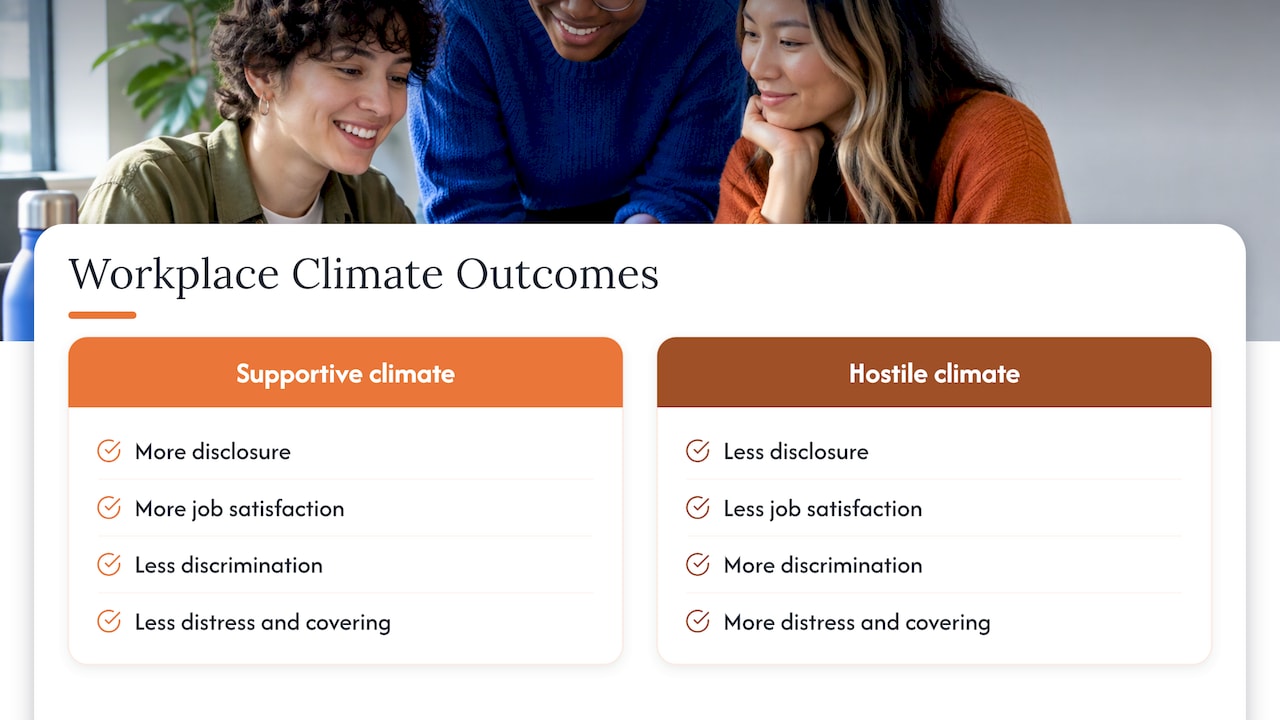
A 2026 meta-analysis in Frontiers in Organizational Psychology points the same direction. A supportive workplace climate is positively associated with disclosure and job satisfaction and negatively associated with discrimination, distress and covering. A hostile climate is linked to more distress and covering and to less disclosure and satisfaction.
The legal floor matters too. In the US, the Supreme Court ruled in 2020 that Title VII bars discrimination against gay and transgender employees. But a legal floor is not a culture. Belonging starts where compliance ends.
What gets in the way of belonging
The barriers are well documented, and most are quiet rather than dramatic.
Discrimination and harassment
The Williams Institute at UCLA reports that 47% of LGBTQ employees experienced discrimination or harassment at work because of sexual orientation or gender identity at some point in their working lives. Nearly half were not open about being LGBTQ to their current supervisor. Transgender and nonbinary employees reported higher rates than cisgender lesbian, gay and bisexual employees.
Covering and not being out
The same report found 58% of LGBTQ employees used covering behaviors to avoid harassment or discrimination. Achievers Workforce Institute reports that about half of 2SLGBTQIA+ people in the US are not out to their managers and a quarter are not out to anyone at work. If you cannot bring your whole self, you cannot fully belong.
Small exclusions that add up
Research on LGBTQ professionals in STEM, published in Science Advances, found that 32.9% experienced one or more types of social exclusion, such as not fitting in or being left out of after-work gatherings, versus 22.7% of non-LGBTQ peers. They were also about 30% more likely to have experienced harassment in the past year.
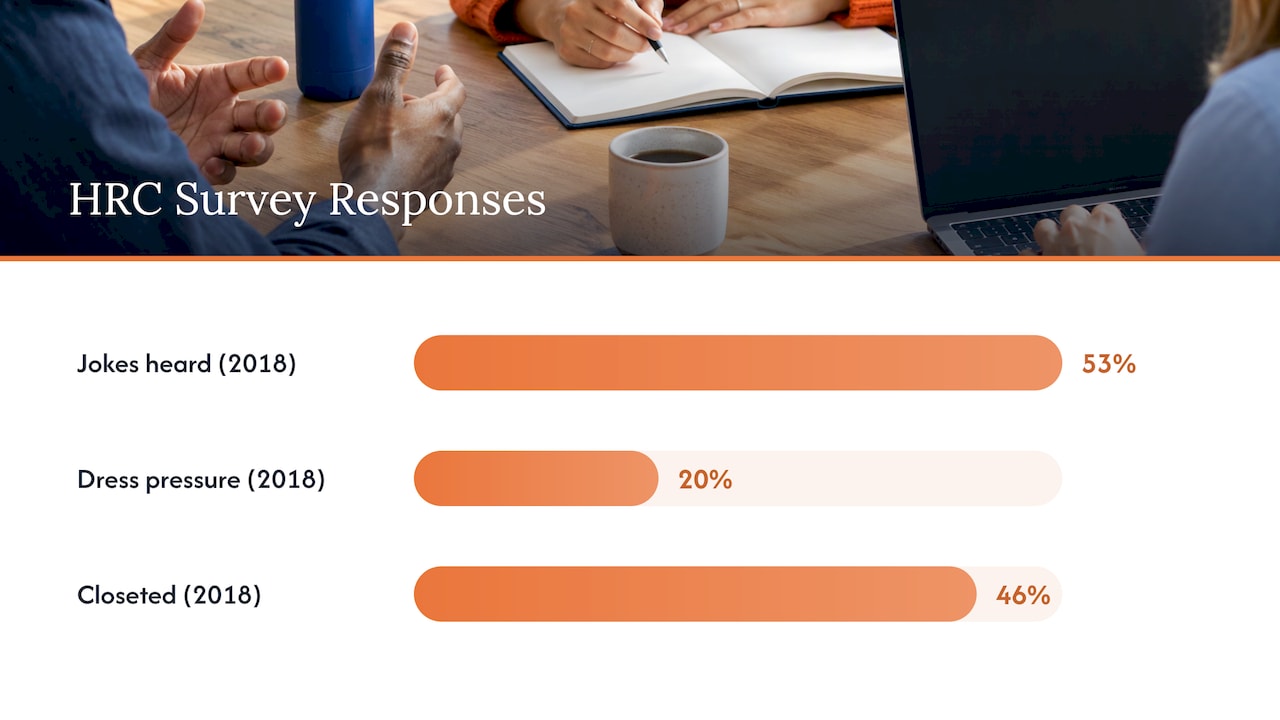
HRC’s survey data shows how ordinary the friction can be: 53% of LGBTQ workers reported hearing jokes about lesbian or gay people at least once in a while. One in five said they were told, or coworkers implied, that they should dress more feminine or masculine. The survey also found 46% of LGBTQ workers were closeted at work. That data is from 2018, so treat it as a baseline rather than a current rate.
None of this requires a villain. It happens through jokes nobody challenges, social events built around assumptions, and forms that only allow for one kind of family.
How employers can build LGBTQ+ belonging
Start with structure, then move to behavior. Structure creates the safety to be yourself. Behavior makes people feel it.
1. Get the foundations right
HRC’s guidance says employers can improve LGBTQ+ inclusion by explicitly covering sexual orientation and gender identity or expression in non-discrimination policies, checking that benefits are inclusive, and assessing whether additional practices welcome and affirm LGBTQ+ employees. Its examples of inclusive benefits include equal health coverage for spouses and domestic partners and transgender-inclusive healthcare. Benefits are not automatically inclusive, so they need a deliberate review.
2. Add the programs people can see
EY’s barometer lists leading practices: LGBTQ+ business resource groups, mentoring programs, inclusive leadership training, frequent communication about new developments, and robust allyship initiatives. Each works as a visible signal. A mentoring program, for example, gives a new LGBTQ+ hire a named person to ask the awkward questions, such as which teams are comfortable and how to handle a client who assumes a spouse’s gender.
For HR teams building this out, our guide to HR and LGBTQ+ inclusion walks through the policy side. Our overview of emerging LGBTQ+ inclusion trends shows where employer practice is heading.
3. Make inclusion routine
EY’s practical pathway from signals to belonging describes everyday inclusion routines: inclusive meetings, equitable staffing, fair access to development and clear reporting channels. The idea is to turn strategy into daily signals that employees read as safety. Examples:
- Rotate who speaks first and who takes notes in meetings.
- Staff high-visibility projects through a transparent process, not by who is closest to the boss.
- Let people choose how they share their pronouns, and never require it.
- Publish what happened after a report was made, in aggregate, so people see that reporting leads somewhere.
4. Write job ads that signal welcome
Belonging begins before day one. The words in a job ad tell candidates whether they will be seen. UK employers can check their wording against the Equality Act job ads checklist, and the principle carries over to the US: say plainly that you welcome LGBTQ+ applicants, describe benefits that cover all families, and avoid language that signals a narrow culture fit.
What managers can do this week
CCL argues that belonging-building falls largely to leaders who intentionally reduce uncertainty about whether people belong, so that employees can set aside worry and contribute fully. In practice, that is a handful of habits:
- Learn about people. Ask open questions about life outside work and accept whatever answer comes, including a short one.
- Use inclusive language by default. Say “partner” or “family” until someone tells you otherwise.
- Respond in the moment. When a joke lands badly, a short, calm correction signals that the team’s norms are not up for negotiation.
- Check your social calendar. If the team only bonds at events that feel unsafe or irrelevant to some people, add other formats.
- Follow through. If someone raises a concern, tell them what you did, even if the answer is that you are still working on it.
- Assign a mentor early. For new hires, a mentor and shared team norms help them feel welcomed from the start.
How coworkers and allies help
A scoping review of workplace allyship by Ho and colleagues identifies three components: knowledge, empathy and action. It reports that non-LGBT coworkers provided interpersonal support to LGBT coworkers and confronted discrimination against them.
That gives allies a simple checklist:
- Knowledge: learn the vocabulary and the policies that cover your colleagues, so they do not have to teach you.
- Empathy: assume that a colleague who is quiet about their personal life may have reasons.
- Action: speak up when someone is excluded, join the employee resource group as a supporter, and ask what would help instead of guessing.
Allyship that stops at a rainbow logo in June does not create belonging. Showing up in March, when no one is watching, does.
How to measure belonging
You cannot improve what you only guess at. Achievers recommends survey items that capture both an overall sense of belonging and specific pillars: feeling warmly welcomed, being known as an individual, being included (able to be yourself and have your opinions valued), and being supported in your development goals.
The same report found that employees who receive pulse surveys four or more times a year are 39% more likely to feel known and 75% more likely to feel welcomed and respected than those surveyed once a year. It recommends at least three surveys a year plus always-on listening.
Three practical points for LGBTQ+ belonging:
- Segment carefully. Break results down by identity where group sizes protect anonymity. An average score can hide a team where trans colleagues are struggling.
- Combine feelings with data. Pair survey perception with retention, promotion and exit data.
- Ask HRC’s practice questions. HRC suggests asking whether you have guidelines for supporting employees who transition on the job, and how any collection of LGBTQ+ data affects culture.
Then close the loop. People stop answering surveys that lead nowhere.
Our perspective
Belonging is not a campaign. It is what people conclude after a hundred small moments, and most of those happen far from HR.
We built myGwork around that idea. LGBTQ+ professionals told us what they wanted: to find employers that actively commit to inclusion, and to meet others who understand their careers. So we work exclusively with organizations that are committed to LGBTQ+ inclusion, and we pair job search with networking, mentorship and community.
For employers, our view is simple. Say it publicly, back it with policy, and give people a place to connect. A visible employer profile, an inclusive job ad and a well-run employee network all send the same message: you can be yourself here. For professionals, belonging starts with choosing where to work and finding peers who help you grow.
Allyship deserves the same intention. Allies who learn, listen and act are part of how belonging gets built, and that is why training for allies sits alongside everything else we do.
Adrien
Build belonging with myGwork
If you are an employer, your belonging work is only visible to candidates if they can find it. myGwork gives organizations committed to LGBTQ+ inclusion a way to reach LGBTQ+ professionals, students and allies through job listings, an employer profile, events and branded content. See the corporate solutions plans or learn how a GEO employer profile presents your commitments.
To train your teams, our academy courses cover LGBTQ+ allyship in the workplace and intersectionality, delivered in person or virtually. If you are a professional looking for your next role, you can join myGwork and explore our LGBTQ+ support resources for career success. For a sector example, see our recap of pathways to belonging in finance and consulting.
FAQ
What is the difference between belonging and inclusion at work?
Inclusion is about access and fair treatment: having a seat at the table. Belonging is the felt experience of being accepted and valued once you are there. A company can run strong inclusion programs and still have employees who do not feel they belong, which is why both need attention.
How do you know if LGBTQ+ employees feel they belong?
Use short, frequent surveys that ask about feeling welcomed, known, included and supported, and segment results by identity where anonymity allows. Add retention and promotion data, plus listening sessions and resource group feedback. Then share what you changed in response.
What can managers do to improve belonging on their team?
Learn about each person, use inclusive language by default, challenge exclusionary jokes calmly and promptly, and distribute opportunities transparently. Follow through on concerns so people see that speaking up leads to action. A mentor for new hires also helps them feel welcomed early.
Are employee resource groups enough to create belonging?
They help, and EY lists LGBTQ+ business resource groups among leading practices, alongside mentoring, inclusive leadership training and allyship initiatives. But groups work best when leaders support them and when everyday routines such as meetings and staffing are also inclusive.
Can allies make a real difference?
Yes. Research on workplace allyship describes knowledge, empathy and action as its core, and reports that coworkers provide interpersonal support and confront discrimination against LGBT colleagues. Small, consistent actions by peers often shape daily experience more than formal programs.
Sources
- The Basics of Belonging, California Management Review
- How a Sense of Belonging Strengthens the Workplace, SHRM
- How to Create a Sense of Belonging in the Workplace, CCL
- Organizational Diversity, Inclusion, and Belonging: 2021 Pulse Report, Harvard Business Publishing
- 2024 EY US LGBTQ+ Workplace Barometer
- Organizational climate of hostility and support, Frontiers
- Supreme Court Rules Title VII Bars Discrimination Against Gay and Transgender Employees, Congress.gov
- LGBTQ People’s Experiences of Workplace Discrimination and Harassment, Williams Institute
- The Belonging Blueprint, Achievers Workforce Institute
- Systemic inequalities for LGBTQ professionals in STEM, Science Advances
- HRC report on LGBTQ employees in the US
- Understanding Best Practices in LGBTQ+ Inclusion, HRC
- From signals to belonging, EY
- Empowering workplace allies for LGB and T employees, PMC
- Equality Act job ads checklist