
Why diverse perspectives drive inclusion and growth
April 17, 2026
Companies in the top quartile for diversity are 39% more profitable than their peers, and LGBTQ+ inclusive firms consistently outperform competitors on key financial metrics. Yet many organizations still treat inclusion as a checkbox rather than a core business strategy. For LGBTQ+ professionals and allies, understanding the real mechanics behind diverse perspectives is not just empowering, it is essential. This article breaks down what diverse perspectives actually mean, shows the evidence behind their impact, and gives you practical tools to foster genuine inclusion and equitable professional growth wherever you work.
Key Takeaways
What do we mean by diverse perspectives?
The phrase “diverse perspectives” gets used a lot, but it is often misunderstood. Many people assume it refers only to visible differences like race, gender, or sexual orientation. In reality, it covers a much wider spectrum of human experience and thought.
Diverse perspectives include:
- Lived experience: The unique lens that comes from navigating the world as an LGBTQ+ person, a first-generation professional, or someone from a non-dominant cultural background.
- Cognitive and neurodiversity: Different ways of processing information, solving problems, and approaching challenges. Neurodivergent colleagues often spot patterns and solutions others miss entirely.
- Intersectionality: The overlapping identities that shape how someone experiences both the world and the workplace. An LGBTQ+ person of color, for example, brings a perspective shaped by multiple layers of lived reality.
- Professional expertise and background: The industry someone came from, the failures they have navigated, and the unconventional paths they have taken to get where they are.
- Values and belief systems: How someone prioritizes decisions, resolves conflict, and defines success.
When teams only seek surface-level demographic variety, they miss the deeper cognitive and experiential richness that actually drives innovation. Research on team diversity confirms that diversity effects are nuanced: while short-term performance benefits may be minimal, diverse teams are critical for long-term organizational viability and adaptability.
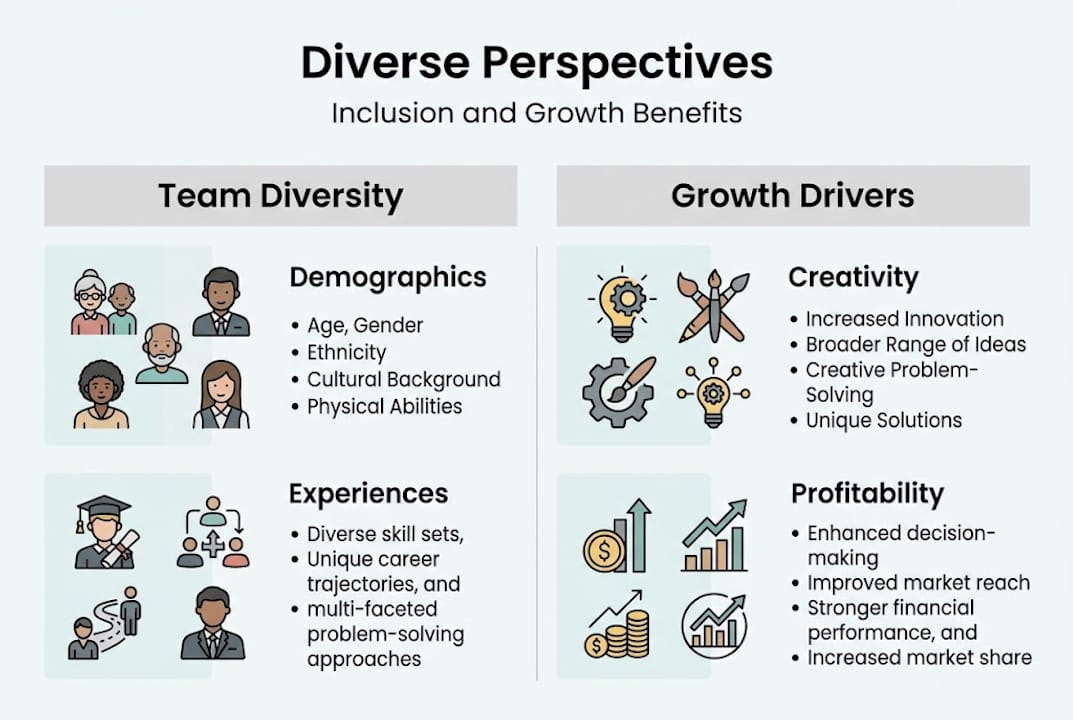
For LGBTQ+ professionals, authenticity at work is directly tied to this broader understanding. When people can bring their whole selves, including their identities and lived experiences, the quality of thinking in a room genuinely changes.
Pro Tip: When building or joining a team, actively seek out cognitive and lived-experience diversity, not just demographic variety. Ask yourself: whose voice is missing from this conversation, and what might they see that we cannot?
The most innovative teams are not necessarily the most demographically varied. They are the ones where different ways of thinking are genuinely welcomed and acted upon. That distinction matters enormously for how you recruit, collaborate, and grow.
The direct impact of valuing diverse perspectives
The business case for diverse perspectives is no longer theoretical. The numbers are clear, and they are hard to ignore.
“Top-quartile diverse firms are 39% more profitable, and LGBTQ+ inclusive Swiss firms show 8 percentage points higher return on equity than their peers.” IMD Research, 2025
These are not marginal gains. They represent a structural advantage that compounds over time. Here is how inclusive and non-inclusive organizations compare across key performance indicators:
The pattern is consistent: organizations that genuinely value diverse perspectives outperform those that do not, across industries and geographies. Earning top diversity recognition is not just a reputational win. It signals the kind of culture that attracts and retains the talent driving those results.
It is also worth addressing a common objection: diverse teams can feel harder to manage in the short term. More voices mean more friction, longer discussions, and sometimes more conflict. Team diversity research confirms this, showing that diversity effects are mixed or neutral in the short term. But organizations that push through that initial friction see dramatically better long-term outcomes in innovation, adaptability, and resilience.
The lesson is not to avoid friction. It is to build the structures that make friction productive rather than destructive. That starts with psychological safety, which we will cover next.
How psychological safety amplifies the value of diversity
Having a diverse team is not enough on its own. If people do not feel safe to speak up, challenge assumptions, or share unconventional ideas, the potential of that diversity stays locked away. Psychological safety is the key that releases it.
Psychological safety means team members believe they will not be punished or humiliated for speaking up, asking questions, or making mistakes. For LGBTQ+ professionals, this is especially critical. When the workplace feels unsafe, people self-censor, hide parts of their identity, and contribute far less than they are capable of. Research from Harvard Business School shows that psychological safety directly moderates the diversity-performance link, meaning diverse teams only outperform when members feel genuinely safe to communicate across differences.
Here is how to build psychological safety in LGBTQ+ inclusive teams:
- Model vulnerability from the top. Leaders who admit mistakes and ask for feedback signal that honesty is safe.
- Respond to dissent with curiosity, not defensiveness. When someone challenges an idea, ask questions before defending your position.
- Acknowledge and address microaggressions immediately. Silence signals tolerance. Speaking up signals safety.
- Create structured opportunities for quieter voices. Not everyone speaks up in large meetings. Rotating facilitation and anonymous input tools help.
- Celebrate ideas that did not work. Rewarding experimentation removes the fear of failure.
Investing in bias training for inclusion is one concrete step organizations can take to build this foundation. Training alone is not sufficient, but it raises awareness of the invisible barriers that silence marginalized voices.
Pro Tip: The next time a colleague shares an idea that surprises or challenges you, pause before responding. Ask one genuine question before offering your opinion. That small habit, practiced consistently, builds the kind of trust that makes diverse teams actually work.
When psychological safety is present, diverse teams communicate more openly, generate more creative solutions, and recover from setbacks faster. It is the difference between diversity as a statistic and diversity as a genuine competitive advantage.

Putting it into practice: Fostering inclusive growth for LGBTQ+ professionals
Knowing the evidence is one thing. Turning it into daily action is another. Here is a step-by-step approach for LGBTQ+ professionals and allies who want to move from awareness to real impact.
- Audit your current environment. Identify where diverse voices are underrepresented in meetings, decisions, and leadership pipelines. You cannot fix what you have not measured.
- Seek out mentorship and sponsorship. Mentors provide guidance; sponsors actively advocate for your advancement. Both are essential, and diverse leaders in senior roles make a measurable difference in whether LGBTQ+ professionals see a future at an organization.
- Advocate for transparent inclusion policies. LGBTQ+ inclusive policies tied to clear accountability boost both representation and performance. Push for policies that are written down, measured, and reviewed regularly.
- Use inclusive hiring tools. Structured interviews, diverse hiring panels, and diversity hiring tools reduce bias at the point of entry, which is where many organizations lose diverse talent before they even start.
- Build your network intentionally. Connect with communities, platforms, and events that center LGBTQ+ professional growth and allyship.
The most effective organizations treat inclusion not as a one-time initiative but as an ongoing practice embedded in how they hire, promote, and recognize people.
The uncomfortable truth most leaders miss about diverse perspectives
Here is what most diversity conversations avoid saying out loud: representation without power is theater. You can fill a room with diverse faces and still make every major decision the same way you always have. Real inclusion means changing who gets heard in the moments that matter, not just who is in the room.
Many leaders focus on optics because optics are measurable and safe. Genuine inclusion is neither. It requires tolerating dissent, slowing down decisions to include more voices, and sometimes being proven wrong by someone with less organizational status than you. That is uncomfortable. Most organizations are not designed to reward that kind of discomfort.
The hard work is measuring and rewarding truly inclusive behaviors, not just diversity metrics. When supporting neurodiverse teams and LGBTQ+ talent means genuinely restructuring how decisions get made, the innovation that follows can surprise even the most well-intentioned leaders. The organizations that figure this out first will not just be more equitable. They will be structurally harder to compete with.
Unlock diverse talent and inclusion with myGwork
If this article has shown you anything, it is that building genuinely inclusive workplaces takes more than good intentions. It takes the right networks, resources, and community.
myGwork exists to make that work easier. Whether you are an LGBTQ+ professional searching for a workplace where you can truly thrive, or an ally looking to build more equitable teams, myGwork LGBTQ+ careers connects you with inclusive employers, mentors, job opportunities, and a global community committed to real change. Explore job listings, join networking events, and access resources designed specifically to support your professional growth and advocacy. Your next step toward a more inclusive career starts here.
Frequently asked questions
Why does valuing diverse perspectives matter for LGBTQ+ professionals?
It leads to greater inclusion, innovation, and opens new paths for career growth in workplaces where all voices are heard. LGBTQ+ inclusive firms consistently outperform their peers on profitability and market performance.
What is psychological safety and why is it central to diversity?
Psychological safety means team members feel safe to speak up, which enables diverse teams including LGBTQ+ staff to communicate and perform better. Without it, diversity’s performance benefits remain largely unrealized.
How do inclusive policies benefit business performance?
Firms with inclusive policies see higher profits, better talent retention, and outperform competitors in the market. Top-quartile diverse firms are 39% more profitable than less diverse peers.
Is diversity just about visible identities?
No, diversity covers different life experiences, ways of thinking, and backgrounds, not just what you can see. Team diversity research confirms it includes lived experience, neurodiversity, and cognitive variation alongside demographic factors.