
Why Measure DEI Progress: A Guide for Leaders
June 5, 2026
Measuring DEI progress means systematically tracking whether diversity, equity, and inclusion initiatives produce real, verifiable outcomes in hiring, advancement, pay, and retention rather than simply documenting activities. The distinction matters because organizations that count events attended and trainings delivered without measuring what changed are, according to the Korn Ferry Institute, not building credible progress. DEI measurement, the recognized industry term for this practice, connects effort to evidence. Platforms like WorkTango and Sopact Sense have made this connection operational, giving DEI professionals and organizational leaders the data infrastructure to move from intention to accountability.
Why measure DEI progress in your organization
DEI progress measurement is defined as the practice of collecting, analyzing, and acting on data that tracks whether an organization’s workforce is becoming more diverse, equitable, and inclusive over time. The importance of measuring DEI cannot be overstated: without it, programs run on assumption rather than evidence. Linking metrics to HR outcomes rather than reporting effort is what separates organizations that achieve change from those that perform it.

The core insight is simple. Activity metrics tell you what you did. Outcome metrics tell you whether it worked. Tracking the number of DEI workshops delivered says nothing about whether underrepresented employees are advancing at equitable rates. Tracking promotion rates by demographic group does. This shift in framing, from effort to outcome, is the foundation of every credible DEI measurement system.
Leadership accountability is the other half of the equation. DEI data that sits in a spreadsheet and never reaches a quarterly business review has no mechanism to drive change. Embedding DEI metrics into leadership goals and performance reviews transforms measurement from a compliance exercise into a management discipline. That is why organizations serious about DEI progress assessment treat their metrics the same way they treat revenue targets: reviewed regularly, assigned to owners, and tied to consequences.
What key metrics should organizations measure to assess DEI progress?
A complete DEI measurement framework covers three distinct categories: representation, equity, and inclusion. Each answers a different question, and omitting any one of them creates blind spots that undermine the whole effort.
Representation metrics answer the question of who is in the organization and at what level. These include:
- Workforce demographics broken down by department, level, and function
- Hiring rates by demographic group across the full recruiting funnel
- Promotion rates compared across groups at each career stage
- Attrition rates segmented by identity and seniority
Equity metrics answer whether the organization’s systems treat people fairly. Pay equity analysis compares compensation for equivalent roles after controlling for legitimate variables. Promotion velocity tracks how long different groups take to advance from one level to the next. Access to high-visibility assignments and sponsorship programs is another equity indicator that rarely appears in standard HR reporting but predicts long-term career mobility.
Inclusion metrics answer whether people feel they belong and can contribute fully. Inclusion metrics like psychological safety must complement demographic data to avoid blind spots. Employee sentiment surveys, belonging scores, and manager effectiveness ratings all belong in this category. Qualitative data from focus groups and exit interviews adds texture that numbers alone cannot provide.
The table below shows how these three categories map to specific measurement tools and the questions they answer.
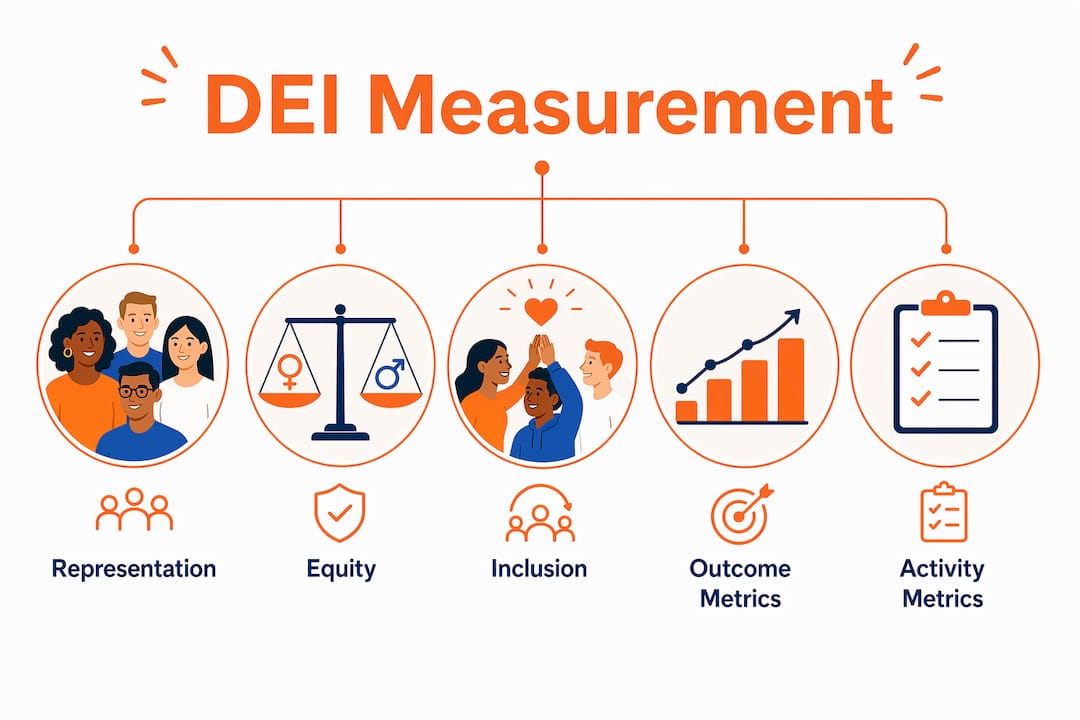
WorkTango and Sopact Sense combine quantitative and qualitative DEI data to provide insights and track progress across lifecycle stages. This integration matters because a high representation score alongside a low belonging score signals a retention crisis in the making. No single metric tells the full story.
Pro Tip: When building your first DEI dashboard, start with three metrics you can track consistently rather than twenty you collect once. Consistency over time is what reveals trends.
How does measuring DEI progress drive accountability and continuous improvement?
Accountability without data is a request. Accountability with data is a system. DEI dashboards reviewed quarterly create accountability by tying metrics to leadership goals and spotting trends early, preventing DEI from becoming a once-a-year reporting exercise.
The mechanism works through what practitioners call a signal-and-decision-loop model. Metrics are signals. Leadership reviews are decision points. Without regular review cycles, metrics alone don’t translate into equity outcomes. The loop closes when a metric triggers a specific intervention, the intervention is tracked, and the next review assesses whether it moved the needle.
Consider a concrete example. A technology company notices through quarterly data that women are promoted at 60% of the rate of men at the manager-to-director transition. That signal triggers an audit of the promotion process at that specific stage. The audit reveals that sponsorship conversations happen informally and disproportionately favor employees with longer tenure in a single office. The company redesigns the sponsorship program. Twelve months later, the promotion rate gap narrows by 15 percentage points. That is the signal-and-decision loop working as designed.
Measurement also exposes operational friction points and enables redesign of DEI as a high-accountability initiative. Transparency creates internal accountability and helps identify barriers in promotion and retention that would otherwise remain invisible. This is why Deloitte’s research on DEI governance consistently points to visibility as a prerequisite for change, not a result of it.
Tying DEI metrics to leadership performance reviews within professional service firms is one of the most direct ways to sustain momentum. When a leader’s annual review includes a DEI scorecard, the quarterly dashboard stops being optional reading.
What are common challenges in DEI measurement and how to overcome them?
Most organizations fail at DEI measurement before they begin because they collect only headcount data. Collecting only headcount data and missing stage-by-stage outcome metrics across hiring, promotion, retention, pay, and experience means true progress cannot be verified. Headcount is a starting point, not a measurement system.
Here are the four most common pitfalls and how to address each one:
- Tracking representation without outcomes. Knowing that 40% of your workforce identifies as a person of color tells you nothing about whether those employees are advancing, paid equitably, or planning to stay. Add promotion rate, pay equity, and retention data segmented by the same demographic categories.
- Failing to disaggregate by level and cohort. Aggregate diversity numbers hide pipeline leaks. A company can have strong overall representation while losing underrepresented talent consistently at the manager-to-director transition. Building a baseline and tracking disaggregated gaps by level and cohort is the only way to diagnose root causes.
- Mismatching survey cadence to metric type. Inclusion and belonging pulse surveys require quarterly cadence, while representation and pay equity reviews need annual intervals. Running an annual inclusion survey means you discover a belonging crisis six months after it started driving attrition.
- Manual, fragmented tracking. Spreadsheets maintained by individual HR business partners produce inconsistent data that cannot be aggregated reliably. Automation tools like Sopact Sense shift DEI measurement from reactive compliance to proactive advantage by delivering real-time dashboards and continuous feedback loops.
Pro Tip: Before selecting a DEI measurement platform, audit where your data currently lives. Most organizations have the raw data they need across HRIS, payroll, and engagement survey systems. The gap is integration, not collection.
How to use DEI measurement data to prioritize interventions and communicate progress
Data without interpretation is noise. The goal of DEI progress assessment is not to produce a report. It is to answer the question: where do we invest next, and why?
Data-driven prioritization works by ranking gaps according to two dimensions: severity and tractability. A 30% pay gap at the senior director level is severe. If it traces to a single identifiable cause, such as a flawed salary-banding system, it is also tractable. That combination makes it the highest-priority intervention. A 5% representation gap in entry-level hiring that traces to dozens of diffuse sourcing decisions is less tractable in the short term, even if it matters strategically.
Clear, numeric DEI goals create accountability by forcing honest progress tracking instead of vague assertions of success. Setting a target of increasing director-level representation for a specific group by 8 percentage points over three years gives the organization something to measure against. Vague commitments to “increase diversity” do not.
Communicating progress transparently, both internally and externally, builds credibility with employees and stakeholders. Internal communication should include what the data shows, what the organization is doing about gaps, and what changed since the last review. External communication, such as an annual DEI report, demonstrates accountability to candidates, clients, and partners. Intersectionality in DEI reporting matters here: disaggregating data by multiple identity dimensions reveals experiences that single-axis reporting obscures.
The benefits of DEI metrics extend beyond culture. Research consistently links workforce diversity to stronger innovation outcomes and broader market reach. When DEI measurement data shows that leadership diversity increased by 12 percentage points over two years, that is a business performance indicator as much as a social one. Connecting DEI outcomes to business results is the most persuasive argument for sustained investment in the work.
Key takeaways
Measuring DEI progress transforms programs from well-intentioned efforts into accountable, outcome-driven systems by linking metrics to leadership decisions and continuous improvement cycles.
Why measurement is the only honest DEI strategy
I have spent years watching organizations invest heavily in DEI programs and then struggle to explain what changed. The pattern is consistent: strong launch energy, visible commitments, and then a gradual drift back to business as usual because no one built a mechanism to check whether anything actually moved.
The uncomfortable truth is that most DEI programs fail not because of bad intentions but because of bad feedback loops. When you do not measure, you cannot distinguish between a program that is working and one that is creating the appearance of progress while leaving structural inequities intact. That distinction is not academic. It determines whether underrepresented employees experience real career mobility or a workplace that talks about inclusion without delivering it.
What I have seen work is treating DEI measurement the same way a finance team treats a budget variance report. You set a target, you track actuals, you investigate gaps, and you adjust. The organizations that do this consistently, including those that build diverse leadership pipelines as a tracked outcome rather than a stated aspiration, are the ones that produce results you can verify.
The skepticism I hear most often is that measurement reduces people to numbers. The opposite is true. Measurement is what forces an organization to see people it has been overlooking. A pay equity audit does not reduce anyone to a number. It reveals whether the organization has been paying someone less than their peers for years without noticing. That is not dehumanizing. That is accountability.
- Adrien
Start measuring DEI progress with the right resources
Mygwork is a global platform built for LGBTQ+ professionals, allies, and the organizations committed to genuine inclusion. If you are ready to move beyond surface-level DEI commitments and build a measurement-driven approach, Mygwork offers resources, community connections, and employer partnerships designed to support that work. Explore diversity hiring tools that integrate with your existing data systems, connect with DEI professionals who have built measurement frameworks from scratch, and access employer resources that help you communicate progress credibly. Visit myGwork to find the tools and community that make rigorous DEI measurement practical rather than theoretical.
FAQ
Why is measuring DEI progress important?
Measuring DEI progress is important because it replaces assumption with evidence, revealing whether initiatives are producing real outcomes in hiring, promotion, pay equity, and retention. Without measurement, organizations cannot distinguish programs that work from those that only appear to.
What metrics should I track to assess DEI progress?
Track representation metrics by level and cohort, equity metrics including pay gaps and promotion rates, and inclusion metrics such as belonging scores and psychological safety. All three categories are required for a complete picture.
How often should DEI data be reviewed?
Inclusion and belonging surveys should run quarterly to detect emerging issues before they drive attrition, while representation and pay equity analyses are typically conducted annually. Embedding both in leadership review cycles is what converts data into decisions.
What is the biggest mistake in DEI measurement?
The most common mistake is tracking only headcount data without measuring outcomes across hiring, promotion, retention, and pay. Aggregate representation numbers hide pipeline leaks that cohort-level disaggregation would reveal.
How does DEI measurement connect to business outcomes?
Organizations that track and improve leadership diversity, pay equity, and inclusion scores consistently report stronger innovation performance and broader talent attraction. Numeric DEI targets, reviewed regularly, make that connection visible and credible to stakeholders.