
Why foster diverse leadership? Boost inclusion and impact
May 8, 2026
Many organizations proudly display rainbow flags during Pride Month, publish diversity reports, and sign pledges committing to inclusion. Yet LGBTQ+ executives hold only about 1% of S&P 500 board seats. That gap tells you something important: visible commitment is not the same as structural change. For LGBTQ+ professionals and diversity advocates, the question worth asking isn’t “Does our company support us?” but rather “Do people who look like us, live like us, and understand our experiences actually lead here?” This guide breaks down what diverse leadership genuinely means, why it drives real inclusion, and how you can push for lasting impact inside your organization.
Key Takeaways
Defining diverse leadership and why it matters
“Diverse leadership” gets thrown around a lot, but it means something specific. It refers to leaders who come from differing social identities, lived experiences, and cultural backgrounds, including race, gender, sexual orientation, disability, and socioeconomic history. The key distinction is that diversity in leadership is not about filling a quota. It’s about bringing genuinely different perspectives into the rooms where decisions get made.
Here’s where many organizations stumble. They treat diversity as a headcount metric, hire one or two people from underrepresented communities, and call it progress. That’s tokenism, not leadership diversity. Token diversity can actually backfire, placing unfair burdens on individuals to “represent” entire communities while giving them little real power or psychological safety (a term that means feeling safe to speak up without fear of punishment or humiliation).
Research confirms what many LGBTQ+ professionals already feel. Inclusive leadership correlates strongly with better inclusion outcomes and higher team performance, not just more diverse headcounts. The difference is significant: leaders who practice inclusion change the climate around them. Leaders who are hired for appearances do not.
Why does authentic LGBTQ+ representation in leadership matter specifically?
- It signals to every LGBTQ+ employee that advancement is genuinely possible.
- It shapes company policy in ways that reflect real community needs.
- It builds organizational credibility with LGBTQ+ talent and customers.
- It shifts cultural norms by normalizing diverse identities in positions of authority.
Data reinforces this point from a talent strategy perspective. Research shows that diverse leaders directly influence job choices for 84% of LGBTQ+ graduates. Put simply, when young LGBTQ+ professionals scout their career options, they look at who leads the organization. If they see no one like them at the top, they move on. That’s an enormous competitive disadvantage for companies that fail to cultivate diverse leadership.
“Diversity in the boardroom is not charity. It’s a business imperative that shapes culture, drives talent acquisition, and fuels long-term performance.”
How inclusive leadership drives better outcomes
Understanding what inclusive leadership looks like on paper is one thing. Seeing the practical mechanisms by which it improves your team is another. Let’s walk through how it actually works.
Key behaviors of inclusive leaders
- Active listening with follow-through. Inclusive leaders don’t just hold open-door meetings. They actively solicit perspectives from quieter team members, then act on what they hear. For LGBTQ+ employees, this behavior signals that their input is valued, not just tolerated.
- Transparent decision-making. When leaders explain why decisions were made, it reduces speculation and fear, both of which are disproportionately high for marginalized employees who may already distrust institutional power.
- Sharing accountability. Inclusive leaders redistribute responsibility and credit fairly. They push back against in-group favoritism, where the same people keep getting high-visibility projects.
- Modeling vulnerability. Leaders who acknowledge their own limitations or gaps in understanding send a clear message that imperfection is safe. For LGBTQ+ professionals who may be navigating coming out at work, this creates enormous psychological relief.
- Sponsoring underrepresented talent. Unlike mentors who offer advice, sponsors use their own political capital to advance others. Inclusive leaders actively sponsor LGBTQ+ professionals for promotions, projects, and visibility.
Research confirms that these behaviors operate through specific organizational mechanisms. Inclusive leadership shapes outcomes via diversity climate, inclusive climate, team coordination, and knowledge sharing. A “diversity climate” refers to employees’ shared perception that the organization is genuinely fair and supportive of diversity. An “inclusive climate” means team members feel psychologically safe and personally valued.
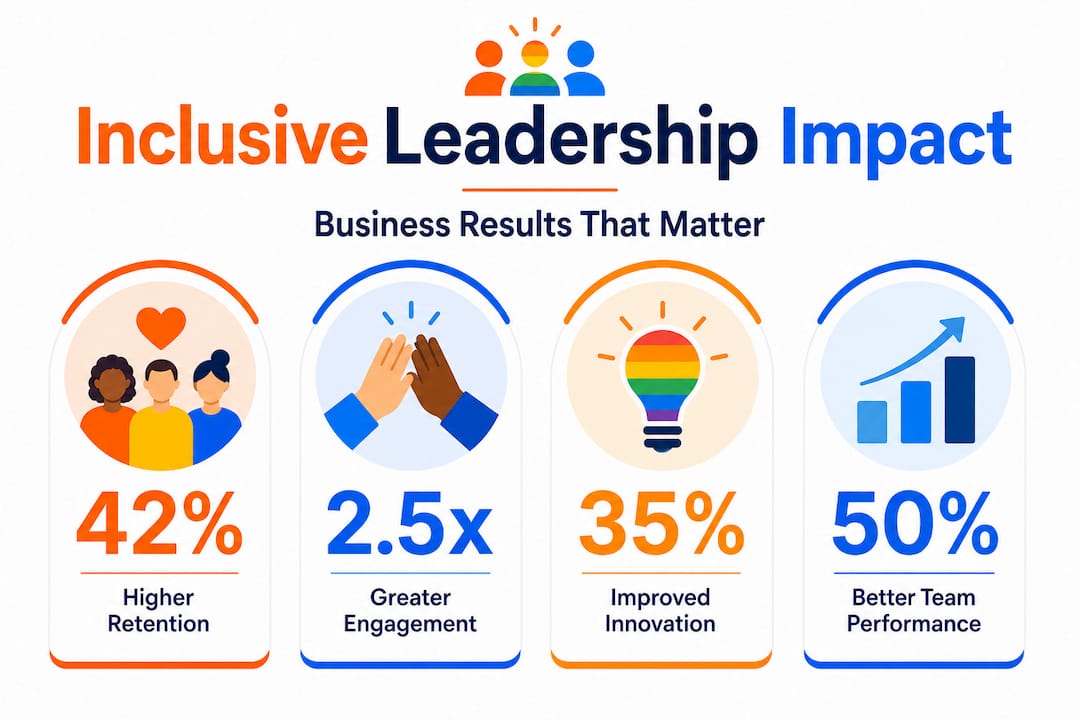
When leaders behave inclusively, they directly improve both of these climates. The result? Teams with inclusive climates show measurably improved performance on collaboration, innovation, and employee retention.

Quantifiable outcomes of inclusive leadership
The numbers matter because executives and boards respond to business cases. When you advocate for diverse leadership, frame it in these terms. Learning from inclusive leadership approaches for neurodiverse teams is also instructive here, as many of the same principles apply across different marginalized groups.
Pro Tip: If you’re an LGBTQ+ advocate inside a corporation, pair your inclusion argument with specific retention data. Show leadership how much it costs to replace a mid-level employee (typically 50 to 200% of their annual salary), then tie that to LGBTQ+ attrition linked to poor inclusion practices. Numbers open doors that values arguments sometimes can’t. You can also point to effective bias training as a documented pathway to shifting leader behavior at scale.
Barriers and caveats: When diversity isn’t enough
Let’s be direct. Diverse leadership, on its own, doesn’t guarantee inclusion. Organizations face real headwinds, and pretending otherwise sets advocates up for frustration.
The backlash problem
LGBTQ+ leaders face a growing political and organizational risk. The current climate of DEI backlash has caused many companies to quietly retreat from commitments they made loudly in 2020 and 2021. Surface-level diversity shows minimal impact in environments with low psychological safety, meaning that when the broader culture doesn’t support inclusion, representation alone doesn’t protect employees or produce results.
Tokenism and the visibility trap
Tokenism is when organizations hire diverse individuals primarily for optics rather than for genuine contribution and authority. The person hired into a “diversity role” often gets:
- Limited decision-making power despite a senior title
- Informal exclusion from key strategy meetings
- Pressure to be the spokesperson for their entire identity group
- Reduced credibility when they raise systemic concerns
This dynamic is exhausting and counterproductive. It signals to other LGBTQ+ employees that the company values the appearance of diversity over its actual practice.
Comparing the two realities
Microaggressions in diverse teams remain a major invisible barrier even when leadership is nominally diverse. Microaggressions are subtle, often unintentional behaviors or comments that communicate hostility or dismissal toward a marginalized identity. When leaders fail to address them, the inclusive climate erodes fast, regardless of who holds the title.
“Putting a diverse face at the top without changing the systems underneath is like changing the label on the box without changing what’s inside.”
The honest reality is that psychological safety, not just representation, is the foundation on which diverse leadership produces outcomes. Without it, even the most committed LGBTQ+ executive will find their impact blunted.
From leadership to culture: How to nurture meaningful inclusion
Facing these barriers honestly, the path forward isn’t to give up on diverse leadership. It’s to build the cultural infrastructure that makes representation actually work.
Research is clear that manager behaviors are the primary shapers of inclusion experiences and that inclusive leadership is a system-level capability, not just an individual trait. That means the goal isn’t to find a few exceptional inclusive leaders. It’s to build systems that make inclusive behavior the organizational default.
Steps for embedding inclusion into organizational practice
- Audit your inclusion climate, not just your diversity numbers. Survey employees about psychological safety, fairness, and belonging. Break down results by identity group to see where gaps exist.
- Tie manager performance reviews to inclusion behaviors. When leaders know that how they treat their teams affects their own evaluations, behavior changes. Accountability is non-negotiable.
- Create formal sponsorship programs. Sponsorship, distinct from mentorship, moves LGBTQ+ talent forward through institutional support, not just advice. Structured programs reduce the reliance on informal networks that often exclude marginalized groups.
- Build LGBTQ+ employee resource groups with real budget and access. ERGs without budget and leadership access are social clubs, not strategic assets. Fund them. Connect them to executive sponsors who have actual influence.
- Communicate setbacks honestly. When organizations face political or financial pressure to scale back DEI efforts, employees notice. Honest communication about challenges and sustained commitment to core principles builds more trust than silence.
Pro Tip: For LGBTQ+ professionals advocating from within, coalition building is your most powerful tool. Identify allies across different departments, seniority levels, and identity groups. Collective voices with aligned data are far harder to dismiss than individual ones. Look at approaches for supporting neurodiverse people at work for frameworks that transfer well to LGBTQ+ inclusion strategies.
Sustained progress is also about anchoring inclusion in the company’s identity, not just its programming calendar. Organizations that earn recognition for diversity consistently do so because inclusion is woven into how they hire, promote, reward, and retain people year-round, not just during Pride Month.
And the returns compound over time. Companies that invest in meaningful inclusion see measurably stronger retention rates among LGBTQ+ employees, cutting the hidden costs of attrition and building the kind of organizational culture that attracts the best talent regardless of identity.
The tough truths most guides miss about diverse leadership
Here’s what we’ve learned from years of watching well-meaning organizations cycle through the same programs without lasting change: checklists don’t shift culture. Training without accountability doesn’t either.
Companies roll out unconscious bias workshops, add rainbow branding to their LinkedIn pages, and congratulate themselves. Meanwhile, LGBTQ+ employees still hide aspects of their identity at work, still get passed over for promotions, and still leave for organizations that feel safer. The program exists. The culture doesn’t follow.
What actually makes a difference? Visible, uncomfortable, personal accountability from senior leadership. When a CEO says, “We lost a talented person because they didn’t feel safe being out here, and that’s on us,” that moment does more than a training module ever could. It tells every employee that authenticity is not just tolerated but protected.
The second truth is that psychological safety isn’t a program. It’s a daily practice. It gets built or broken in small moments: how a leader reacts when someone corrects them, whether they shut down a dismissive comment in a meeting, whether they publicly credit the LGBTQ+ colleague who had the idea first. These moments are invisible to HR dashboards but visible to every person in the room.
We also believe that LGBTQ+ professionals should demand more than a seat at the table. A seat without voice, without safety, and without real influence isn’t inclusion. It’s performance. Engaging authentically with authentic leadership practices means not just showing up but insisting that the environment is structured so your presence produces actual impact.
Finally, build your peer network deliberately. Allies across teams and identities create a web of accountability that outlasts any single leader’s tenure. When the executive sponsor leaves, it’s those relationships that sustain progress.
Taking the next step toward inclusive leadership
Understanding diverse leadership, its mechanisms, its limits, and its cultural requirements, positions you to advocate and lead more effectively. But knowledge is only the first step.
myGwork exists to bridge that gap between understanding and action. As a global professional networking platform designed specifically for LGBTQ+ professionals, allies, and organizations committed to inclusion, myGwork connects you to LGBTQ+ inclusive jobs and resources that match your values and your ambitions. Whether you’re looking for an organization where authentic leadership is already practiced, seeking mentors who’ve navigated the same challenges, or trying to benchmark your company’s inclusion climate, myGwork offers the community, the tools, and the connections to make it real. Join a network where diverse leadership isn’t aspirational. It’s the standard.
Frequently asked questions
What is inclusive leadership in the context of workplace diversity?
Inclusive leadership means leaders actively create an environment where all team members, including those from marginalized identities, can contribute and belong. Research shows inclusive leadership operates through specific organizational constructs like diversity climate and inclusive climate to produce measurable outcomes.
How does diverse leadership benefit LGBTQ+ employees?
Diverse leadership ensures LGBTQ+ voices are represented at the decision-making level, creating environments that are safer, more engaging, and more innovative. Given that LGBTQ+ executives hold only 1% of S&P 500 board seats, closing this gap is both a justice issue and a performance opportunity.
What are common barriers to effective diverse leadership?
Barriers include tokenism, organizational backlash, lack of psychological safety, and insufficient accountability after public commitments. DEI backlash can prompt organizations to quietly retreat from visible inclusion pledges, leaving LGBTQ+ employees more vulnerable.
What practical steps can companies take to foster diverse leadership?
Companies should prioritize inclusive leadership behaviors, build psychological safety into team norms, and ensure representation carries real authority and influence. Manager behaviors directly shape inclusion experiences, making leadership development and accountability systems essential components of any meaningful strategy.
Recommended
- 84% say visible LGBTQ+ leaders influence their job choices – does your organization qualify?
- Bias Training: Fostering LGBTQ+ Workplace Inclusion
- RX Global’s Charlie Oxford on Inclusive Leadership for Neurodiverse Teams
- Top 5 ways we can support and empower neurodiverse people in the workplace and promote inclusivity
- What is fair hiring? Principles, pitfalls, and real strategies