
Improve CEI Score: A 2026 Playbook for HR Leaders
August 20, 2026A prioritized, audit-ready checklist raises your Corporate Equality Index (CEI) score faster than any single grand gesture. The five moves that matter most: name sexual orientation and gender identity explicitly in your nondiscrimination policy, extend family-formation benefits (adoption, fertility, surrogacy) equitably, confirm transgender-inclusive healthcare parity across every plan, document at least four internal training and accountability efforts, and log five distinct community outreach activities.

Start here, in order:
- Update nondiscrimination policy language (workforce protections pillar)
- Audit benefits for family-formation parity (inclusive benefits pillar)
- Verify transgender-inclusive healthcare coverage (inclusive benefits pillar)
- Compile training and ERG documentation (inclusive culture pillar)
- Log outreach and philanthropic activity (corporate social responsibility pillar)
- Each action maps to one of the four CEI pillars, so an audit against this list doubles as a pre-submission readiness check.
- Most of these can be documented within 30 to 90 days; benefit changes may need to wait for the next plan year.
Key Takeaways
Raising a CEI score requires explicit nondiscrimination language, verified benefit parity, documented culture programs, and a monitored philanthropic footprint working together, not any single fix in isolation.
Key Official Resources for CEI Documentation
- HRC Corporate Equality Index 2026 report
- HRC Foundation survey guidance and templates
- Sample Equality 100 Award announcement
- myGwork employer solutions
How Is the CEI Score Calculated?
The Corporate Equality Index grades employers across four pillars: workforce protections, inclusive benefits, supporting an inclusive culture, and corporate social responsibility. Workforce protections cover nondiscrimination policy language. Inclusive benefits, the heaviest-weighted category, covers health plan design and family-formation support. Culture points come from training, employee resource groups (ERGs), and documented accountability. Corporate social responsibility rewards outreach and philanthropic engagement with LGBTQ+ communities.
The benefits pillar typically carries the largest portion of the available points, according to the HRC Foundation’s survey methodology, which is why a single missed line in plan documentation can cost more than an entire underdeveloped training program. On the other side of the ledger, a Responsible Citizenship violation can subtract 25 points in one stroke.
HRC expects specific evidence for each pillar:
- Actual policy text naming sexual orientation and gender identity, not a general “all forms of discrimination” clause
- Summary plan descriptions showing benefit parity, not marketing language about being “inclusive”
- Training rosters, dates, and topics, plus ERG charters and meeting cadence
- Outreach logs: sponsorships, partnerships, recruitment events, and donations with dates and amounts
What’s the Fastest Way to Improve Your CEI Score?
Treat this as a 30/60/90-day project, sequenced by point impact and how much internal coordination each task requires.
Days 1 to 30: Policy and documentation cleanup. This phase costs almost nothing and moves fast because it’s mostly a legal review, not a benefits negotiation.
- Pull your current nondiscrimination policy and confirm it explicitly names sexual orientation and gender identity. If it says “all protected classes” without naming them, legal needs to revise the language this month.
- Inventory every training program touching diversity, inclusion, or harassment prevention. HRC wants specifics: who delivered it, how often, and whether managers versus general staff got different content.
- Confirm your ERGs (or LGBTQ+ affinity group) have a charter, an executive sponsor, and a meeting record. An informal Slack channel doesn’t count as documented evidence.
- Assign a single owner, usually a benefits or total rewards lead, to start the plan document review described below.
Days 30 to 60: Benefits audit and vendor coordination. This is where most organizations lose points without realizing it, because benefit parity has to hold up on paper, not just in intent.
- Request full plan documents from every health insurance carrier and ask directly whether transgender-inclusive care, including hormone therapy and gender-affirming surgery, is covered with the same cost-sharing as comparable procedures.
- Check family-formation benefits for parity between different-sex and same-sex couples, and between biological and adoptive or surrogate paths to parenthood. The HRC Foundation’s benefits criteria treat unequal access here as a major gap, not a minor one.
- If gaps exist, draft a benefits amendment now even if it can’t take effect until the next open enrollment. Plan-year timing is the single biggest constraint in this whole process, and starting the paperwork early avoids missing a full cycle.
- Loop in legal to confirm plan amendments comply with state insurance regulations before finalizing language.
Days 60 to 90: Outreach documentation and submission prep. This phase is mostly about collecting proof of work you may already be doing.
- Compile a list of at least five distinct community engagement activities: sponsorships, recruitment partnerships with LGBTQ±focused organizations, Pride event participation, scholarship funding, or supplier diversity commitments.
- Draft internal talking points and a short communications brief in case you’re approached for comment, modeled on how Equality 100 awardees describe sustained commitments rather than one-off actions.
- Build a single documentation packet: policy PDFs, plan summaries, training logs, ERG charters, and outreach records, cross-referenced to each CEI question.
- Route the packet through HR, legal, benefits, and communications for sign-off before submission.
Roles matter here. The HR benefits lead owns the plan audit. Legal owns policy language and compliance risk. Total rewards owns cost modeling for benefit changes. ERG sponsors own culture documentation. Communications owns public-facing language and press coordination if you’re aiming for Equality 100 recognition.
Pro Tip: Build your documentation packet as a single indexed file with a table of contents that mirrors the CEI survey’s section order. Reviewers move faster through organized evidence, and it forces your own team to notice gaps before HRC does.
Sponsorship and advancement programs also strengthen your workforce protections story. A structured approach to sponsoring LGBTQ+ professionals for promotion gives you concrete, dated evidence of accountability beyond a policy statement.

Does a Higher CEI Score Actually Pay Off?
Raising your score isn’t a symbolic exercise. It changes who applies, who stays, and how your financials look over time. HRC’s 15-year financial analysis tied to the 2026 Corporate Equality Index links consistently high CEI performance to stronger revenue growth and materially higher net income compared to lower-scoring peers.
That’s not a coincidence. Companies that build genuine benefit parity and documented culture programs tend to also run tighter operations generally, and LGBTQ+ candidates increasingly screen employers before applying, not after getting an offer.
For a leadership team weighing whether this is worth the investment, the case comes down to three numbers you can act on directly: recruitment costs drop when candidates self-select into your pipeline, retention improves when employees see benefits and policies that match stated values, and employer brand strength compounds year over year as recognition builds. A documented LGBTQ+ support program can move retention by a wide margin, and that single metric often justifies the entire CEI project on its own.
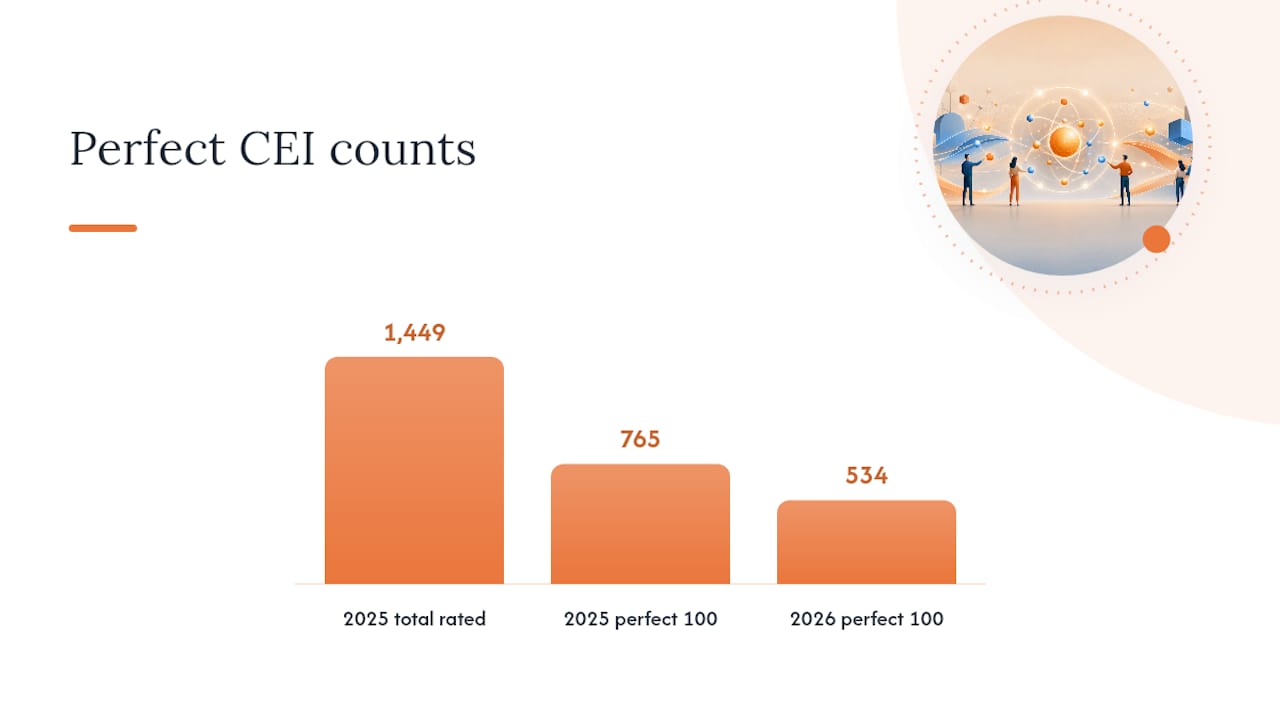
- 534 companies earned a perfect 100 in the 2026 CEI, while 2025 saw 765 companies hit that mark out of a record 1,449 rated, giving HR teams a real benchmark for how competitive top-tier scoring has become.
- Even with Fortune 500 participation dropping sharply between cycles, many large employers still verified at a perfect 100 in 2026, showing that scale isn’t an excuse for a middling score.
What Costs the Most CEI Points?
The single biggest risk to your score isn’t a missing training log. It’s the Responsible Citizenship deduction, worth 25 points, triggered by large-scale public anti-LGBTQ+ actions, funding organizations that actively work against LGBTQ+ rights, or reversing previously adopted inclusive policies. A company can do everything right on benefits and culture and still lose the equivalent of an entire pillar because of one poorly vetted donation or a public statement legal never reviewed.
Build a monitoring habit, not a one-time check:
- Audit corporate philanthropy and foundation giving annually against known anti-LGBTQ+ organizations.
- Review investor relations and public policy statements before they go out, especially around election cycles or state legislation fights.
- Never quietly roll back a benefit or policy once adopted; if a plan change is unavoidable, document the reasoning and keep parity intact elsewhere.
Smaller pitfalls add up too: inconsistent policy language across subsidiaries, benefits documentation that describes intent instead of quoting actual plan text, and ERGs with no meeting records to show. Each one is fixable with a single documentation sprint.
Pro Tip: Assign one person, ideally in legal or communications, as the standing reviewer for any public statement or major donation before it goes out. A five-minute check prevents a 25-point loss.
How Do You Submit Your CEI Documentation?
You’ll need policy documents, benefit plan summaries, training records, ERG charters, and outreach logs, typically owned jointly by HR, benefits, legal, and communications, with final sign-off from a senior HR or CEO-level sponsor.
The realistic sequence:
- Run the gap analysis described above across all four pillars.
- Assemble the documentation packet with evidence indexed to each survey question.
- Submit through HRC’s web-based survey, which allows employers to review preliminary ratings before the final report publishes.
- Respond promptly to any clarification requests during HRC’s review window.
- Follow up internally to fix any gaps the review surfaces before the next cycle opens.
- Coordinate early with benefits vendors and third-party administrators. Plan amendments often need lead time that outpaces the survey window.
- Keep a single point of contact for HRC correspondence so nothing gets lost between departments.
How Can myGwork Support Your CEI Efforts?
Improving your score is a policy and benefits exercise, but converting that work into visible employer-brand value takes recruitment reach. myGwork connects employers directly to LGBTQ+ professionals actively evaluating inclusive workplaces, which turns your CEI investment into measurable hiring outcomes rather than a report that sits in a drawer.
myGwork services that plug directly into CEI-related work include:
- Employer profiles that showcase your policies, benefits, and culture commitments to job seekers who specifically prioritize LGBTQ±friendly employers
- Targeted job listings that reach LGBTQ+ professionals and allies actively searching for inclusive workplaces
- Mentorship programs and networking events that build the talent pipeline your CEI documentation describes
For the official scoring criteria and templates, HRC’s survey guidance is the authoritative starting point before you touch internal documentation.
Get Employer-Brand Support From myGwork
CEI documentation proves your policies exist. It doesn’t put you in front of the candidates who care about them most. That’s the gap myGwork closes: employer profiles, targeted job listings, and networking events built specifically for LGBTQ+ professionals evaluating where to work next.
If your CEI submission includes new nondiscrimination language, expanded benefits, or fresh outreach commitments, myGwork's employer solutions turn that work into visible recruitment reach instead of a static report. Strong employer branding built around genuine policy work, not marketing gloss, is what separates a top CEI scorer from a company merely checking boxes. A clear approach to prioritizing employer branding for LGBTQ+ inclusion makes that difference visible to the candidates you’re trying to reach.
Where CEI Efforts Actually Move the Needle
The conventional advice treats CEI improvement like a compliance checklist: update the policy, check the box, submit the form. That undersells what’s actually happening. The 25-point Responsible Citizenship deduction proves HRC built asymmetric risk into the score on purpose. You can spend a year doing benefits work correctly and lose more points in one bad quarter of unreviewed philanthropy than you gained all year.
What gets overlooked most is documentation discipline. Plenty of employers have genuinely inclusive cultures and still score poorly because nobody wrote it down in a form HRC’s reviewers can verify. An ERG that meets monthly but keeps no charter is functionally invisible to this scoring system.
Prioritize the benefits audit first. It carries the most points, takes the longest lead time because of plan-year constraints, and it’s where good intentions most often fail to translate into actual plan language. Everything else, including outreach and culture documentation, can move faster once benefits parity is locked in.
Frequently Asked Questions
How long does it take to improve a CEI score? Policy and documentation fixes can happen within 30 days. Benefit plan changes usually need to align with your next plan year, so a full improvement cycle often spans several months to a year.
What’s the single highest-impact change for a low-scoring company? Confirming inclusive benefits, especially transgender-inclusive healthcare coverage and family-formation parity, since the benefits pillar carries the heaviest point weight of the four categories.
Can a small or mid-size employer realistically score well? Yes. Score depends on policy language, benefit design, and documentation, not headcount. A tightly run mid-size employer with clean documentation can outscore a larger company with sloppy paperwork.
What triggers the Responsible Citizenship deduction? Large-scale public anti-LGBTQ+ actions, funding organizations opposed to LGBTQ+ rights, or reversing previously adopted inclusive policies can each trigger the 25-point penalty described in HRC’s survey methodology.
Sources
- HRC | Corporate Equality Index 2026
- HRC Foundation | Corporate Equality Index: About the Survey
- Arcadis earns Equality 100 Award in HRC’s CEI