
What Is Social Impact Hiring? A 2026 Employer Guide
June 30, 2026Social impact hiring is the intentional practice of recruiting qualified candidates from underrepresented groups by removing systemic barriers within traditional hiring processes. Unlike standard recruitment, this approach treats every hire as a decision that shapes organizational culture, community outcomes, and long-term business performance. Research links inclusive hiring to 28% higher revenue and up to 40% lower turnover. Those numbers make the business case clear: social impact recruitment is not philanthropy. It is a performance strategy.

The industry term most HR professionals use is impact hiring, though “social impact hiring” and “social impact recruitment” describe the same practice across different organizational contexts. Both terms refer to the same core shift: moving from passive sourcing to active, barrier-removing recruitment that targets talent pools most organizations overlook.
What is social impact hiring, and how does it differ from traditional recruitment?
Traditional recruitment relies on standardized resumes, degree requirements, and passive job board postings. Social impact hiring replaces that model with active community engagement, redesigned screening, and sourcing from talent pools that conventional processes exclude.
The groups most commonly targeted include refugees, neurodiverse professionals, people with disabilities, long-term unemployed workers, and individuals from low-income backgrounds. These are not charity hires. They are qualified candidates who get filtered out by systems designed for a narrower definition of “qualified.”
The success metrics are also different. Traditional hiring measures headcount and time-to-fill. Social impact recruitment measures social mobility, leadership diversity, and community impact. Specialist firms deliver complex leadership shortlists within 3–4 weeks by using community networks rather than conventional databases. That speed comes from knowing where overlooked talent actually is.
One distinction that often gets missed: the recruitment process itself is a public-facing signal. Exclusionary screening conflicts with claimed inclusivity and damages employer brand trust before a single interview takes place. Candidates judge organizational integrity based on how accessible the application process is, not just what the careers page says.
Pro Tip: Audit your job application process as if you were a first-generation college graduate applying from a mobile phone with no LinkedIn profile. If the process breaks at any point, your inclusivity claim breaks with it.
What are the key benefits of social impact hiring for businesses?
Social impact hiring delivers measurable returns across revenue, retention, and employer brand. The data is not ambiguous.

Organizations with strong employer brands reduce cost-per-hire by 50% and employee turnover by 28%. When inclusive hiring is visible and authentic, it attracts candidates who are already values-aligned. That alignment reduces early attrition and shortens onboarding time.
The competitive advantage compounds over time. Values-aligned hiring shapes organizational culture and employee engagement in ways that generic diversity statements cannot. Employers who hire for genuine fit with social mission build teams that make better decisions because more perspectives are in the room.
Employers who feature inclusive hiring efforts attract broader talent pools and build a social impact reputation that compounds over years. That reputation becomes a recruiting asset that no job board budget can replicate.
How can organizations implement social impact hiring practices?
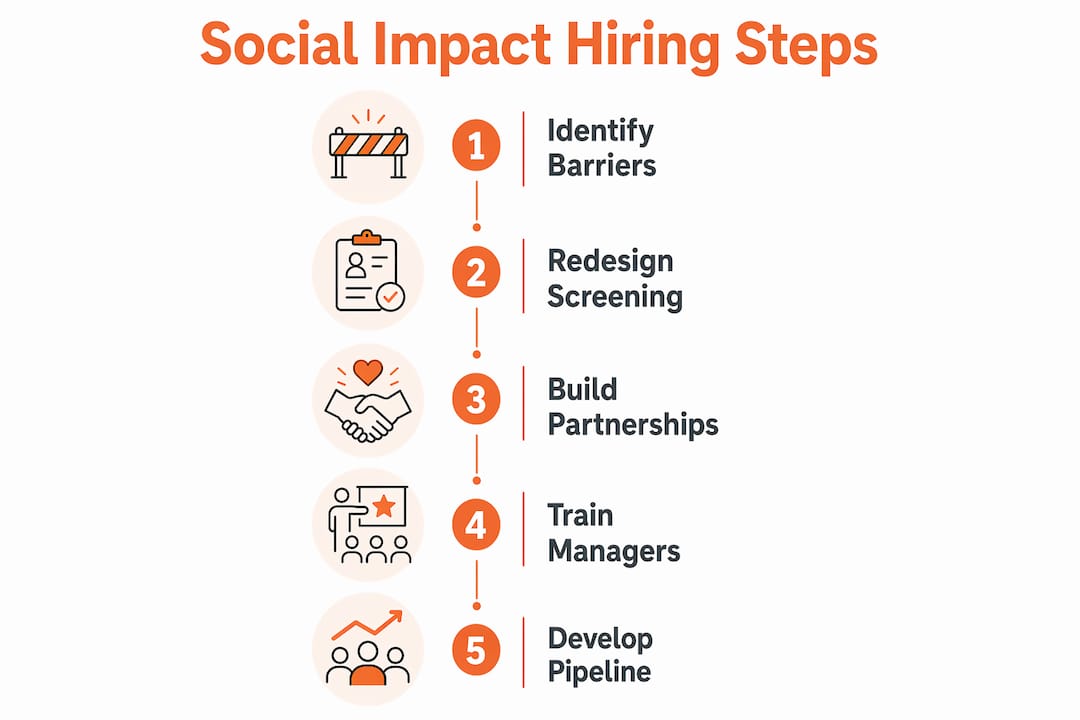
Effective implementation starts with removing the structural barriers that block underrepresented candidates before they ever reach a hiring manager. Degree mandates are the most common example. Many roles list a bachelor’s degree as a requirement when the actual job demands skills that can be demonstrated without one. Removing that requirement immediately expands the candidate pool.
Redesigning screening for accessibility is the next step. This means offering multiple application formats, removing timed assessments that disadvantage neurodiverse candidates, and writing job descriptions in plain language. True impact hiring demands a full redesign of screening processes, not just a diversity statement added to the footer.
Building partnerships with community organizations, educational institutions, and support groups is where sourcing shifts from passive to active. These partnerships give employers direct access to talent pools that job boards never reach. An employer partnering with a refugee resettlement organization, for example, gains access to multilingual professionals with international experience who are actively seeking work.
Defining impact metrics before recruitment begins keeps hiring efforts focused on measurable outcomes. Without defined metrics, social impact hiring becomes fragmented and unmeasurable. Set targets for social mobility improvements, leadership diversity ratios, and community representation before posting a single role.
The implementation sequence that works:
- Audit current job descriptions and remove unnecessary credential requirements.
- Map which underrepresented groups your organization currently excludes and why.
- Build partnerships with at least two community organizations serving those groups.
- Redesign application and screening processes for accessibility.
- Define three to five measurable impact metrics tied to specific recruitment goals.
- Train middle management on inclusive onboarding before the first diverse hire arrives.
- Review metrics quarterly and adjust sourcing or screening based on outcomes.
Long-term success depends on middle management commitment matching the executive team’s stated values. Culture shock during onboarding is the most common reason diverse hires leave within the first year. If the daily operational culture does not reflect the hiring promise, retention fails regardless of how good the recruitment process was.
Pro Tip: Build an inclusive talent pipeline before you have open roles. Relationships with community organizations take months to develop. Waiting until a position opens means you will default to the same sourcing channels you have always used.
How is social impact hiring evolving as a strategic advantage in 2026?
Candidate expectations have shifted significantly. 75% of candidates actively research a company’s social commitments and values before applying. That figure means employer branding and impact hiring are now the same conversation. A company that hires inclusively but communicates it poorly loses the talent attraction benefit entirely.
The sourcing methods used by leading organizations have also evolved. Network-based sourcing, sometimes called covert discovery, has become the primary method for engaging purpose-driven leaders. Purpose-driven leaders require active engagement because they are not browsing job boards. They respond to direct outreach through trusted networks, peer referrals, and community channels.
B Corp certification has become a talent magnet for mission-driven professionals. Organizations that pursue B Corp standards signal a structural commitment to social and environmental accountability. That signal attracts candidates who want their work to align with their values, and it filters for the kind of applicant who stays longer and performs at a higher level.
“Social impact hiring reshapes who makes decisions and whose voices are heard in organizations, linking directly to improved community and organizational outcomes.”
The most persistent misconception is that social impact hiring is a form of corporate social responsibility, a box to check alongside charitable donations and sustainability reports. It is not. Every appointment influences organizational culture and decision-making. The difference between a leadership team that reflects one demographic and one that reflects many is not symbolic. It changes what problems get solved and how.
Employers building an inclusive talent pipeline in 2026 are treating social impact recruitment as a core business function, not a side initiative managed by a single diversity officer. That structural shift is what separates organizations that see results from those that produce annual diversity reports with no measurable change.
Key Takeaways
Social impact hiring is a performance-driven recruitment strategy that removes systemic barriers, expands talent pools, and delivers measurable gains in revenue, retention, and employer brand strength.
Why social impact hiring is harder than it looks
I have watched organizations announce inclusive hiring commitments and then change nothing about how they actually recruit. The job description still requires a degree. The application still times out on mobile. The interview panel still looks identical to the team being hired into. The commitment exists on a webpage. The process contradicts it everywhere else.
The uncomfortable reality is that social impact hiring requires organizations to examine which of their “standards” are actually proxies for exclusion. Degree requirements often screen out candidates by socioeconomic background, not by ability. Timed assessments disadvantage neurodiverse professionals who perform exceptionally in actual work settings. These are not edge cases. They are the norm in most hiring processes.
What I have found works is starting with the audit, not the announcement. Map where your current process loses underrepresented candidates. Then fix those specific points before claiming any commitment publicly. The diversity hiring tools available in 2026 make that audit faster than it used to be, but the organizational will to act on the findings is still the limiting factor.
The broader implication is significant. Organizations that hire inclusively and retain diverse talent build decision-making teams that reflect the communities they serve. That is not a soft benefit. It is a structural advantage that compounds over time and is very difficult for competitors to replicate quickly.
myGwork's role in social impact recruitment
myGwork is a global LGBTQ+ talent and hiring network built specifically for inclusive recruitment. Employers committed to social impact hiring use myGwork to reach LGBTQ+ professionals and allies who are actively seeking values-aligned workplaces.
The platform connects organizations with a community that prioritizes employer authenticity. Employers can showcase their inclusive hiring commitments, post roles with LGBTQ+ friendly organizations, and access resources designed to strengthen their social responsibility in recruitment. For professionals, myGwork offers job listings, mentorship, and networking with employers who have made genuine structural commitments to inclusion. Visit myGwork to explore inclusive job opportunities and employer tools built for real impact.
FAQ
What is social impact hiring in simple terms?
Social impact hiring is the practice of intentionally removing barriers in recruitment to hire qualified candidates from underrepresented groups. It treats inclusive hiring as a business strategy, not a charitable act.
How does social impact hiring benefit employers financially?
Research links inclusive hiring to 28% higher revenue and up to 40% lower turnover. Organizations with strong inclusive employer brands also reduce cost-per-hire by 50%.
What groups does social impact recruitment typically target?
Social impact recruitment commonly targets refugees, neurodiverse professionals, people with disabilities, long-term unemployed workers, and individuals from low-income or first-generation backgrounds.
How do you measure the success of social impact hiring?
Effective organizations measure social mobility improvements, leadership diversity ratios, and community representation alongside traditional metrics like retention and time-to-fill. Defining these metrics before recruitment begins is critical.
Is social impact hiring the same as diversity hiring?
The terms overlap but are not identical. Diversity hiring focuses on workforce representation. Social impact hiring goes further by actively redesigning recruitment processes to remove systemic barriers and measuring outcomes beyond headcount.