
Inclusive Talent Pipeline Process: 2026 HR Guide
June 15, 2026An inclusive talent pipeline process is a structured, documented recruitment workflow that removes systemic barriers at every hiring stage so diverse candidates can compete on equal terms. The EEOC reported 88,531 discrimination charges filed in 2024, a 9.2% year-over-year increase, signaling that unstructured hiring is still failing workers. HR professionals and diversity officers who treat pipeline development for diversity as an operational priority, not a one-time initiative, are the ones actually closing representation gaps. This guide walks you through every stage: auditing your funnel, expanding sourcing, standardizing evaluation, and measuring what matters.

How to audit your inclusive talent pipeline for bias
Before spending a dollar on new sourcing channels, audit the pipeline you already have. Most organizations assume their diversity problem is a sourcing problem. Pipeline issues are often caused by internal process bias, not a shortage of diverse applicants. Fixing the wrong problem wastes budget and leaves the real leak untouched.
A funnel audit examines representation and pass-through rates at five stages: applicant, screening, first-round interview, final-round interview, and offer. Here is how to run one:
- Pull 12 months of hiring data. Twelve months gives you enough volume to see patterns rather than noise. Shorter windows produce misleading results.
- Calculate pass-through rates by demographic group. Divide the number of candidates who advance by the number who entered each stage, broken out by race, gender, disability status, and any other tracked dimensions.
- Flag gaps above 5 percentage points. A pass-through gap over 5% between diverse candidates and the overall candidate pool is a red flag for bias at that stage.
- Separate sourcing problems from process problems. If diverse candidates enter the funnel at low rates, the issue is sourcing. If they enter at normal rates but drop off at screening or interviews, the issue is internal process bias.
- Document your findings before making changes. Write down where leakage occurs and at what rate. This baseline lets you measure whether interventions actually work.
Pro Tip: Run the audit before launching any new diversity recruitment strategy. Adding sourcing volume to a leaky funnel just means more diverse candidates hit the same bias points and drop out.
What sourcing strategies build a diverse candidate pool?

Once your audit confirms that sourcing is the actual gap, expand your channels deliberately. Relying on LinkedIn and employee referrals alone replicates existing networks, which tend to be demographically homogeneous. Equitable talent acquisition requires reaching candidates where they already are.
Effective sourcing channels for a diverse candidate pipeline include:
- Anonymized sourcing platforms. Organizations using these tools achieved 6x more diverse pipelines compared to traditional sourcing. Removing names, photos, and graduation years from initial profiles reduces affinity bias before a recruiter ever makes a judgment call.
- Minority-serving institutions (MSIs). HBCUs, Hispanic-Serving Institutions, and tribal colleges produce large pools of qualified graduates who are underrepresented in corporate pipelines. Building relationships with their career centers creates a repeatable sourcing channel.
- Specialized professional networks. Platforms like Mygwork connect recruiters directly with LGBTQ+ professionals and allies who are actively seeking employers committed to inclusion.
- Community-based organizations. Workforce development nonprofits, veteran service organizations, and disability employment networks reach candidates who rarely appear on mainstream job boards.
Set a directional 12-month goal to increase diverse candidates in your final interview stage by 20%, then review progress quarterly. This approach avoids rigid quotas while still creating accountability.
Pro Tip: Pair every new sourcing channel with a tracking tag in your ATS. If you cannot measure which channel produced which candidates, you cannot know what is working.
Does structured interviewing reduce bias in hiring?
Yes. Structured interviews tied to job competencies are more predictive of performance and reduce bias compared to informal, conversation-style interviews. The difference is not subtle. Unstructured interviews let interviewers reward candidates who feel familiar, which consistently disadvantages people from underrepresented groups.
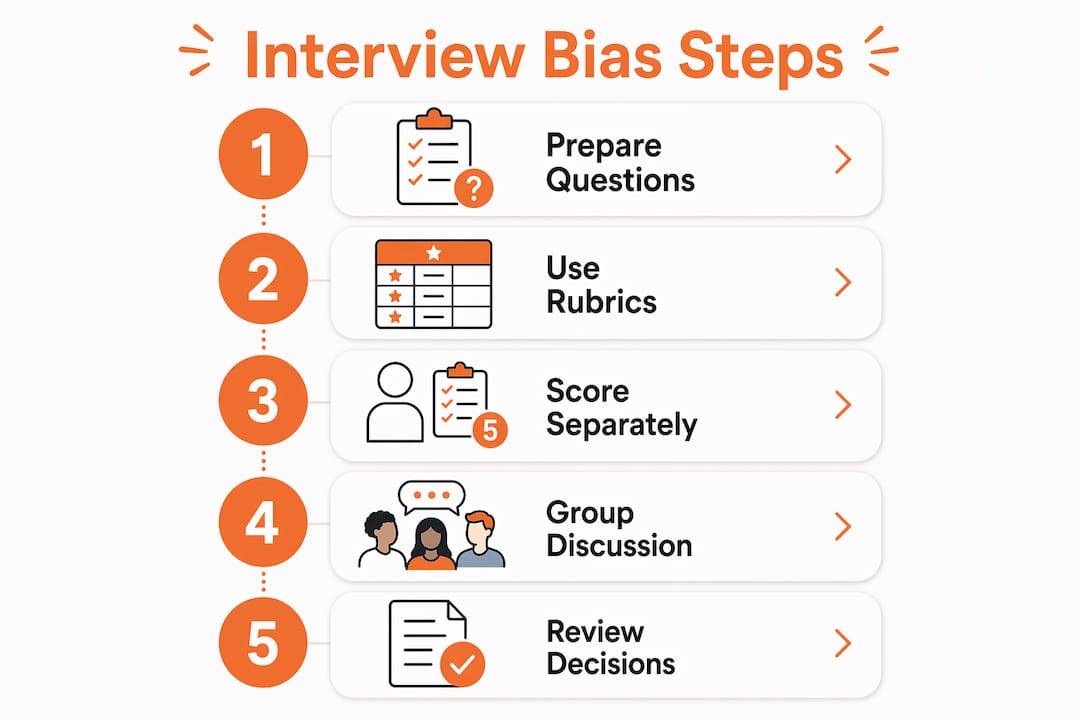
Standardizing your screening and evaluation process requires four concrete changes:
- Build a predefined question bank. Every candidate for a given role answers the same questions in the same order. Questions map directly to the competencies the role requires, not to general impressions of culture fit.
- Use scoring rubrics. A rubric defines what a strong, acceptable, and weak answer looks like for each question. Interviewers score candidates independently before discussing, which prevents the first person to speak from anchoring the group.
- Build diverse interview panels. Interview panels lacking demographic representation signal poor inclusion to candidates, which negatively affects their performance and their likelihood of accepting an offer. A candidate who sees no one who looks like them on the panel draws conclusions about the organization’s culture.
- Remove subjective language from debrief conversations. Phrases like “culture fit,” “executive presence,” and “not quite right” are proxies for bias. Train interviewers to tie every evaluation comment back to a rubric criterion.
Pro Tip: Record the rubric scores before the debrief meeting, not during it. Interviewers who score after group discussion tend to align with whoever spoke most confidently, not with the evidence.
The documented recruiting workflow that ties every candidate to the same rubric also creates a legal record. If a hiring decision is ever challenged, you have evidence that the process was consistent. That matters given the EEOC charge volume cited earlier.
You can review diversity hiring tools that support structured evaluation, from ATS platforms with built-in rubric scoring to video interview tools with bias-flagging features.
How do you measure progress in an inclusive talent pipeline?
Measurement without accountability is just reporting. The goal is to connect pipeline metrics to decisions that leaders actually care about.
- Track representation at every funnel stage, not just at hire. A company that celebrates a diverse hire class while losing diverse candidates at the screening stage is papering over a structural problem.
- Set quarterly review cycles. Quarterly progress reviews on pipeline targets catch problems before they compound. Annual reviews are too slow to course-correct.
- Tie DEI outcomes to leader performance and compensation. Linking DEI metrics to leader pay is the single clearest signal that inclusion is a business priority, not a communications exercise. Organizations that do this see sustained change. Organizations that do not see DEI treated as optional.
- Communicate results transparently, including setbacks. Publishing pipeline data internally, even when it shows regression, builds credibility with employees. Silence breeds skepticism.
- Use analytics tools to monitor in real time. Modern ATS platforms and people analytics tools from vendors like Workday, Greenhouse, and Lever offer demographic pass-through dashboards that surface problems before the quarterly review.
“DEI is not a side project but a business imperative embedded in strategy. Tying leadership pay and performance to inclusion targets signals true commitment.” From Checkbox to Culture
Understanding how to measure diversity progress at each pipeline stage is the foundation for any accountability conversation with senior leadership. Without the data, the conversation stays theoretical.
Key takeaways
A structured, audited, and accountable inclusive talent pipeline process is the only approach that produces lasting workforce diversity.
Why most inclusive pipeline efforts stall before they start
I have watched organizations invest heavily in diversity recruitment strategy and see almost no change in their workforce composition. The pattern is almost always the same: they add sourcing channels without fixing the funnel, they run training without changing the process, and they report on hiring numbers without tracking what happens to diverse employees after day one.
The operational details of inclusion, things like gender-neutral language in job postings, accessible application platforms, and flexible identity expression in onboarding paperwork, are not soft extras. They are the signals candidates use to judge whether your stated commitment is real. A candidate who encounters a binary gender field on an application form has already learned something about your organization before they meet a single person.
The inclusive onboarding process matters as much as the pipeline itself. You can build a diverse candidate pool and lose the gains within 18 months if the onboarding experience signals that the organization was not actually ready for them. I have seen this happen at companies with strong DEI branding and weak internal practices.
My honest recommendation: treat the pipeline as a system, not a campaign. Document every step. Assign owners to every metric. Review the data with the same rigor you apply to revenue forecasts. Inclusion does not happen by intention alone. It happens by design.
You can find practical guidance on workplace equality practices that cover the everyday operational details most pipeline guides skip entirely.
Build your inclusive pipeline with Mygwork
HR teams that want to reach LGBTQ+ talent directly need a sourcing channel built for that purpose.
Mygwork is the leading global platform connecting LGBTQ+ professionals, allies, and organizations committed to workplace inclusion. For diversity officers building a diverse candidate pipeline, Mygwork offers direct access to an active community of job seekers who prioritize employers with demonstrated inclusion records. Partnering with a specialized network like Mygwork complements every stage of your pipeline strategy, from sourcing to employer branding to community engagement. Explore how Mygwork’s talent network can expand your reach to LGBTQ+ candidates and signal your organization’s commitment where it counts.
FAQ
What is an inclusive talent pipeline process?
An inclusive talent pipeline process is a structured recruitment workflow that removes barriers at every hiring stage so candidates from all backgrounds compete on equal terms. It combines documented processes, bias-reduction tools, and consistent measurement to produce equitable outcomes.
How do you identify bias in a hiring funnel?
Audit pass-through rates at five stages: applicant, screening, first-round, final-round, and offer. A gap of more than 5 percentage points between diverse candidates and the overall pool at any stage indicates a bias leak that needs intervention.
What is the fastest way to diversify a candidate pipeline?
Anonymized sourcing platforms are the fastest structural change, with research showing 6x more diverse pipelines compared to traditional sourcing. Pair anonymized sourcing with outreach to minority-serving institutions for sustained pipeline growth.
How do structured interviews support equitable hiring?
Structured interviews use predefined questions tied to role competencies and scoring rubrics that all interviewers apply consistently. This removes the subjective “vibe” assessments that systematically disadvantage candidates from underrepresented groups.
How should leaders be held accountable for DEI pipeline goals?
Tie DEI pipeline metrics directly to leader performance reviews and compensation decisions. Organizations that link inclusion outcomes to pay embed accountability into the management system rather than treating DEI as a voluntary initiative.