
Rewrite the Job Description, Get More Diverse Applicants
August 27, 2026Lead with skills and outcomes instead of years of experience, add a real accommodation statement, name your inclusive benefits, and post a salary range. That combination is what separates a job ad that gets a wide, qualified applicant pool from one that quietly filters out good candidates before they ever click apply. Below you’ll find copy-ready snippets for each piece, plus a one-paragraph template you can paste straight into your applicant tracking system.

A few numbers explain why this is worth the rewrite:
- Removing coded and biased language from a job posting can lift applications by up to 42%, according to peer-reviewed research on wording and applicant diversity.
- The Equal Employment Opportunity Commission expects job-related, neutral qualifications, not vague pedigree requirements that screen out otherwise qualified people.
- myGwork works with employers who want their postings to actually reach LGBTQ+ professionals and allies, not just sit on a generic job board.
Copy this sentence: “We welcome applicants who meet the core requirements below and encourage you to apply even if you don’t check every box. If you need an accommodation at any stage of the hiring process, let us know.”
Key Takeaways
Inclusive job description examples work when they replace tenure requirements with skills, name real benefits, and pair plain language with an explicit accommodation statement.
What Makes Inclusive Job Description Examples Effective
The strongest inclusive job description examples share one trait: they measure candidates by what they can do, not by who they resemble on paper. That distinction is where most job postings quietly go wrong, and it’s also the easiest one to fix.
Coded language is the biggest hidden filter. A PNAS study found that stripping biased or coded wording from postings can increase applications by up to 42%. Words like “rockstar,” “ninja,” or “aggressive go-getter” read as fun to some hiring managers and as a closed door to plenty of qualified candidates who don’t see themselves in that language.

Legal obligations reinforce the business case. The EEOC requires that qualifications be job-related and applied consistently, and the University of Illinois’s Office for Access and Equity recommends stating that accommodations are available under the Americans with Disabilities Act. Skip that language, and you’re not just missing a nice-to-have. You’re increasing legal exposure and signaling, often unintentionally, that disabled candidates aren’t welcome.
Here’s a common failure mode: a posting requires “5+ years of experience with a bachelor’s degree” for a role that really needs three specific skills. That single line disqualifies career-changers, self-taught professionals, and people who took nontraditional paths, before a human ever reads their resume.
Core Principles For Writing An Inclusive Job Ad
Every inclusive job posting rests on a handful of repeatable rules. Apply these before you touch a template.
Lead with skills and outcomes, not tenure. Instead of “5 years of project management experience required,” write “demonstrated ability to manage cross-functional projects from kickoff to delivery.” The second version lets a self-taught project lead with two years of scrappy startup experience compete fairly with someone who spent five years at a large company.
Separate must-haves from nice-to-haves, and mean it. A true must-have is something the role cannot function without: a nursing license, a coding language the team uses daily. Everything else, like “experience with a specific software” or “advanced degree preferred,” belongs in a nice-to-have list. Bloated must-have lists are one of the most common reasons qualified women and underrepresented candidates self-select out, since research on hiring behavior repeatedly shows they apply only when they meet nearly every listed requirement.
Cut gender, age, and ableist-coded terms. A few frequent offenders and better options:
- “Rockstar” or “ninja” → “skilled” or “experienced”
- “Young and energetic” → “motivated” or “adaptable”
- “Able-bodied” or “must be able to stand for long periods” → describe the actual task, and note accommodations are available
- “Native English speaker” → “fluent in written and spoken English”
- “Aggressive” or “dominant” → “proactive” or “results-driven”
Format for readability. Use short paragraphs, bullet points under three lines each, and clear H3-style headers for sections like Responsibilities, Requirements, and Benefits. Dense blocks of text push away neurodivergent candidates and anyone reading on a phone, which is most applicants today.
Pro Tip: Run your draft through a gender-decoder tool, check its readability score, and ask someone from your target candidate pool to review it before you post. Fifteen minutes of feedback can catch what a full team of recruiters missed.
Copy-Ready Snippets For Inclusive Job Postings
These sample inclusive job postings snippets cover the sections where bias hides most often. Swap in your role details and use them as-is or as a starting point.
- Skills-first qualification. “You’ve led at least one project from concept to launch, whether at a company, a nonprofit, or on your own initiative.” This replaces a degree-and-years requirement with a demonstrated capability anyone could show.
- Must-have vs. nice-to-have split. “Must-have: comfort working with spreadsheets and basic data analysis. Nice-to-have: familiarity with SQL.” Separating these two categories keeps your applicant pool from shrinking over skills you could teach in a week.
- ADA/accommodation statement. “We provide reasonable accommodations throughout the hiring process. If you need an adjustment to apply or interview, contact [email/phone] and we’ll work with you.” Place this near the “How to Apply” section, not buried in fine print.
- Inclusive benefits blurb. “Our benefits include health coverage for you and your partner regardless of marital status, employee resource groups including an LGBTQ+ ERG, flexible and remote work options, and mental health support through our EAP.” Naming specific programs beats a generic diversity statement every time.
- Salary-range example. “This role pays $68,000 to $82,000 based on experience and location.” Posting a range up front, rather than “competitive salary,” signals transparency and saves everyone time.
- Neutral job title swaps. “Sales Representative” instead of “Sales Ninja.” “Team Lead” instead of “Rockstar Manager.” Titles get indexed and searched, so a coded title can quietly suppress your posting’s reach.
- Neuro-inclusive phrasing. “You’ll manage your own calendar and prioritize tasks independently, with regular check-ins rather than constant real-time collaboration.” Naming the actual working style helps neurodivergent candidates self-assess fit instead of guessing.
- “What success looks like” bullets, used instead of a duties list:
- Within 90 days, you’ve onboarded three new client accounts.
- Within six months, you’ve built a reporting process the team still uses.
- You’re comfortable presenting results to stakeholders monthly.
- Culture-add framing, replacing “must be a culture fit”: “We’re looking for someone who brings a different perspective to how we solve problems, not someone who fits an existing mold.”
- DEI statement tied to programs, replacing a generic equal-opportunity line: “We back our commitment to inclusion with four employee resource groups, mentorship pairing for new hires, and manager training on inclusive leadership.”
Writing Accommodation Language That Actually Works
Placement matters as much as wording. An accommodation statement buried at the bottom of a long legal disclaimer gets ignored. One placed right under “How to Apply” gets read.
Use this sentence, adapted from Office for Access and Equity guidance: “We are committed to providing reasonable accommodations to applicants with disabilities. If you need an accommodation during the application or interview process, please contact [name/email] and we will work with you to meet your needs.”
The harder skill is distinguishing essential functions from tasks that just got copied from an old template. A warehouse role might genuinely require lifting 40 pounds; a data-entry role almost never needs “must be able to stand for 8 hours.” When a physical requirement is truly essential, describe the task directly, such as “moves equipment up to 40 lbs between stations,” and pair it with a line noting that accommodations will be considered. That phrasing keeps the requirement legitimate under the ADA while not scaring off a qualified candidate who could do the job with a minor adjustment.
- List only tasks the role cannot function without as “essential.”
- Move everything else into responsibilities or nice-to-haves.
- Reframe physical or communication requirements as outcomes: “communicates clearly with clients” instead of “must have excellent verbal skills.”
A Quick QA Checklist And Rebuild Template
Before you publish, run the draft through this checklist:
- Does every requirement reflect a true must-have, or did you list it out of habit?
- Did you replace years-of-experience language with skills and outcomes wherever possible?
- Is there an ADA accommodation statement near “How to Apply”?
- Do the benefits name specific programs, like ERGs or flexible work, instead of vague perks language?
- Is a salary range included?
- Did you check the draft with a gender-decoder tool and a readability check?
For a fast rebuild, fill in this one-paragraph template: “[Role title] is responsible for [primary outcome]. Success in this role looks like [outcome 1] and [outcome 2] within the first 90 days. Must-have: [core skill]. Nice-to-have: [preferred skill]. We offer [benefits and accommodations line]. This role pays [salary range]. To apply, [instructions], and if you need an accommodation during this process, contact [contact info].”
Once it’s live, A/B test the job title and opening line, since small wording changes can shift click-through meaningfully, and run the final copy through a gender-decoder tool one more time before it goes to your ATS.
How MyGwork Supports Inclusive Hiring Beyond The JD
A well-written job description gets you further, but where you post it matters just as much. myGwork connects employers directly with LGBTQ+ professionals and allies who are specifically looking for workplaces that back up their words with programs, not just statements.
Here’s what that looks like in practice:
- Job listings distributed to a network of LGBTQ+ professionals actively job-hunting, not scrolling a generic board.
- Employer branding tools that let you showcase ERGs, inclusive benefits, and diversity commitments alongside your postings.
- Mentorship programs and community events that build your employer reputation long before a role even opens.
- Company profile pages where you can detail your mental health and inclusive benefits programs in more depth than a job posting allows.
Pairing a rewritten, skills-first job description with a myGwork employer profile gives candidates two signals at once: the language tells them they’re welcome, and the platform tells them you mean it.
What The Research Actually Tells Hiring Teams
The conventional advice on inclusive hiring language stops at “remove biased words,” and that’s where most guides quit too early. Word choice matters, but the deeper problem is structural: job descriptions get copied from old templates that nobody rewrites from scratch, and each copy inherits a little more unnecessary friction than the last.
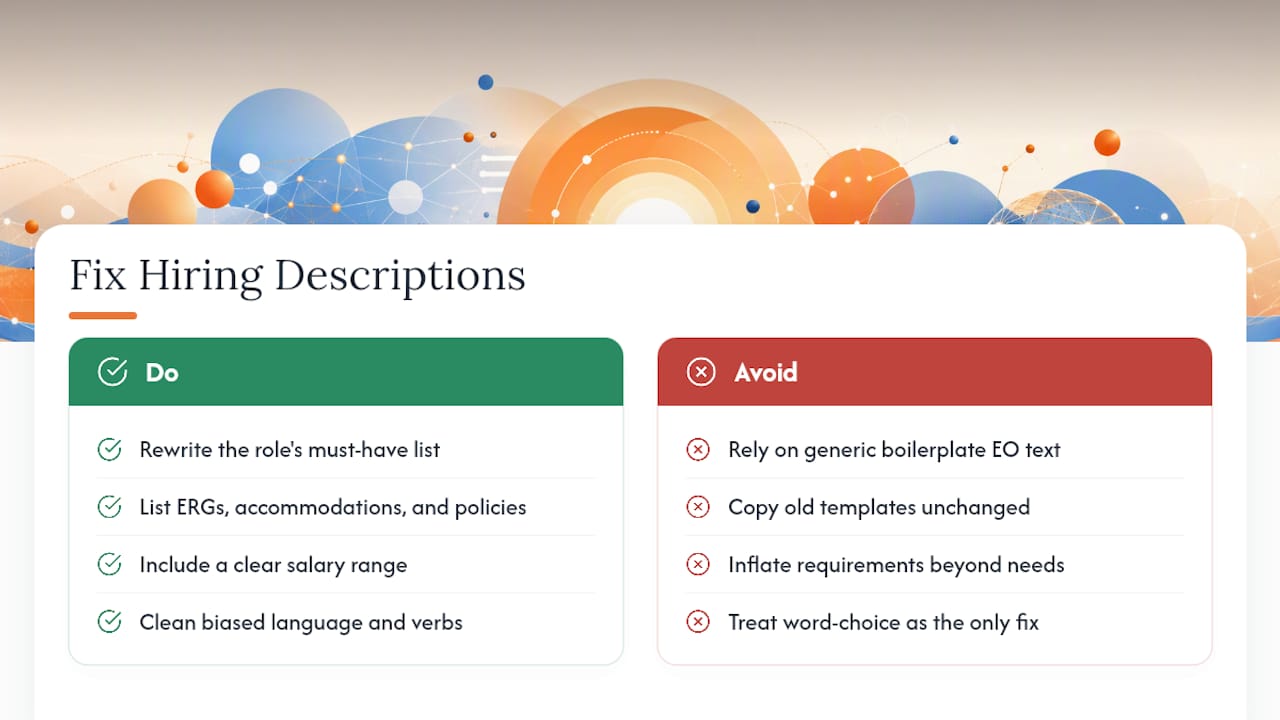
What’s overrated is treating a generic equal-opportunity statement as the finish line. It reads as boilerplate because it usually is. Candidates, especially ones from underrepresented groups who’ve been burned by empty promises before, notice the difference between “we value diversity” and a specific list of ERGs, accommodation processes, and flexible policies.
If you do only one thing after reading this, rewrite your must-have list. Most postings inflate it far beyond what the role actually requires, and that inflation is what quietly filters out the candidates you claim you want to reach. Fix that first. The language cleanup and the salary range matter too, but they’re easier fixes once the requirements themselves are honest.
Sources
- Office for Access and Equity — Writing Inclusive Job Descriptions & Position Announcements (University of Illinois)
- U.S. Equal Employment Opportunity Commission (EEOC)