
Mental health in business: a guide for LGBTQ+ professionals
May 14, 2026Walking into a Monday morning meeting while managing anxiety, depression, or the quiet weight of concealing your identity is not a niche experience. For LGBTQ+ professionals, mental health in the business environment carries layers that most workplace wellness programs were never designed to address. Mental health conditions cause significant lost workdays in businesses across every sector, yet the specific pressures on LGBTQ+ employees, from discrimination to the exhausting performance of being someone you are not, remain largely invisible in corporate strategy. This guide changes that.

Understanding mental health challenges in the workplace for LGBTQ+ professionals
The conversation about employee mental health in corporate settings has grown louder in recent years. But volume is not the same as depth. Most workplace mental wellness initiatives still treat mental health as a personal issue rather than a product of the environment employees work in every day. For LGBTQ+ professionals, that environment can include microaggressions, exclusion from informal networks, fear of being outed, and the constant calculation of how much of yourself is safe to reveal.
The data is clear. 54% of LGBTQIA+ people say that not being able to bring their whole self to work directly affects their productivity and mental health. That is not a soft finding. It means that a significant portion of your LGBTQ+ colleagues are operating at reduced capacity not because of personal failings, but because the workplace itself is not safe enough for authenticity.
Key mental health stressors for LGBTQ+ employees at work:
- Lack of psychological safety, meaning the fear that being open about identity will lead to judgment or professional consequences
- Workplace discrimination and harassment, which remain documented contributors to burnout and anxiety
- Financial stress compounded by wage gaps that disproportionately affect LGBTQ+ workers
- Higher rates of burnout among younger employees and those from multiple marginalized groups
- Social isolation when company culture centers heteronormative or cisnormative norms
The business impact of ignoring these realities is measurable. Absenteeism tied to mental health conditions is rising across industries, and companies that fail to address the root causes, not just the symptoms, are paying for it in turnover costs and lost institutional knowledge.
Preparing your business to support mental health inclusively
Preparation is where most companies stall. They announce a mental health day or add a meditation app to their benefits package and call it done. Real preparation for business mental well-being, especially for LGBTQ+ employees, requires structural decisions made before a crisis occurs.
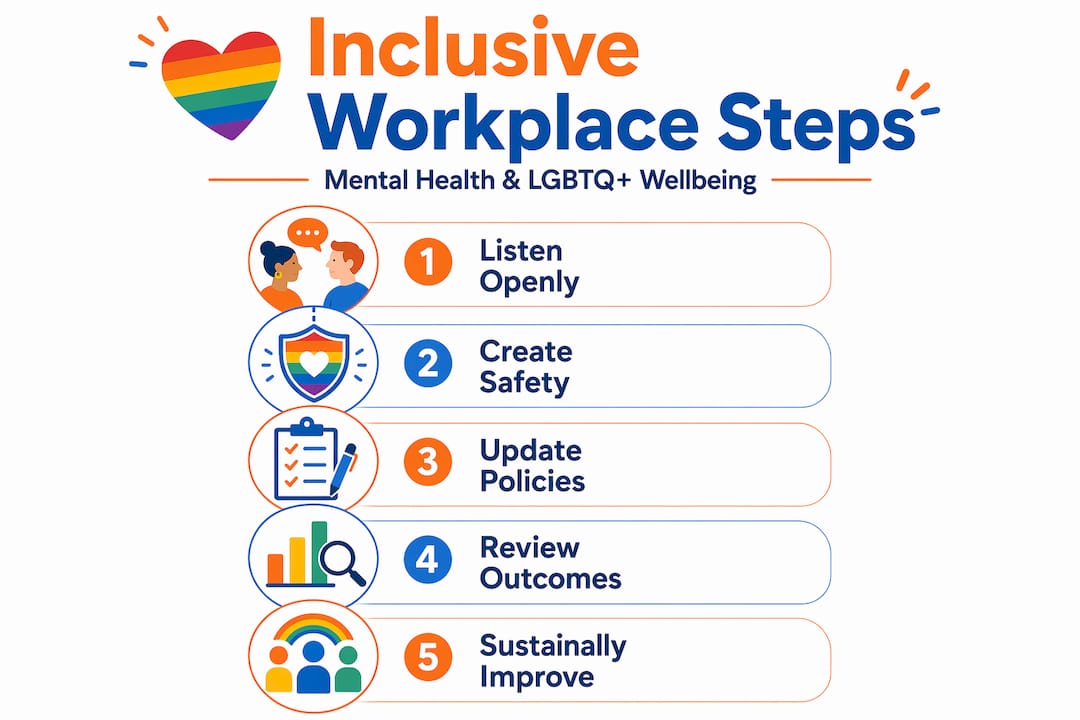
Steps to build an inclusive mental health foundation:
- Write inclusive mental health policies that explicitly name LGBTQ+ identities as protected and valued. Vague language about “all employees” is not enough when your LGBTQ+ staff have reason to doubt it applies to them.
- Implement a confidential Employee Assistance Program (EAP) that offers free short-term counseling with providers trained in LGBTQ+ issues. An EAP is only useful if employees trust it.
- Communicate benefits clearly and repeatedly. Many employees do not use mental health benefits simply because they do not know what is available or how to access it. Effective mental health support requires removing practical barriers like time, cost, and confusion about resources.
- Train managers on mental health conversations. A manager who responds poorly to an employee disclosure can cause more harm than no support at all. Training should cover active listening, appropriate referrals, and strict confidentiality.
- Audit your benefits for access barriers. Does your EAP require a phone call during business hours? Does your counseling benefit have a high copay? These friction points disproportionately affect employees already stretched thin.
Common barriers employees face when accessing mental health care:
- Stigma about being seen as weak or unstable
- Uncertainty about whether information will stay private
- Limited provider availability, especially LGBTQ+ affirming therapists
- Cost and time constraints that make appointments feel impossible
Confidentiality and proper handling of mental health information are foundational to building trust, particularly among LGBTQ+ employees who have learned through experience that disclosure carries risk.

Pro Tip: Survey your employees anonymously about whether they feel mental health resources are accessible and relevant to their needs. LGBTQ+ employees often have specific concerns that a generic benefits survey will not surface.
The goal of preparation is not to have a policy document. It is to create conditions where an LGBTQ+ employee who is struggling actually believes that asking for help is safe. That belief is built through LGBTQ+ support workflows that are visible, consistent, and backed by real organizational commitment.
Executing inclusive mental health initiatives in corporate settings
Having a plan is not the same as running one. Execution is where promoting mental health at work becomes real, and where the gap between intention and impact becomes obvious.
How to execute mental health initiatives that work for LGBTQ+ employees:
- Enforce anti-discrimination and anti-harassment policies with actual consequences. A policy that exists on paper but is never enforced tells LGBTQ+ employees exactly how safe they are. Fair and inclusive workplace actions prevent harassment, reduce occupational stress, and improve recovery outcomes.
- Secure visible leadership commitment. When senior leaders speak openly about mental health and inclusion, it shifts the culture. This is not about performative statements. It is about leaders modeling the behavior they want to see.
- Use mental health training programs that include LGBTQ+ specific content. Generic mental health first aid training is a start, but it will not address the specific stressors that LGBTQ+ employees face. Look for programs that address identity-based stress, minority stress theory, and the intersection of identity and mental health.
- Build flexible accommodations into your processes. Employees in mental health crises need options, not just sympathy. Modified schedules, remote work, reduced workloads, and leave are all tools that should be available without bureaucratic obstacles.
- Create visible peer support networks. LGBTQ+ employee resource groups (ERGs) that have a mental health focus give employees a place to connect with people who understand their experience. Pair this with trained mental health first aiders who are known, accessible, and trusted.
What effective execution looks like vs. what it does not:
Pro Tip: Pair your mental health first aiders with your LGBTQ+ ERG leadership. When employees know they can go to someone who understands both mental health and LGBTQ+ experience, they are far more likely to actually reach out.
Inclusive execution also means paying attention to employees who sit at multiple intersections. Trans inclusion guidance and resources for neurodiverse employees are not separate tracks. They are part of the same commitment to designing workplaces where every employee can function at their best.
Verifying and sustaining mental health and inclusivity success
Launching a mental health initiative and sustaining it are two very different challenges. Most companies do the first and skip the second. Verification is what separates a genuine mental health strategy for businesses from a one-time campaign.
What to track and how to act on it:
- Utilization data for mental health benefits. If your EAP has a 2% utilization rate, that is not a sign that employees are fine. It is a sign that the program is not trusted or accessible.
- Absenteeism and presenteeism rates broken down by department and demographic where legally permissible. Patterns often reveal where the culture is failing specific groups.
- Exit interview themes. LGBTQ+ employees who leave often cite inclusion and mental health concerns. Tracking these themes over time shows whether your initiatives are working.
- Manager training completion and quality. Training that is completed but not applied is not training. Follow up with scenario-based assessments.
“The most important thing you can do after implementing a mental health program is find out whether the people who need it most are actually using it, and if not, why not.”
Employers must engage in interactive dialogue to provide reasonable accommodations during mental health crises while respecting confidentiality and legal requirements. This means having clear escalation pathways before a crisis occurs, not scrambling to create them in the moment.
Pro Tip: Make the 988 Suicide and Crisis Lifeline visible in your workplace, not just in a policy document. Post it in break rooms, on your intranet, and in manager training materials. Visibility signals that you take crisis seriously.
Sustaining a mentally healthy, inclusive workplace also means supporting employees after they return from mental health leave. Helping employees manage stress and transition back to full workloads requires scheduled check-ins, flexible ramp-up periods, and a manager who knows how to have that conversation without making the employee feel surveilled.
A fresh perspective: why mental health and inclusivity are inseparable in business
Here is the uncomfortable truth that most corporate mental health programs are built to avoid: you cannot fix employee mental health without fixing the workplace. Resilience training, mindfulness apps, and wellness stipends are not wrong. They are just insufficient when the environment itself is the source of harm.
Workplace mental health is inseparable from systemic factors including fair treatment, inclusive culture, and psychosocial risk management. The WHO’s guidance on this is not ambiguous. Yet most companies continue to treat mental health as an individual responsibility and inclusion as a separate diversity initiative. That split is where the strategy fails.
For LGBTQ+ professionals, this is not theoretical. When the workplace is not psychologically safe, the mental health cost is not just personal stress. It is the chronic, compounding effect of minority stress, which is the additional burden that comes from navigating environments that were not designed with your identity in mind. No amount of individual resilience fully offsets a structurally unsafe environment.
The most forward-thinking companies are beginning to treat psychological safety as an auditable workplace control, similar to how ISO 45003 frames psychosocial risk management. That means measuring it, reporting on it, and holding leaders accountable for it. Not as a values statement, but as an operational standard. The companies doing this are not just better places to work for LGBTQ+ employees. They retain more talent, see higher engagement, and build the kind of culture that champions LGBTQ+ talent as a genuine competitive advantage.
The shift required is not complicated, but it is demanding. Stop asking LGBTQ+ employees to be resilient in environments that should not require that level of resilience in the first place. Start treating psychological safety as a design problem, not a personal one.
Discover inclusive professional support and resources at myGwork
Mental health in the business environment does not improve in isolation. It improves when LGBTQ+ professionals and allies have access to the right community, the right resources, and workplaces that are genuinely committed to inclusion.
myGwork is built for exactly that. Whether you are an LGBTQ+ professional navigating a workplace that is not yet where it needs to be, an ally looking to advocate more effectively, or an organization ready to build something better, the myGwork platform connects you to job listings at LGBTQ+ inclusive employers, expert guides on workplace inclusion, mentorship opportunities, and a global community that understands what you are working through. Your mental well-being at work matters, and you deserve a professional network that reflects that.
Frequently asked questions
How does mental health uniquely affect LGBTQ+ employees in business?
LGBTQ+ employees carry the added burden of navigating workplaces where authenticity can feel risky, and 51% report that not being able to be themselves directly harms their productivity and mental health. This is a workplace design problem, not a personal one.
What are common barriers to mental health care access at work?
Employees cite lack of time (43%), cost (42%), and difficulty finding affirming providers as the top reasons they do not use mental health benefits, even when those benefits exist.
What legal protections exist for employees with mental health conditions?
Laws like the ADA and FMLA may require employers to provide reasonable accommodations such as modified schedules or leave, while maintaining strict confidentiality of mental health information.
How can managers best support employees experiencing a mental health crisis?
Managers should recognize behavioral warning signs early, use non-judgmental language, and follow crisis protocols that connect employees to professional resources while protecting their privacy.
Why is psychological safety important in workplaces for LGBTQ+ mental health?
When LGBTQ+ employees feel psychologically safe, they can be authentic without fear of professional consequences, which directly improves both their mental health and their engagement at work.