
The Real Role of Workplace Pride Events in 2026
June 25, 2026Workplace pride events are defined as intentional, visible organizational activities that affirm LGBTQ+ inclusion and signal credible support to employees. The role of workplace pride events goes well beyond rainbow logos in june. When executed with purpose, these programs reduce stigma, build belonging, and drive measurable employee engagement. Research from the HRC Foundation’s Corporate Equality Index, Workplace Pride, and the American Journal of Management confirms that Pride programming is one of the most visible and effective tools organizations have for demonstrating year-round inclusion commitment.

How workplace pride events build belonging and reduce stigma

Belonging at work is not a soft metric. Higher belonging is directly linked to fewer harmful workplace behaviors and lower rates of employees leaving, according to research validating the Belonging at Work Scale. That connection matters because Pride events, when designed well, are one of the fastest ways to move the belonging needle for LGBTQ+ employees.
The stigma data is equally clear. Employees at organizations that maintain inclusion practices, including Pride events, report stigma or bias at 24.9%, compared to 54.2% at organizations that have rolled back DEI efforts. That gap is not marginal. It represents the difference between an employee who feels safe being visible at work and one who actively hides their identity.
Social identity research explains the mechanism. Participation in Pride facilitates shared rituals that reinforce group solidarity and in-group identity, according to Frontiers research applying social identity theory. When employees participate together in a Pride event, they are not just attending a celebration. They are forming a shared identity that carries into daily work interactions.
Visible, credible Pride programming also changes how employees respond to uncertainty. Rather than going quiet or disengaging, employees at organizations with consistent inclusion practices increase engagement when they see visible support. That behavioral shift is the core business case for investing in Pride events.
“Pride events are not a perk. They are a signal. When employees see their organization show up publicly and consistently, they decide whether it is safe to show up too.”
What separates meaningful Pride events from performative ones
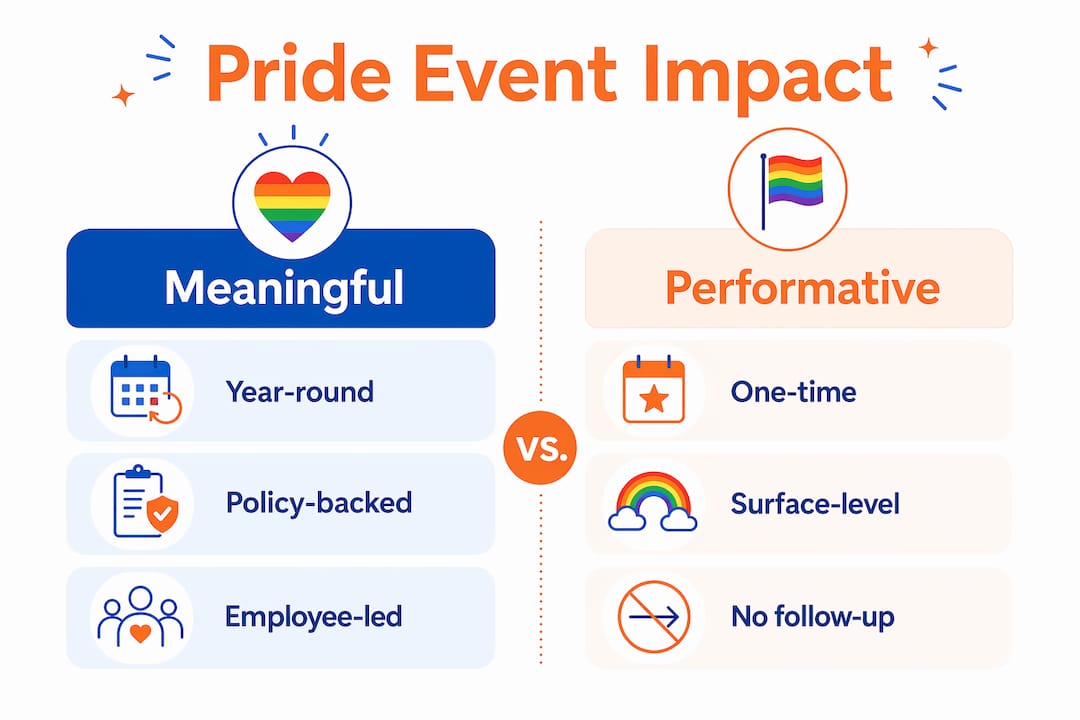
Performative Pride is a real risk. When organizations abandon DEI practices, employees reduce their visibility and engagement, according to HRC Foundation 2026 findings. A Pride event that is not backed by credible year-round inclusion policy does not just fail to help. It can actively increase distrust and disengagement.
The difference between impactful and performative Pride comes down to three factors:
- Year-round policy credibility. Pride events must sit inside a broader framework of non-discrimination policies, bias training, and LGBTQ+ employee support programs. Without that foundation, a june celebration reads as marketing, not commitment.
- Intersectional co-creation. Workplace Pride’s QPOC Vision Paper calls for safe storytelling spaces and event design that centers underrepresented groups within the LGBTQ+ community. Planning a Pride event without input from queer people of color, transgender employees, or non-binary staff produces a celebration that excludes the people it claims to honor.
- Measurable belonging outcomes. Effective Pride programming sets clear goals around belonging, participation rates, and post-event sentiment. Organizations that measure impact can iterate and improve. Those that do not are guessing.
Pro Tip: Before planning your next Pride event, audit your existing inclusion policies. If your non-discrimination policy, parental leave benefits, and gender-affirming healthcare coverage are not in place, address those first. The event will land differently when the policy foundation is credible.
The HRC Corporate Equality Index scores organizations on exactly this kind of policy depth. Using it as a benchmarking tool before and after Pride programming gives organizations an objective measure of where they stand.
How Pride events fit within broader workplace diversity initiatives
Pride events do not operate in isolation. They work best as one visible component of a wider set of workplace diversity initiatives that include non-discrimination policies, bias training, employee resource groups (ERGs), and LGBTQ+ mentorship programs. Each element reinforces the others.
The generational data on this is striking. A longitudinal study of more than 7,700 employees published in the American Journal of Management found consistent approval of non-discriminatory LGBTQ+ employer practices across all generational cohorts from 2018 to 2024. Inclusion is not a generational preference. It is a baseline expectation across the workforce.
Pride events also carry direct weight in talent acquisition. Visible LGBTQ+ leaders and consistent year-round support strongly influence LGBTQ+ talent recruitment and retention, according to Mygwork research. Organizations that treat Pride as a public signal of their culture attract candidates who are evaluating exactly that signal. Candidates researching inclusive LGBTQ+ workplaces look for visible evidence of commitment, and Pride events are among the most searchable and shareable proof points available.
One often overlooked dimension is safety and accessibility funding. The Canadian federal government invested $7.5 million over five years for Pride festivals to address rising security costs, improving safety and accessibility for 4.7 million participants. That investment reflects a broader truth: safety infrastructure is inclusion infrastructure. Organizations that budget for security, accessibility accommodations, and emergency readiness at Pride events are making a concrete statement about who they want to show up.
How to celebrate pride at work: practical planning guidance
Effective Pride programming starts months before june. Early planning gives organizations time to involve diverse employee voices, secure safety logistics, and build communications that reach employees across locations and work arrangements.
The most impactful programs share several characteristics:
- Hybrid participation models. Not every employee can or will attend an in-person event. Offering virtual participation options, recorded storytelling sessions, and digital ally signals allows employees who are not yet out to engage safely without forced visibility.
- Storytelling spaces with clear safety norms. Sharing personal experiences builds the social bonds that reinforce belonging, but only when employees trust the space. Establish clear guidelines before any storytelling session and give employees the option to share anonymously.
- Diverse planning committees. Invite employees from across LGBTQ+ identities, including transgender, non-binary, bisexual, and queer people of color, to co-design the program. The intersectional approach recommended by Workplace Pride is not optional for organizations that want genuine impact.
- Safety and accessibility budgeting. Treat venue accessibility, security staffing, and emergency protocols as core line items, not afterthoughts. The Canadian federal investment in Pride safety underscores that physical safety is a prerequisite for participation.
- Integration with ERGs and year-round programs. Pride events that connect directly to existing LGBTQ+ ERGs, mentorship programs, and inclusion calendars have a longer impact window. A standalone event fades. A program that feeds into ongoing community does not.
Pro Tip: Plan a post-event debrief with your planning committee within two weeks of the event. Collect participation data, post-event belonging survey scores, and qualitative feedback from diverse employee groups. Use that data to set a higher baseline for next year.
Organizations looking for practical event planning frameworks can also draw from community-focused resources. Guides on inclusive Pride planning offer operational checklists that translate well to workplace settings, particularly for hybrid and multi-site organizations.
Key Takeaways
Workplace pride events reduce stigma and build belonging only when they are backed by credible year-round inclusion policies, intersectional co-creation, and measurable outcomes.
Why most Pride programs miss the point
Pride programming tends to fail in a predictable way. Organizations plan a great event in june, collect positive feedback, and then go quiet for eleven months. The next year, they repeat the cycle. Employees notice. LGBTQ+ workers are particularly attuned to the gap between celebration and policy, because many of them have experienced that gap personally.
The research I find most clarifying is the stigma data from the HRC Foundation. A 30-point gap in reported bias between organizations that maintain inclusion practices and those that roll back DEI is not a nuance. It is a structural outcome. Pride events are part of what creates that gap, but only when they sit inside a system of credible, consistent support.
The intersectionality piece is where I see the most room for improvement in 2026. Most Pride programs still center a relatively narrow slice of the LGBTQ+ community. Queer people of color, transgender employees, and non-binary workers often describe feeling like guests at someone else’s celebration. The Workplace Pride QPOC Vision Paper names this directly and offers a practical path forward. Co-creation is not a nice-to-have. It is the difference between an event that builds belonging and one that reinforces existing hierarchies within the LGBTQ+ community itself.
The organizations getting this right are treating Pride events the same way they treat any other high-stakes employee program: with clear goals, diverse input, measured outcomes, and a commitment to iteration. That is not complicated. It just requires treating inclusion as a discipline rather than a gesture.
myGwork: connecting organizations with LGBTQ+ inclusive talent
myGwork is the global professional network built specifically for LGBTQ+ professionals, allies, and the organizations committed to including them.
For organizations planning Pride events and building year-round inclusion programs, myGwork offers direct access to LGBTQ+ talent, employer branding tools, and a network of inclusion-focused partners. Whether you are looking to hire diverse talent or signal your organization’s commitment to LGBTQ+ employees, myGwork connects the right people with the right employers. The platform also provides educational resources, mentorship programs, and community events that extend the impact of Pride programming well beyond june. Organizations that want to move from performative celebration to credible inclusion have a practical starting point here.
FAQ
What is the role of workplace pride events?
Workplace pride events serve as visible, intentional signals of an organization’s commitment to LGBTQ+ inclusion. They build employee belonging, reduce stigma, and reinforce the credibility of broader diversity initiatives.
Do Pride events actually reduce workplace bias?
Yes. Employees at organizations that maintain Pride and inclusion practices report bias at 24.9%, compared to 54.2% at organizations that have scaled back DEI efforts, according to the HRC Foundation’s 2026 Corporate Equality Index.
How do you make Pride events more than performative?
Pair Pride events with year-round non-discrimination policies, bias training, and LGBTQ+ support programs. Co-create event content with diverse LGBTQ+ employees, including queer people of color and transgender staff, and measure belonging outcomes after each event.
How does Pride programming support employee engagement?
Visible Pride programming encourages LGBTQ+ employees to increase engagement rather than disengage, particularly in uncertain social climates. Shared rituals at Pride events reinforce group identity and belonging, which links directly to stronger workplace participation.
Why does safety matter for workplace Pride events?
Safety is a prerequisite for participation. The Canadian federal government invested $7.5 million over five years specifically to address security and accessibility costs for Pride festivals serving 4.7 million participants. Organizations that budget for safety at Pride events signal that inclusion extends to physical presence, not just policy language.