
How to spot truly inclusive LGBTQ+ friendly workplaces
May 6, 2026
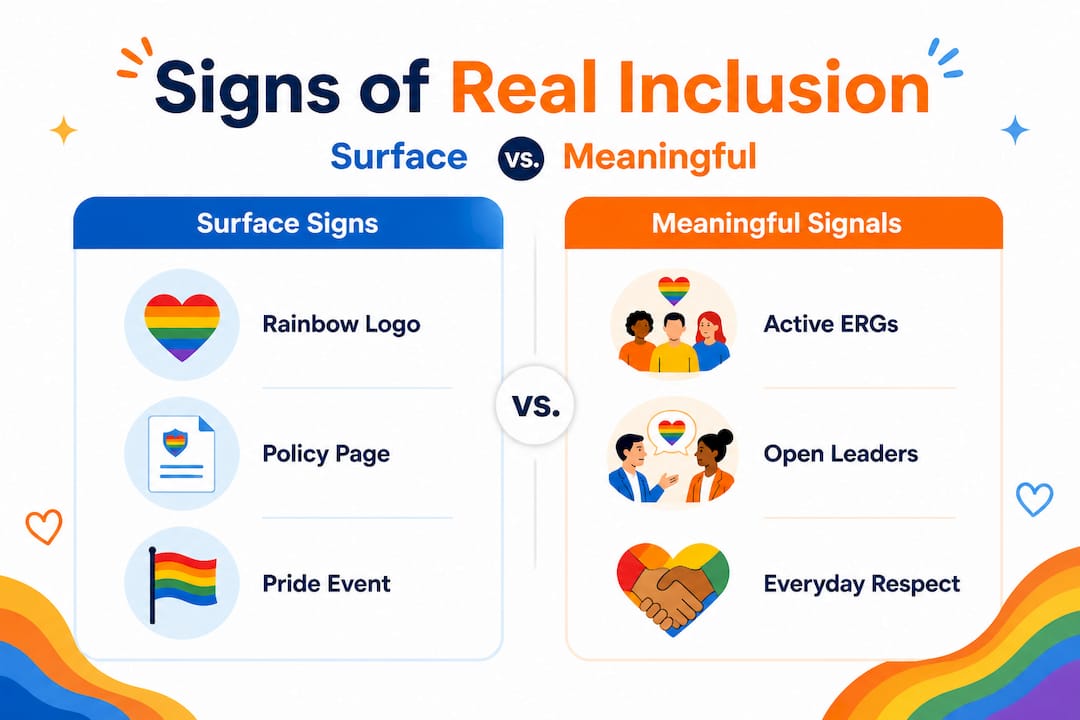
A rainbow logo during Pride Month does not make a workplace inclusive. Many organizations display the right symbols, publish the right policies, and still leave LGBTQ+ employees feeling invisible, undervalued, or afraid to speak up. Real inclusion, as GitLab’s culture handbook puts it, means ensuring people feel valued, can participate fully, and genuinely belong — not just that they are represented on a diversity slide. This article breaks down how to tell the difference, what to look for as a job seeker or employee, and how organizations can move from optics to actual belonging.
Key Takeaways
What does ‘friendly’ really mean for LGBTQ+ professionals?
Let’s start with a definition problem. Most people use “LGBTQ±friendly” to mean a company that does not actively discriminate. That is a very low bar. True friendliness in a workplace context means something much more specific: an environment where LGBTQ+ employees can participate fully, share ideas without fear, and advance their careers on merit rather than despite their identity.
Diversity vs. inclusion is a distinction worth understanding clearly. Diversity means having people from different backgrounds in the room. Inclusion means those people are heard, respected, and able to contribute equally. You can have one without the other. A company might hire a diverse workforce and still have a culture where LGBTQ+ employees self-censor, avoid mentioning their partners, or skip company events because they feel unwelcome. As GitLab’s inclusion framework states, inclusion is about being valued and able to participate, not just being present.
The fear factor is central here. When LGBTQ+ employees worry about bias or discrimination, they spend cognitive energy managing their identity instead of doing their best work. That fear is not hypothetical. It shapes daily decisions: whether to mention a same-sex partner at a team lunch, whether to correct a colleague who uses the wrong pronoun, whether to apply for a promotion at all. A truly friendly workplace removes that fear systematically, not just through a written policy, but through everyday behavior and leadership modeling.
Here is a quick comparison of token gestures versus genuine inclusion:
“Inclusion is not a destination you arrive at. It is a daily practice of making sure every person in your organization can show up, speak up, and grow.”
Pro Tip: When evaluating a company, do not just read the policy page. Ask a current or former employee what inclusion looks like on a Tuesday afternoon, not during Pride Month.
Efforts around fostering LGBTQ+ inclusion through targeted bias training show that organizations willing to invest in structured, ongoing education create measurably safer environments than those relying on annual checkbox training alone.
How organizations signal true LGBTQ+ inclusion (and how to spot it)
Once you know the difference between surface-level friendliness and genuine belonging, you can start reading organizational signals more accurately. This matters whether you are a job seeker evaluating offers, an employee deciding whether to stay, or an HR leader benchmarking your own culture.
Genuine inclusion shows up in specific, observable ways:
- Visible LGBTQ+ leaders. When LGBTQ+ people hold senior roles and are openly supported, it signals that identity is not a career liability. Research shows that visible LGBTQ+ leaders influence the job choices of 84% of LGBTQ+ graduates. That is not a soft metric. That is a direct pipeline signal.
- Structured support programs. Employee resource groups (ERGs), mentoring programs, and formal allyship training are not just nice to have. Organizations that implement a structured LGBTQ+ support program workflow see retention improve by up to 35%. That is a business result, not just a culture benefit.
- Pay and benefits transparency. Equitable pay is a concrete signal of inclusion. If a company cannot tell you how compensation is structured or whether benefits extend equally to same-sex partners, that silence is telling.
- Behavioral norms, not just written policies. Watch how people actually interact. Do leaders use inclusive language? Do meetings include everyone? Are microaggressions addressed or ignored?
- Mental health support. Access to mental health support that explicitly covers LGBTQ+ experiences, including gender dysphoria, relationship stress, and identity-related anxiety, is a meaningful differentiator.
Belonging, as GitLab’s framework defines it, is about feeling your insights and contributions are valued. That feeling does not come from a policy document. It comes from repeated, consistent experiences of being heard.
Red flags to watch for:
- Leadership that is entirely non-LGBTQ+ with no visible representation
- Vague answers when you ask about LGBTQ+ specific benefits or ERGs
- Performative Pride Month activity with no year-round programming
- Secrecy around pay equity data or promotion rates
- High turnover among LGBTQ+ employees (ask about this directly if you can)
Questions to ask in interviews:
- “Can you describe what your LGBTQ+ employee resource group does on a typical month?”
- “How does the company handle reports of bias or discrimination?”
- “Are same-sex partner benefits equal to those for heterosexual couples?”
- “Who are the LGBTQ+ leaders in this organization?”
These questions do two things. They give you real information, and they signal to the employer that you take inclusion seriously.
How a friendly culture drives career growth and retention
After recognizing the signs, here is why it matters: inclusive workplaces directly affect your professional journey in measurable ways.

The connection between inclusion and career growth is not abstract. When LGBTQ+ employees feel safe, they participate more, take on visible projects, build stronger networks, and advance faster. Fear-free, supportive cultures enable full career participation and better decision-making. The reverse is also true: when employees spend energy hiding their identity, they have less capacity for the work that drives advancement.
Key data points that illustrate the stakes:
- Pay transparency has been linked to a 7% reduction in the wage gap for LGBTQ+ workers, showing that structural changes have direct financial impact.
- Organizations that actively celebrate and support Pride see 25% better retention among LGBTQ+ employees compared to those that do not.
- Political and social shifts are reshaping career decisions: 1 in 3 LGBTQ+ graduates have reconsidered their career path because of recent political and social changes, according to myGwork’s 2026 student and graduate survey.
These numbers matter for organizations too. High turnover is expensive. Replacing an employee typically costs between 50% and 200% of their annual salary, depending on their seniority. If LGBTQ+ employees are leaving because they do not feel included, that is a direct financial loss that shows up in recruitment, onboarding, and lost institutional knowledge.
What inclusion looks like for career progression:
- LGBTQ+ employees in inclusive environments are more likely to apply for stretch assignments and leadership roles
- They report higher job satisfaction and lower burnout rates
- They are more likely to recommend their employer to peers, which strengthens talent pipelines
- They build stronger internal networks because they are not managing a double life at work
Pro Tip: If you are evaluating a new role, ask specifically about career progression data for LGBTQ+ employees. A company confident in its inclusion record will have this information and share it willingly.
For organizations, the pitfall of ignoring inclusion is not just reputational. It is structural. Companies that fail to build genuinely inclusive cultures lose access to a significant talent pool, face higher turnover costs, and miss the innovation benefits that come from diverse, psychologically safe teams.
Actions for professionals and organizations: Building and supporting friendly workplaces
Ready to take action? Whether you are an individual or a decision-maker, here is how you can drive real progress.
For LGBTQ+ professionals:
- Research before you apply. Use platforms like myGwork to identify employers with verified inclusion commitments. Read employee reviews that specifically mention LGBTQ+ experiences.
- Ask the hard questions in interviews. Use the checklist from the previous section. An employer’s response tells you as much as the answer itself.
- Connect with ERGs early. If a company has an LGBTQ+ employee resource group, reach out before you even accept an offer. Current members will give you an honest picture.
- Build your network intentionally. Connect with LGBTQ+ professionals in your field who can share their experiences at specific companies.
- Advocate from within. Once you are in a role, use your voice. Share feedback through formal channels and informal conversations. Your experience is data.
For organizations and allies:
- Conduct regular, anonymous surveys that specifically ask LGBTQ+ employees about their sense of belonging and safety
- Ensure LGBTQ+ representation at the leadership level, not just in entry-level roles
- Make pay equity data visible and act on gaps
- Train managers specifically on LGBTQ+ inclusion, not just general diversity
- Create formal feedback loops so employees can report concerns without fear of retaliation
- Invest in employee wellbeing programs that explicitly address LGBTQ+ mental health needs
As GitLab’s inclusion principles emphasize, active recognition, respect, and valuing of differences are central to real inclusion. That means going beyond tolerance to active appreciation of what different identities and experiences bring to a team.
Insights from championing LGBTQ+ talent show that organizations with dedicated advocates in senior roles see faster culture change than those relying on bottom-up pressure alone. Leadership commitment is not optional. It is the accelerator.
Organizations like Marsh have shown what it looks like to reimagine support for LGBTQ+ colleagues by building structured, ongoing programs rather than one-off initiatives. The lesson is consistency. Inclusion that only shows up during awareness months is not inclusion. It is marketing.
Pro Tip: For organizations, the most powerful inclusion signal is not a policy. It is a senior leader who openly shares their own experience with inclusion challenges and models the behavior they want to see across the company.
Why real inclusion is still rare — and what most organizations miss
Here is an uncomfortable truth: most workplaces that call themselves LGBTQ±friendly are not lying. They genuinely believe they are inclusive. That gap between belief and reality is where most inclusion efforts fail.
The problem is that organizations measure what is easy to measure. They count ERG members, track training completion rates, and report on the number of LGBTQ+ hires. What they rarely measure is the day-to-day experience of belonging. Do LGBTQ+ employees feel comfortable correcting a wrong pronoun in a team meeting? Do they mention their partners in casual conversation without calculating the risk? Do they apply for the same promotions as their non-LGBTQ+ peers?
Those micro-moments of inclusion or exclusion accumulate over time. They shape whether someone thrives or quietly disengages. And they are almost never captured in a policy audit.
Inclusion is not a box-ticking exercise but requires an ongoing commitment to value differences. That ongoing commitment is exactly what most organizations fail to sustain. They launch an initiative, see initial positive feedback, and then move on to the next priority. Inclusion falls off the agenda until the next Pride Month or the next high-profile departure.
What actually moves the needle is accountability at the manager level. Not just senior leadership statements, but the direct manager who sets the tone in every team meeting, every performance review, and every hallway conversation. When managers are trained, measured, and held accountable for inclusive behavior, culture changes. When they are not, policy documents collect dust.
We have seen positive LGBTQ+ stories emerge from organizations that made this shift. The common thread is not a bigger budget or a more sophisticated program. It is a genuine, sustained commitment from people with power to use that power differently.
The organizations that get this right treat inclusion not as a project with a deadline, but as a standard of professional conduct. Just like financial integrity or customer service quality, it is something you maintain, measure, and improve continuously.
Find and foster your inclusive workplace community
If this article has made one thing clear, it is that finding a truly inclusive workplace takes more than reading a company’s diversity page. It takes access to real information, real connections, and a community that understands your experience.
myGwork exists precisely for this. As a global professional networking platform built for LGBTQ+ individuals, allies, and inclusive organizations, myGwork connects you to job listings at verified inclusive employers, mentorship programs, networking events, and a community of professionals who share your commitment to belonging. For organizations, myGwork offers a direct channel to attract LGBTQ+ talent and demonstrate inclusion in a credible, specific way. Whether you are searching for your next role, looking to grow your network, or building a more inclusive team, myGwork is where that work happens. Join the community and take your next step with confidence.
Frequently asked questions
How do I know if a company is truly LGBTQ±friendly?
Look for visible representation at leadership levels, explicit support programs like ERGs, open communication about inclusion data, and evidence that employees feel safe participating fully. Inclusion is about whether people feel valued and can genuinely belong, not just whether a policy exists.
What should organizations do beyond policies to be inclusive?
Foster everyday practices that value differences, ensure all voices are heard in meetings and decisions, and build ongoing feedback systems that LGBTQ+ employees can use safely. Inclusion requires recognizing, respecting, and actively valuing differences as a continuous practice, not a one-time initiative.
Why does inclusion matter for career advancement?
Inclusive environments reduce the fear of discrimination and enable full participation in the opportunities that drive career growth. When LGBTQ+ professionals are not spending energy managing their identity at work, that environment enables better decision-making and stronger career participation.
How can allies help create a friendly environment?
Allies can listen actively, speak up when they witness bias or exclusion, and advocate for policies and leadership behaviors that promote belonging and representation. Consistent, everyday allyship has more impact than public statements made only during awareness events.
Recommended
- 84% say visible LGBTQ+ leaders influence their job choices – does your organization qualify?
- Bias Training: Fostering LGBTQ+ Workplace Inclusion
- LGBTQ+ support program workflow boosts retention 35%
- 1 in 3 LGBTQ+ graduates have reconsidered career paths due to recent political shifts, myGwork survey finds
- Networking LGBTQIA+ à Paris : guide pour réussir · Vibes 🏳️🌈