
The Role of Employee Networks in Workplace Inclusion
June 4, 2026Employee networks are voluntary, employee-led groups organized around shared identities, experiences, or professional interests, and they are one of the most direct mechanisms organizations have for building genuine inclusion. The role of employee networks extends well beyond social connection. These groups influence hiring, retention, policy, and culture in ways that individual programs rarely match. About 90% of Fortune 500 companies have established employee resource groups (ERGs), which signals that organizational leaders have recognized their strategic value. For LGBTQ+ professionals and their allies, platforms like myGwork exist precisely because networks built around shared identity create belonging that generic workplace programs cannot replicate.

How do employee networks contribute to diversity, inclusion, and engagement?
Employee networks create the conditions for psychological safety, which is the foundation of any genuinely inclusive workplace. When employees see a group that reflects their identity or experience, they are more likely to stay, contribute, and grow within the organization. The benefits of employee networks are not abstract. They show up in measurable outcomes like retention rates, promotion pipelines, and employee satisfaction scores.
These groups serve four distinct functions inside organizations:
- Voice and advocacy: Networks represent minoritized or underrepresented groups in conversations about policy, benefits, and workplace culture. Staff networks act as a vehicle for organizational change by surfacing issues that formal HR channels often miss.
- Career development: Members gain access to mentors, sponsors, and cross-functional relationships that accelerate professional growth, particularly for employees who lack access to informal power networks.
- Recruitment support: Networks help organizations attract diverse candidates by demonstrating authentic commitment to inclusion. A job listing backed by an active LGBTQ+ ERG carries more credibility than a diversity statement alone.
- Community and support: Networks provide safe spaces for employees navigating identity-related challenges at work, including discrimination, microaggressions, and the emotional labor of code-switching.
One underappreciated challenge is intersectionality. Employees who hold multiple marginalized identities, such as a Black transgender woman or a disabled LGBTQ+ professional, may find that single-identity networks do not fully address their experience. Organizations that acknowledge this complexity and create space for cross-network collaboration see stronger engagement outcomes.
Pro Tip: Invite network leaders to present at senior leadership meetings at least twice a year. Visibility at the top signals that the network has real organizational standing, not just social permission to exist.

What factors determine the success and impact of employee networks?
Not all employee networks deliver the same results. The difference between a thriving network and a stagnant one comes down to intentional design, not enthusiasm. Harvard Business School identified the FAIR model as key to ERG impact, built around four dimensions: formality, audience, identities, and resilience.
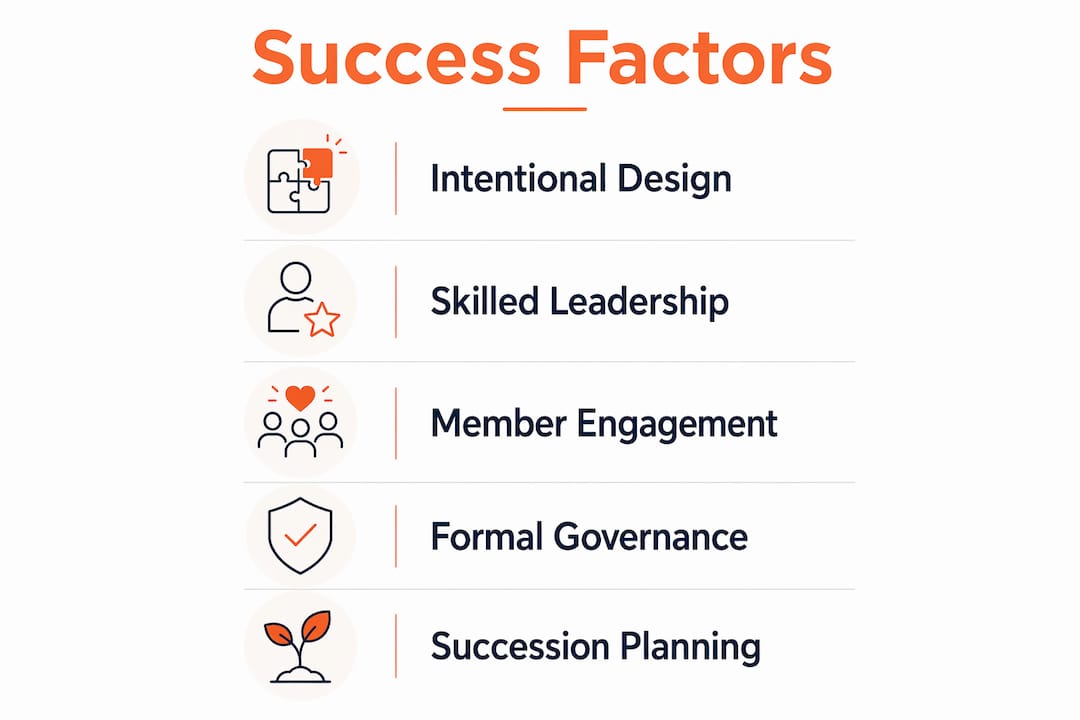
Here is how each dimension plays out in practice:
The formality dimension deserves particular attention. Intentional design of network formality balances daily member needs with visibility to leadership, enabling authentic voice and strategic influence simultaneously. A network that operates only as a social club loses its ability to influence policy. One that operates only as a formal committee loses the trust of its members.
Leadership capability is the second critical factor. ERG leadership requires skills beyond enthusiasm, including stakeholder influence, organizational navigation, and credible communication. Organizations that treat network leadership as a volunteer side project, without training or recognition, consistently underperform those that invest in formal leadership development for ERG chairs.
Pro Tip: Build a leadership transition plan into every network’s governance structure from day one. Succession planning prevents the single-point-of-failure problem that collapses many otherwise strong networks.
How are employee networks assessed and measured for effectiveness?
Measurement is where most organizations fall short. The most common metrics used to evaluate ERGs are event participation, cited by 77.67% of organizations, and membership levels, cited by 65.05%. These numbers are easy to collect but tell you almost nothing about whether the network is actually improving inclusion or retention.
The core problem is a mismatch between what organizations measure and what networks are designed to achieve. Over-reliance on activity metrics risks obscuring true impact, since event counts and headcounts do not capture whether employees feel more included, whether diverse talent is being retained, or whether the network is influencing organizational decisions.
A more useful measurement framework separates inputs, outputs, and outcomes:
The University of Manchester developed the Staff Networks Voice Capabilities Self-Assessment Tool specifically to help networks evaluate their capacity to influence organizational change. This kind of diagnostic tool shifts the conversation from “how many events did we run?” to “how effectively are we representing our members’ interests?”
Organizations should align evaluation methods with the network’s stated purpose. A network focused on career development should track mentorship participation and promotion rates. A network focused on policy advocacy should track how many recommendations were adopted. Measuring the wrong things is not neutral. It actively misleads leaders about where to invest.
What are the differences between employee networks, ERGs, and affinity groups?
The terms employee network, employee resource group, and affinity group are often used interchangeably, but they carry distinct meanings that matter for how you structure and support them. Staff networks differ in membership inclusivity and purpose, though they frequently serve overlapping goals around support and advocacy.
Here is a practical breakdown:
- Affinity groups are the oldest form, originating in the 1960s at Xerox. They are typically organized around a shared identity, such as race, gender, or sexual orientation, and membership is often limited to people who share that identity. The focus is primarily on community and mutual support.
- Employee resource groups (ERGs) evolved from affinity groups and are now the dominant model in large organizations. ERGs are usually open to all employees, including allies, which broadens their reach but can sometimes dilute their focus on the core community they serve.
- Employee networks is the broader umbrella term. It encompasses ERGs, affinity groups, professional interest groups, and cross-functional communities of practice. Not all employee networks are identity-based. Some form around professional disciplines, career stages, or shared experiences like parenthood or military service.
The employee resource groups role in DEI strategy is now well established. What is less understood is that the label matters less than the design. A well-structured affinity group with clear purpose and executive sponsorship will outperform a poorly designed ERG every time. Organizations should choose the model that fits their culture and then invest in making it work, rather than chasing terminology.
How can organizations build, support, and sustain effective employee networks?
Building a network that lasts requires more than a launch event and a Slack channel. The following steps reflect what research and practice show actually works:
- Define the purpose clearly. Every network needs a written statement of purpose that connects to both member needs and organizational goals. Vague missions produce vague results.
- Invest in leadership development. ERGs can serve as leadership development platforms when supported with skills training. Provide ERG chairs with training in facilitation, stakeholder communication, and project management.
- Assign a senior executive sponsor. Sponsors should be active participants, not figureheads. They open doors, advocate for resources, and signal organizational commitment.
- Build governance that scales. Establish clear roles, decision-making processes, and term limits. Governance prevents burnout and ensures continuity.
- Address intersectional identities. Design programs that acknowledge members hold multiple identities. Cross-network collaboration between, for example, an LGBTQ+ ERG and a disability network produces richer outcomes than siloed programming.
- Plan for succession and burnout prevention. Voluntary leadership is demanding. Rotate responsibilities, recognize contributions formally, and monitor for signs of fatigue.
- Know when to evolve or sunset a group. Sunsetting ERGs strategically through listening sessions with members can rebuild trust and refocus organizational energy. Ending a network is not failure. Keeping a hollow one running is.
Pro Tip: Use a diagnostic tool like the Staff Networks Voice Capabilities Self-Assessment Tool annually to identify gaps in your network’s capacity before they become crises.
The importance of networking at work is not just about individual career advancement. When organizations treat employee networking strategies as a system rather than a collection of individual groups, the cumulative impact on culture, retention, and innovation is substantially larger. Explore how diverse leadership drives inclusion to understand how network leadership connects to broader organizational outcomes.
Key takeaways
Employee networks deliver their greatest impact when organizations invest in intentional design, skilled leadership, and outcome-based measurement rather than treating them as self-sustaining volunteer programs.
Why I think most organizations are still getting employee networks wrong
I have spent years watching organizations launch ERGs with genuine enthusiasm and then quietly let them stagnate. The pattern is consistent. A founding leader drives the group forward through sheer personal commitment. The organization provides minimal resources and no formal training. When that leader moves on or burns out, the network collapses. Leadership then concludes that “employees weren’t that interested” rather than examining what the organization failed to provide.
The research is clear that ERG effectiveness depends not on existence but on how networks are nurtured and balanced with organizational needs. Yet many CHROs still treat ERGs as a low-cost diversity signal rather than a strategic asset. Some CHROs express concerns about ERGs not demonstrating business impact. The honest response to that concern is that organizations designed the measurement systems that produce that result.
The most underutilized opportunity I see is using ERGs as leadership pipelines. When a mid-career LGBTQ+ professional chairs an ERG and learns to navigate executive stakeholders, build coalitions, and communicate business impact, that person is developing skills that translate directly into senior leadership. Organizations that recognize this and formalize it gain a talent development advantage that no external program can replicate.
The future of employee networks is not about adding more groups. It is about designing fewer, better-supported networks with clear purposes, real resources, and measurement systems that capture what actually matters. That requires organizational leaders to treat networks as partners, not programs.
— Adrien
Build your inclusive network with myGwork
myGwork is the world’s largest professional platform built specifically for LGBTQ+ talent and the organizations committed to hiring them. For leaders building or strengthening employee networks, myGwork offers direct access to a global community of LGBTQ+ professionals, allyship through employee networks, and resources designed to support genuine inclusion rather than performative diversity. Organizations can list roles, showcase their ERGs, and connect with candidates who are actively seeking workplaces where inclusion is structural, not aspirational. Visit myGwork to explore how the platform supports inclusive hiring and employee network initiatives at every stage of organizational maturity.
FAQ
What is the role of employee networks in an organization?
Employee networks create belonging, amplify underrepresented voices, support career development, and influence organizational policy. They function as both support communities and strategic mechanisms for driving diversity and inclusion outcomes.
How do ERGs differ from affinity groups?
Affinity groups are typically identity-restricted and focused on peer support, while ERGs are usually open to all employees including allies and carry a broader mandate that includes business impact and organizational advocacy.
What metrics should organizations use to evaluate ERG success?
Organizations should track outcome-based metrics like retention rates, promotion rates, and inclusion survey scores rather than relying solely on event participation and membership counts, which measure activity rather than impact.
How can leaders prevent ERG burnout?
Rotate leadership responsibilities, set term limits, provide formal training and recognition, and build succession plans into governance structures from the start. Treating ERG leadership as a career development opportunity rather than an unpaid obligation reduces attrition significantly.
When should an organization consider sunsetting an ERG?
An ERG should be evaluated for sunsetting when it no longer serves a clear purpose, membership engagement has declined significantly, or organizational priorities have shifted. Conducting listening sessions with members before making a decision preserves trust and surfaces options for restructuring rather than closure.