
The Role of LGBTQ+ Advisory Boards in 2026
July 6, 2026An LGBTQ+ advisory board is defined as a specialized body that provides strategic guidance to organizational or governmental leadership on policies affecting LGBTQ+ communities, without holding direct legislative authority. The role of an LGBTQ+ advisory board is to channel lived experience and expert knowledge into decision-making processes that would otherwise exclude community voices. These boards sit at the intersection of governance and advocacy, making them one of the most practical tools for advancing inclusion at scale. Understanding how they function, why representation matters, and how to build one effectively gives advocates and leaders a real advantage in 2026.

How do LGBTQ+ advisory boards function and influence policy?
LGBTQ+ advisory boards typically operate as specialized liaisons, meeting monthly or quarterly and delivering formal recommendations to leadership. They carry no direct lawmaking power, but their influence on policy direction is real and documented. The board’s value lies in translating community experience into language that decision-makers can act on.

Most boards are composed of 11–16 members, selected for both lived experience and professional skills. That combination matters because policy gaps rarely show up in data alone. A member who has navigated a discriminatory workplace or an inaccessible healthcare system brings a different kind of evidence to the table.
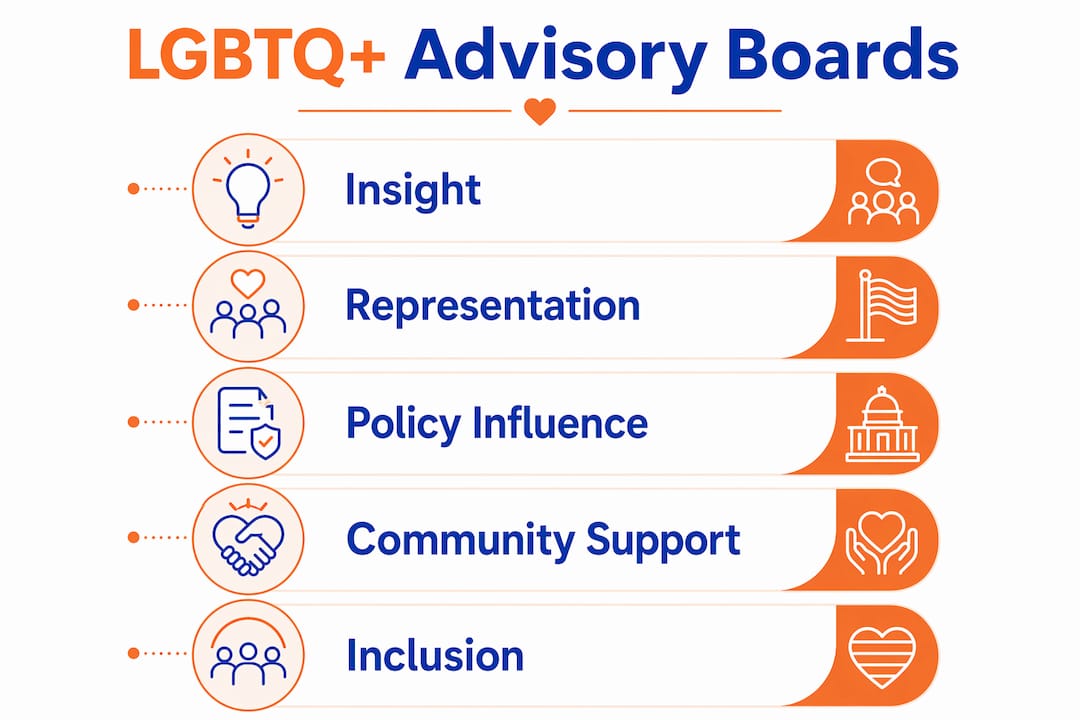
The functions of an LGBTQ+ advisory body typically cover several areas:
- Policy development: Reviewing proposed legislation or organizational policies for gaps that affect LGBTQ+ people
- Suicide prevention and mental health: Advising on programs and resource allocation for at-risk community members
- Inclusive curricula: Recommending changes to educational content and training programs
- Anti-discrimination enforcement: Identifying where existing protections fail in practice
- Community liaison: Acting as a two-way communication channel between leadership and the broader LGBTQ+ community
Cincinnati approved its inaugural LGBTQ+ Advisory Commission in march 2026 with 12 members. The commission was designed explicitly as a bilateral communication channel, not a legislative body. That distinction is what makes it functional rather than ceremonial.
Pro Tip: When structuring board meetings, assign a formal reporting mechanism to leadership at the end of each session. Boards that document and submit written recommendations are far more likely to see their input reflected in policy outcomes.
Why is LGBTQ+ representation in boards vital?
The representation gap in formal governance is stark. LGBTQ+ directors hold only 0.9% of Fortune 500 board seats and 1.3% of NASDAQ board seats, despite LGBTQ+ people making up roughly 10% of the population. That gap means the people most affected by workplace and social policy have almost no formal voice in setting it.
Advisory boards exist precisely to close that gap at the organizational and governmental level. They give LGBTQ+ professionals and community members a structured seat at the table, even when full board representation remains out of reach. Research on LGBTQ+ visibility in careers confirms that formal representation shapes both policy outcomes and individual career trajectories.
Boards that reflect the communities they serve make better decisions. When LGBTQ+ voices are absent from governance, policies get designed around assumptions rather than realities. Advisory boards are the fastest structural fix available to most organizations right now.
The risks of tokenism are real. A board with one LGBTQ+ member from a single demographic does not represent the full community. Intersectional diversity is a governance best practice, requiring boards to recruit across multiple identity dimensions including race, socioeconomic status, disability, and neurodiversity alongside LGBTQ+ identity. Boards that focus on a single identity dimension consistently underperform on inclusion outcomes.
The data above illustrates why advisory boards matter as a near-term governance fix. Full board representation at the Fortune 500 level will take years to shift. Advisory structures can be built and activated within months.
What are the best practices for forming an effective LGBTQ+ advisory board?
The most effective advisory boards treat governance as a strategic performance lever, not a compliance checkbox. That distinction changes everything about how a board is built, managed, and evaluated. A board created to satisfy a diversity requirement will produce surface-level recommendations. A board built to drive real policy change will operate differently from day one.
Here are the core practices that separate high-impact boards from symbolic ones:
- Draft a Terms of Reference document. A formal Terms of Reference defines membership criteria, roles, responsibilities, and community representation standards. Without it, boards drift toward whoever is most available rather than whoever is most representative.
- Recruit for intersectional diversity. Membership should span multiple LGBTQ+ identities, age groups, racial backgrounds, socioeconomic statuses, and disability experiences. A board of gay white men in professional roles does not represent the full community it is meant to serve.
- Set ground rules that prioritize listening. The Michigan LGBTQ+ Commission uses explicit ground rules that push members toward pattern recognition rather than reactive problem-solving. That approach enables multi-year policy investment instead of episodic fixes.
- Establish formal reporting to leadership. Recommendations submitted in writing carry more weight than verbal feedback in meetings. Build a reporting cadence into the board’s charter from the start.
- Evaluate the board regularly. Annual reviews of board composition, output, and policy influence keep the body accountable and adaptive. Boards that never self-assess tend to calcify.
- Avoid the compliance trap. Organizations that build advisory boards to check a diversity box produce exactly that: a box that gets checked. The shift from compliance to strategy is what makes boards resilient and genuinely useful over time.
San Francisco and Michigan both offer models worth studying. Michigan’s commission focuses on systemic issues across multiple policy cycles rather than reacting to individual incidents. That long-view approach produces durable policy change rather than one-off wins.
Pro Tip: Build your Terms of Reference before recruiting any members. Defining the role before filling it prevents the board from being shaped by whoever shows up first rather than by what the community actually needs.
How do LGBTQ+ advisory boards impact community support and inclusion?
The impact of LGBTQ+ committees on community wellbeing is most visible in four areas: anti-discrimination enforcement, healthcare access, education, and workforce equity. These are not abstract policy categories. They map directly to the daily experiences of LGBTQ+ people in workplaces, schools, and healthcare systems.
The Michigan LGBTQ+ Commission’s 2026 priorities illustrate what focused advisory work looks like in practice. The commission targets gender-affirming healthcare access, inclusive school curricula, and workplace anti-discrimination protections as its core focus areas. Each priority connects to documented gaps in existing policy.
Community engagement is what gives advisory boards their legitimacy. Cincinnati’s commission holds public meetings open to community participation, which builds trust and ensures the board’s recommendations reflect actual community priorities rather than leadership assumptions. Transparent processes matter because LGBTQ+ communities have a long history of being consulted without being heard.
The following comparison shows how advisory boards differ from standard diversity committees in their community impact:
Advisory boards also play a direct role in mental health and safety outcomes. When boards advocate for suicide prevention programs or anti-bullying policies in schools, they are translating community data into funded initiatives. That liaison function, connecting community need to resource allocation, is where advisory boards have their most measurable impact. Mygwork’s research on diverse leadership influence shows that 84% of LGBTQ+ graduates say diverse leaders affect their job choices. Advisory boards shape the organizational culture that produces those leaders.
Key Takeaways
LGBTQ+ advisory boards are the most accessible governance tool available for closing the representation gap between LGBTQ+ communities and the leadership structures that shape their lives.
Why advisory boards need more than good intentions
The boards I have seen fail share one trait: they were built to signal commitment rather than to do work. Leadership announces the board, recruits a handful of visible community members, and then treats the quarterly meeting as a formality. The board produces recommendations that sit in a folder. Nothing changes. The community notices.
What separates the boards that actually move policy is a willingness to sit with discomfort. Listening to lived experience data means hearing things that challenge existing assumptions about what the organization is doing well. The Michigan commission’s ground rules exist precisely because the instinct to jump to solutions is strong and counterproductive. Pattern recognition takes time. Systemic change takes longer.
Intersectionality is not a buzzword here. It is a practical governance requirement. A board that represents only one slice of the LGBTQ+ community will produce recommendations that serve that slice. The communities most underserved by existing policy, including transgender people of color, LGBTQ+ people with disabilities, and low-income queer youth, are also the least likely to be represented on boards built without explicit intersectional criteria. That is a design flaw, not a coincidence.
The organizations I respect most treat their advisory boards as genuine thought partners. They share real data, ask hard questions, and act on what they hear. That relationship requires trust, and trust requires consistency over time. If you are building a board, commit to the long game. The LGBTQ+ support program data shows that structured inclusion programs boost retention significantly. Advisory boards are the upstream governance structure that makes those programs possible.
myGwork and LGBTQ+ inclusion leadership
myGwork connects LGBTQ+ professionals, allies, and organizations through a global platform built specifically for inclusive career development and community advocacy.
For advocates building advisory boards, myGwork offers access to a network of LGBTQ+ professionals with the lived experience and leadership skills boards need most. Organizations can use the platform to identify candidates, share inclusion initiatives, and signal their commitment to authentic representation. Whether you are forming a new board or strengthening an existing one, myGwork provides the community infrastructure to support that work. Visit myGwork to connect with LGBTQ+ professionals and organizational partners advancing inclusion at every level.
FAQ
What is the role of an LGBTQ+ advisory board?
An LGBTQ+ advisory board provides strategic guidance and lived experience insights to organizational or governmental leadership on policies affecting LGBTQ+ communities. It operates without direct legislative authority but shapes decisions through formal recommendations.
How many members does an LGBTQ+ advisory board typically have?
Most LGBTQ+ advisory boards have 11–16 members, selected for both professional skills and lived experience within the LGBTQ+ community.
How do advisory boards avoid tokenism?
A formal Terms of Reference document that defines membership criteria, representation standards, and roles before recruitment is the most effective safeguard against tokenism. Intersectional diversity requirements built into the charter prevent single-demographic dominance.
What areas do LGBTQ+ advisory boards focus on?
The most common focus areas include anti-discrimination enforcement, gender-affirming healthcare access, inclusive education, workforce equity, and mental health and suicide prevention programs.
How often do LGBTQ+ advisory boards meet?
Most boards meet monthly or quarterly, with formal written recommendations submitted to leadership after each session to ensure accountability and policy follow-through.