
Why prioritize employer branding for LGBTQ+ inclusion
May 18, 2026Employer branding is not a marketing exercise. It is the clearest signal your organization sends about whether LGBTQ+ professionals will be safe, seen, and valued there. When companies ask why prioritize employer branding, the answer runs deeper than recruitment metrics: it determines whether queer talent walks through your door at all, and whether they stay once they do. Get it right and you reduce turnover, lower hiring costs, and build teams where people can bring their full selves to work. Get it wrong and no diversity policy will compensate.

What is employer branding and why it matters for LGBTQ+ inclusion
To understand why prioritizing employer branding is essential, it helps to first clarify what employer branding is and how it directly affects LGBTQ+ inclusion.
Employer branding is the practice of shaping how your organization is perceived as a place to work. It sits at the heart of your employee value proposition (EVP), which is the total set of reasons someone would choose to join and stay. In a crowded labor market, it is what differentiates you from every other company posting the same job title at a similar salary.
For LGBTQ+ professionals, the stakes are higher than for many other groups. The signals embedded in your employer brand, the language in job postings, the faces on your careers page, the policies your leaders visibly champion, tell a prospective employee whether they will need to stay closeted to survive at your company. That calculation happens before a single interview.
68% of LGBTQIA+ workers say they would leave a job where they cannot comfortably be out. That figure is not about benefits packages or flexible hours. It is about whether the brand promise of inclusion matches daily reality. And candidates are increasingly skilled at detecting the gap.
Here is what authentic employer branding looks like in practice for LGBTQ+ inclusion:
- Visible representation: LGBTQ+ employees and leaders featured in real communications, not stock photos during Pride month
- Policy transparency: Publicly stated gender-affirming healthcare, equal partnership benefits, and clear anti-discrimination protections
- Leadership voice: Senior leaders who actively advocate for LGBTQ+ inclusion, not just HR communications
- Community proof: Partnerships with LGBTQ+ organizations, presence on dedicated diversity hiring tools, and ERG visibility year-round
- Employee testimony: Authentic stories from people who are actually out at work
One critical point: every organization already has an employer brand. The only question is whether you are managing it deliberately. If you are not, the internet is doing it for you through employee reviews, social media, and word-of-mouth within queer professional communities.
Pro Tip: Before publishing any inclusion messaging externally, run it past LGBTQ+ employees and allies internally. Authenticity in branding builds measurable trust only when the message reflects lived reality. A polished campaign built on hollow promises erodes trust faster than saying nothing at all.
The business case for prioritizing employer branding in 2026
Having established what employer branding entails for LGBTQ+ inclusion, we can now explore the concrete business advantages organizations gain by prioritizing it strategically.
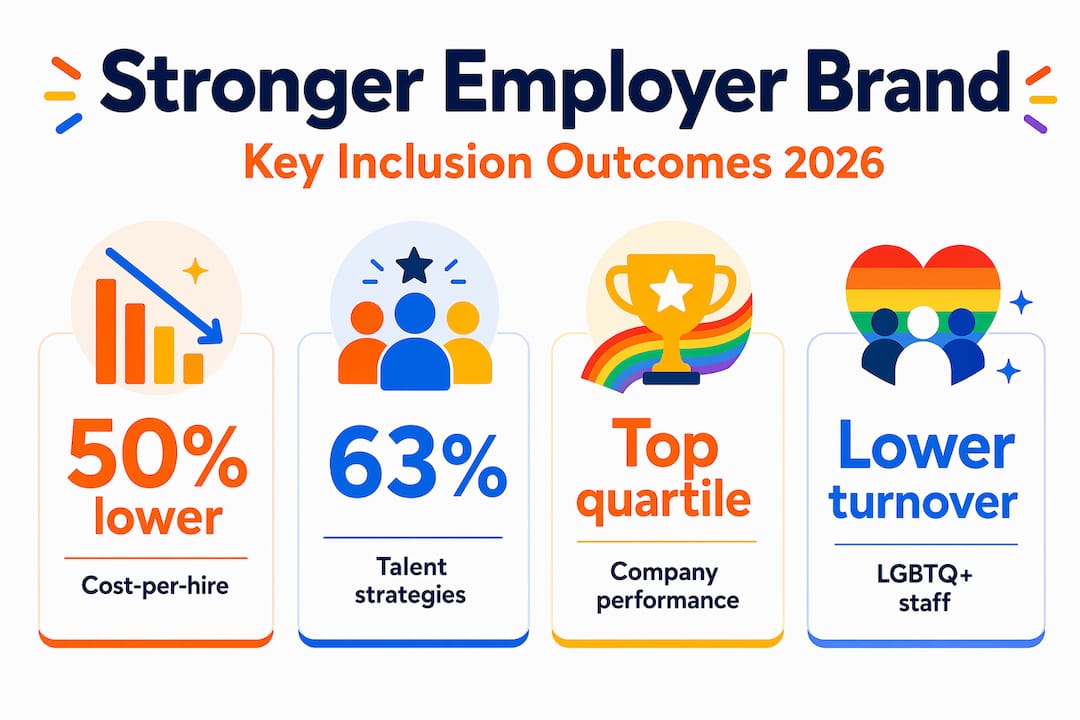
The numbers are difficult to ignore. Organizations with strong employer brands report approximately 50% lower cost-per-hire, 28% less turnover, and 2.5x more applications per job. These are not marginal gains. They represent millions of dollars saved annually for mid-to-large employers and a significantly stronger talent pipeline.

The LGBTQ+ inclusion dimension compounds those returns. Companies leading on LGBTQ+ inclusion outperform their peers on revenue growth, net income, and market stability. That correlation is not coincidental. Inclusive environments unlock psychological safety, which drives innovation, risk-taking, and retention of top performers.
Meanwhile, 63% of organizations name developing critical talent sourcing strategies a top priority in 2026. That is the macro environment your employer brand competes in. Passive positioning is no longer viable when your competitors are actively working to attract diverse, high-quality talent.
What makes this particularly relevant for LGBTQ+ inclusion advocates is that the business case and the equity case point in the same direction. You do not have to choose between doing what’s right and delivering results. Championing LGBTQ+ talent at every organizational level is both good ethics and good strategy.
A few concrete benefits of investing in employer branding specifically for LGBTQ+ inclusion:
- Reduced time-to-fill for specialized roles because you reach candidates who already trust your brand
- Lower attrition costs from LGBTQ+ employees who feel visible and valued
- Stronger allyship through employee networks that reinforce inclusion culture from the inside
- Better reputation with institutional investors who track diversity and inclusion metrics
- Access to a broader talent pool through LGBTQ±focused professional networks
Pro Tip: When making the case for employer branding investment to leadership, bring the cost-per-hire data alongside your current LGBTQ+ attrition rates. An effective brand strategy only gets funded when its financial return is visible. Put both numbers in the same slide.
Building credibility and trust with LGBTQ+ candidates through authentic employer branding
Next, we focus on how authentic employer branding directly builds trust with LGBTQ+ candidates and employees, helping reduce turnover and foster inclusion.
Trust is the currency employer branding trades in. For LGBTQ+ candidates, the trust question is existential, not transactional. They are not just evaluating salary or growth opportunities. They are evaluating whether they will be safe.
The Corporate Equality Index 2026 shows that low trust in employer inclusion commitments strongly correlates with increased intent to leave. This plays out in predictable patterns: a candidate sees inclusive messaging, joins the organization, finds the reality falls short, and exits within 18 months. The recruiting cost is wasted, the damage to your employer brand grows through that person’s network, and the next candidate is even more skeptical.
“Only 34% of LGBTQ+ workers feel comfortable raising workplace concerns with leadership.” That figure, from the 2026 Shine the Light Study, tells you how wide the gap between policy and culture actually is for most organizations.
That gap is the central employer branding problem. You can fix it, but not with better copywriting. Here is what actually builds credibility:
- Consistent leadership behavior: Visible LGBTQ+ leaders influence job choices for 84% of LGBTQ+ graduates. If your senior team is silent on inclusion, candidates notice.
- Policy that matches promise: Gender-affirming benefits, equal parental leave, and pronoun guidance in HR systems are table stakes in 2026, not differentiators.
- Psychological safety in practice: Regular listening sessions, anonymous feedback tools, and manager training on LGBTQ+ inclusion demonstrate ongoing commitment.
- Transparent reporting: Publishing LGBTQ+ representation data, even when imperfect, signals accountability in a way that vague mission statements never will.
The mismatch between brand promise and workplace reality is the most damaging form of employer brand failure. It costs you twice: once in recruitment spend and again in the reputational damage that follows when employees talk.
How to prioritize employer branding to support LGBTQ+ workplace inclusion in practice
With a clear understanding of trust and credibility, let’s now explore how organizations can practically prioritize employer branding to make LGBTQ+ inclusion real and sustainable.
Effective employer branding works best when it manages expectations across the full candidate lifecycle, not just at the application stage. That means your inclusion message needs to be consistent from the first job posting through onboarding, performance reviews, and promotion cycles.
Here are the steps that actually move the needle:
- Audit your current employer brand signals. Review your careers page, job descriptions, Glassdoor presence, and social media for gaps between inclusion messaging and the evidence supporting it. Ask: would a skeptical LGBTQ+ candidate believe this?
- Collect and share employee stories. Real, named accounts from LGBTQ+ employees (with their consent) carry more weight than any brand statement. Video testimonials, blog features, and panel events all work. Explore LGBTQ+ inclusion best practices to find examples of how organizations communicate these stories effectively.
- Embed inclusion proof points in policies. Inclusive healthcare coverage, zero-tolerance anti-discrimination enforcement, and gender transition guidelines should be findable within two clicks on your careers site.
- Make ERG visibility year-round. Pride and ERG visibility must extend far beyond June. Quarterly ERG highlights, internal showcases, and remote-inclusive programming all demonstrate sustained commitment rather than seasonal performance.
- Train managers, not just HR. Line managers are the day-to-day face of your employer brand. If they cannot confidently support LGBTQ+ employees, no amount of external branding will compensate.
- Measure and report. Track LGBTQ+ representation, promotion rates, and attrition separately. Publish what you find. Accountability creates the credibility that messaging alone cannot.
Pro Tip: Involving recruiters, managers, and ERG representatives together in shaping inclusion messaging produces far more credible content than anything developed solely by a marketing or HR team working alone. Diverse internal voices create employer brand claims that hold up to scrutiny.
Why focusing solely on Pride month messaging undermines true employer branding for LGBTQ+ inclusion
There is a particular pattern that has become so common it deserves its own examination. Every June, thousands of organizations change their logos to rainbows, post celebratory content, and announce their commitment to LGBTQ+ inclusion. Then July arrives, and the subject disappears entirely for eleven months.
LGBTQ+ professionals see this cycle clearly. They have lived through it. And the damage it does to employer branding is real and measurable.
ERG and Pride visibility must be continuous, reaching remote employees and persisting beyond seasonal moments, because candidates judge authenticity by how an organization behaves when there is no PR incentive to perform. A company that only speaks about LGBTQ+ inclusion when it is culturally convenient is telling you exactly how much that inclusion is worth to them.
The deeper problem with Pride-only employer branding is that it treats LGBTQ+ inclusion as a campaign rather than a condition. It signals that queer employees are a target audience to attract in June, not colleagues to support in February when anti-discrimination legislation is threatened or when a trans employee needs healthcare navigation support.
Authentic employer branding, the kind that actually reduces turnover and builds reputational trust, requires something harder than a content calendar. It requires that inclusion be embedded in how decisions are made at every level. Allyship through employee networks functions year-round because the need for it does not pause. Your employer brand should reflect that reality.
The organizations that have genuinely differentiated themselves in the LGBTQ+ talent market are not the ones with the best Pride campaigns. They are the ones where LGBTQ+ employees publicly say, without prompting, that they feel safe. That kind of advocacy cannot be manufactured. It has to be earned, one consistent action at a time.
How myGwork can help you elevate your employer brand for LGBTQ+ inclusion
If you are ready to move from intention to action, the right platform makes a measurable difference. myGwork connects LGBTQ+ professionals and allies with organizations that have made verifiable commitments to inclusive workplaces, giving both candidates and employers a foundation of established trust.
For employers, myGwork provides direct access to a global network of LGBTQ+ talent, tools to showcase authentic inclusion credentials, and a community that evaluates employer brand claims with real experience. For LGBTQ+ professionals and allies, the platform surfaces employers whose inclusion commitments extend beyond logo changes. Job listings, networking events, mentorship programs, and educational resources are all in one place, built specifically for this community. Whether you are building an employer brand strategy from scratch or strengthening an existing one, myGwork offers the network, visibility, and resources to do it with credibility.
Frequently asked questions
Why is employer branding important for LGBTQ+ inclusion?
Employer branding shapes how LGBTQ+ candidates assess safety and inclusion before applying, directly influencing who joins, who stays, and whether trust in the organization holds over time.
How does authentic employer branding reduce turnover for LGBTQ+ employees?
When employer brand messaging accurately reflects the actual workplace experience, LGBTQ+ employees encounter fewer unpleasant surprises after joining. Trust and transparency correlate directly with reduced intent to leave and higher engagement.
What are practical steps to improve employer branding for LGBTQ+ inclusion?
Integrate inclusion proof points across every stage of recruitment and the employee lifecycle, sustain ERG visibility throughout the year, ensure leadership advocacy is visible, and align EVP messaging with the experiences employees actually report.
Why should organizations avoid focusing only on Pride month for LGBTQ+ employer branding?
Candidates and employees judge inclusion authenticity by what happens the other eleven months of the year. Continuous ERG visibility and year-round advocacy signal genuine commitment, while Pride-only messaging typically reads as performative and erodes trust.