
Why Fund LGBTQ+ Career Programs: 2026 Guide
June 17, 2026Funding LGBTQ+ career programs is a direct driver of talent retention, workforce performance, and organizational competitiveness. With 30% of Gen Z identifying as LGBTQ+ and representing a $1.4 trillion buying power, the business case for investing in LGBTQ+ workforce development has never been stronger. Organizations that treat these programs as optional are already losing ground in the talent market. The Human Rights Campaign (HRC) Foundation and the Corporate Equality Index have both documented the measurable returns that come from structured, funded inclusion programs. This guide explains why fund LGBTQ+ career programs is the right question for every employer, HR leader, and diversity advocate to be asking right now.

Why fund LGBTQ+ career programs: the business case
The most direct answer is this: funded LGBTQ+ career programs reduce talent loss, improve employee health, and strengthen your employer brand in a market where top candidates have real choices.
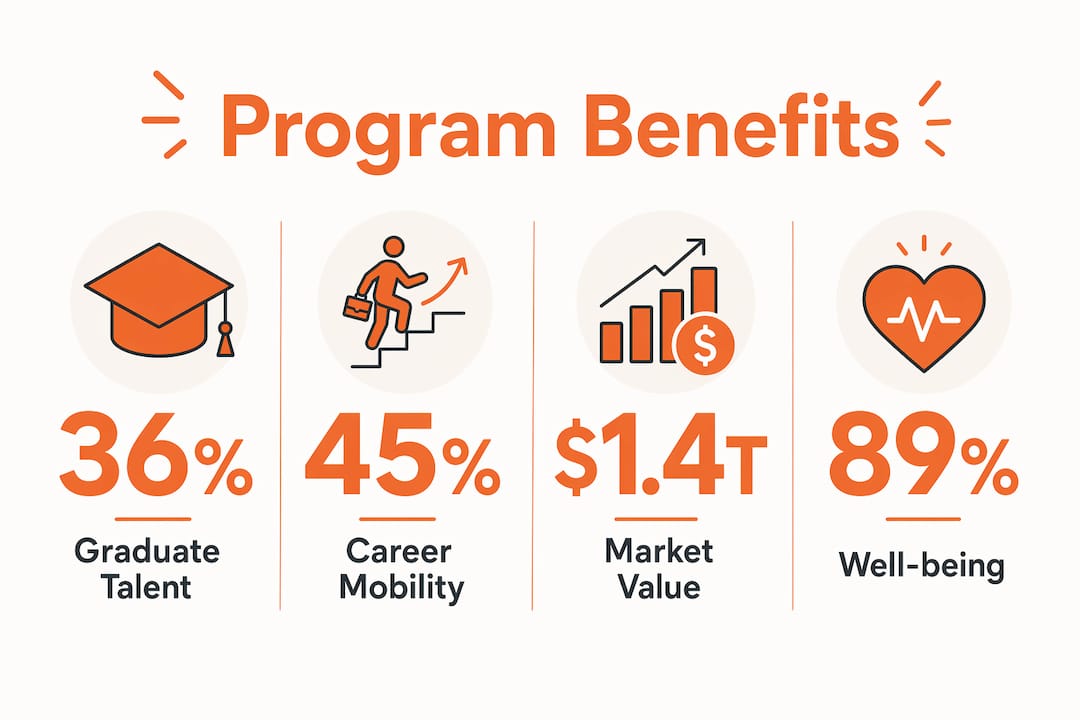
36% of over 2,000 surveyed students and graduates actively avoid employers they perceive as non-inclusive. That is more than one in three candidates removing your organization from consideration before you ever post a job listing. The talent pipeline impact is not theoretical. It is measurable and immediate.
LGBTQ+ employees who are out at work report 45% greater access to mentorship and career growth opportunities compared to those who are not out. The same longitudinal study, covering 7,700 employees from 2018 through 2024, found that 89% of out LGBTQ+ employees report better health and well-being. Healthier employees take fewer sick days, stay longer, and perform at higher levels.
The economic argument extends beyond the workforce. LGBTQ+ consumers and professionals represent a $1.4 trillion buying power. Companies that visibly invest in LGBTQ+ career development attract both talent and customers who prioritize inclusion. Supporting LGBTQ+ careers is not a cost center. It is a revenue-adjacent strategy.
Pro Tip: When building your internal business case, tie each funded program directly to a KPI: time-to-fill for open roles, 90-day retention rates, or employee net promoter scores. Numbers convert skeptics faster than values statements.
What measurable outcomes do these programs deliver?
The benefits of LGBTQ+ programs fall into three clear categories: recruitment, retention, and employee well-being. Each category has documented, quantifiable outcomes.

On recruitment, the talent pipeline data is unambiguous. LGBTQ+ graduates now evaluate employers through visible leadership, dedicated budgets, and empowered Employee Resource Groups (ERGs) before submitting applications. A policy document on a careers page no longer signals genuine inclusion. Candidates want to see visible LGBTQ+ leaders in decision-making roles and funded programs with real authority.
On retention, well-designed support programs demonstrate that structured inclusion workflows produce measurable retention gains. Retention improvements directly reduce the cost of turnover, which averages between 50% and 200% of an employee’s annual salary depending on seniority.
On well-being, inclusive workplace policies act as protective buffers against minority stress, anxiety, and depression. This is not a soft benefit. Reduced psychological burden translates directly into higher productivity and lower absenteeism. The 2026 research published in BMC Public Health confirms this link between structural inclusion policies and measurable mental health outcomes.
How do funded programs create safer, more authentic workplaces?
Funded programs create safety through structure. Without a budget and formal mandate, inclusion efforts depend on the goodwill of individual champions who can leave, burn out, or be overruled.
The Corporate Equality Index functions as both a benchmark and a trust signal. RaShawn Hawkins of the HRC Foundation has stated that the CEI helps HR leaders navigate workplace uncertainty and communicate employee safety during periods of rising hostility. Organizations that score well on the CEI send a credible signal to LGBTQ+ candidates and employees that inclusion is institutional, not performative.
Authentic inclusion requires three structural elements that only funded programs can deliver:
- Dedicated budgets that give ERGs real authority to design and run programs
- Leadership visibility with LGBTQ+ executives and allies in senior roles
- Formal mentorship pipelines that connect LGBTQ+ employees to career growth opportunities
Stonewall’s Diversity Champions program frames diversity as a business necessity, not a social obligation. The program’s findings show that environments where LGBTQ+ employees genuinely flourish are built through sustained organizational commitment, not annual awareness events.
“Mentorship programs are most effective when participants co-create institutional change rather than being passive recipients.” — 2026 academic research on LGBTQ+ career program efficacy
This distinction matters. Programs that treat LGBTQ+ employees as beneficiaries rather than architects produce weaker outcomes. The most effective funded initiatives give LGBTQ+ staff a seat at the design table from the start.
Pro Tip: When launching a new inclusion program, form a co-design committee with at least 50% LGBTQ+ representation. Their lived experience will surface barriers that no external consultant will catch.
Mentorship vs. systemic change: which approach delivers more?
The honest answer is that mentorship without systemic change produces limited results. One-off events and standalone mentorship programs improve individual outcomes but do not shift organizational culture at scale.
Sustainable programs embed LGBTQ+ development into promotions, stretch assignments, and performance review systems. This is the finding from the Authentic Leaders LGBTQ Leadership Report 2026. Organizations that limit inclusion to voluntary ERG participation without connecting it to formal talent processes see minimal long-term impact.
The pitfall most organizations fall into is relying on a single passionate advocate, often unpaid and working outside their job description, to carry the entire inclusion agenda. When that person leaves, the program collapses. Funded, institutionalized programs do not depend on any one individual.
What steps can employers take to fund these programs effectively?
Funding LGBTQ+ initiatives effectively requires a structured approach that connects resources to outcomes. Here is a practical sequence for employers, HR leaders, and advocates.
- Audit your current state. Identify what programs already exist, who funds them, and what outcomes they track. Most organizations discover that inclusion efforts are fragmented and underfunded relative to their stated DEI commitments.
- Identify funding sources. Corporate DEI budgets are the most direct source. External options include grants from foundations like the Gill Foundation, partnerships with LGBTQ+ advocacy organizations, and co-funding arrangements with industry peers.
- Engage LGBTQ+ talent networks. Platforms like Mygwork connect employers with LGBTQ+ professionals and provide access to community organizations that can co-design programs. Mygwork’s job board and mentorship resources give employers a direct channel to the talent they are trying to reach.
- Set measurable goals. Define success before you spend a dollar. Metrics might include the percentage of LGBTQ+ employees in senior roles, mentorship program completion rates, or scores on the Corporate Equality Index. Goals without metrics are wishes.
- Secure leadership buy-in. Programs without executive sponsorship stall. Present the business case using the recruitment and retention data from the HRC Foundation and the 2026 talent pipeline research. Decision-makers respond to numbers.
- Communicate transparently. LGBTQ+ candidates evaluate truly inclusive workplaces through what they see and hear from current employees, not just what appears on a careers page. Internal communication about funded programs is as important as external employer branding.
Advocating for LGBTQ+ job programs also means connecting with peer organizations. Industry coalitions and nonprofit partners can provide both funding leverage and credibility that internal programs alone cannot generate.
Key takeaways
Funded LGBTQ+ career programs deliver measurable gains in talent recruitment, employee retention, and workplace well-being that directly improve organizational performance.
The uncomfortable truth about DEI budgets
I have spent years watching organizations announce LGBTQ+ inclusion commitments and then fund them at a level that guarantees failure. A $5,000 annual ERG budget and a Pride logo on LinkedIn is not a program. It is a liability.
The data from 2026 is unambiguous. One in three LGBTQ+ graduates has reconsidered their career path because of social and political shifts. These are not abstract statistics. They represent real candidates choosing your competitor because your inclusion program looks like a checkbox.
What I have seen work, consistently, is when organizations treat LGBTQ+ career development the same way they treat leadership development: with a dedicated budget, executive ownership, and quarterly performance reviews. The companies that do this do not just score better on the Corporate Equality Index. They hire faster, retain longer, and build cultures where everyone performs at a higher level.
The argument that inclusion programs are a cost is simply wrong. The cost is losing 36% of your candidate pool before the first interview. The cost is replacing an employee who left because they never felt safe enough to be out at work. Funding these programs is the cheaper option. It is also the right one.
How myGwork connects employers with LGBTQ+ talent
myGwork is the global platform built specifically to connect LGBTQ+ professionals with inclusive employers and career development resources. For organizations serious about improving LGBTQ+ job opportunities, myGwork provides direct access to a talent network that actively seeks employers who demonstrate real inclusion. The platform offers job listings, mentorship programs, networking events, and educational resources designed to support every stage of LGBTQ+ career development. Employers can showcase their inclusion credentials, engage with LGBTQ+ talent directly, and build the kind of employer branding for LGBTQ+ inclusion that converts candidates into hires. Start building your inclusive talent strategy at myGwork.
FAQ
What are LGBTQ+ career programs?
LGBTQ+ career programs are structured workplace initiatives that provide mentorship, career coaching, leadership development, and advocacy resources specifically designed to support LGBTQ+ professionals. They range from ERG-led mentorship to fully integrated talent development systems embedded in promotion and performance processes.
Why do LGBTQ+ career programs improve retention?
Out LGBTQ+ employees report 45% greater career mobility and 89% better well-being outcomes, both of which are directly linked to lower turnover. Inclusive programs reduce the minority stress that drives LGBTQ+ employees to leave organizations.
How do employers measure the impact of LGBTQ+ programs?
Employers track impact through metrics including Corporate Equality Index scores, LGBTQ+ representation in senior roles, mentorship completion rates, and employee net promoter scores segmented by demographic group. Tying these metrics to business outcomes like retention cost and time-to-fill builds the internal case for sustained funding.
What is the difference between a performative and a funded LGBTQ+ program?
A performative program relies on volunteer effort, has no dedicated budget, and produces no measurable outcomes. A funded program has executive sponsorship, defined KPIs, LGBTQ+ co-designers, and integration into formal talent processes like promotions and performance reviews.
Where can employers find resources to support LGBTQ+ workforce development?
The HRC Foundation, the Corporate Equality Index, Stonewall’s Diversity Champions program, and Mygwork all provide frameworks, benchmarks, and talent networks to help employers design and fund effective LGBTQ+ career development programs.