
Why LGBTQ+ History Month matters for real inclusion
May 7, 2026
More than a third of LGBT workers hide their identity at work fearing discrimination, even as many organizations declare their commitment to inclusion. That statistic should stop us cold. Workplace inclusion is not a solved problem, and LGBTQ+ History Month exists precisely to remind us of that. This guide breaks down what the month actually achieves, why it goes far beyond symbolic gestures, and how organizations and allies can use it to drive genuine, lasting change.
Key Takeaways
What is LGBTQ+ History Month and why does it matter?
Before dismissing any awareness month as “just another calendar event,” it helps to understand what LGBTQ+ History Month actually is and the concrete purpose it serves.
LGBTQ+ History Month is an annual observance dedicated to recognizing the history, contributions, and ongoing struggles of lesbian, gay, bisexual, transgender, and queer people. The timing differs depending on where you are. In the United States, it falls in October, a choice with roots in the 1988 anniversary of the National March on Washington for Lesbian and Gay Rights. In the United Kingdom, it is observed in February, chosen partly to honor the anniversary of the partial decriminalization of homosexuality in England and Wales in 1967.
It is also worth separating this observance from Pride Month, which is celebrated in June. The distinction matters. Pride Month vs. History Month serve different purposes: Pride is celebratory and visibility-centered, while History Month is rooted in education, reflection, and honest assessment of how far workplaces still have to go.
As one resource puts it, LGBTQ+ History Month provides workplaces an opportunity to educate on LGBTQ+ history, reflect on inclusion progress, and address ongoing challenges like identity concealment due to discrimination fears. That framing is important. This is not a passive observance. It is an active checkpoint.
“History is not just something that happened to other people. For LGBTQ+ professionals, knowing the history of the movement is directly connected to understanding the rights and protections they hold, and the ones they are still fighting for.”
The month pushes organizations to ask harder questions: Are our policies genuinely protective? Do our LGBTQ+ employees feel safe enough to be themselves? Are we doing enough for the most vulnerable members of our community? These questions matter every day of the year, but LGBTQ+ History Month gives teams a structured moment to actually address them.
The workplace impact: Safety, retention, and well-being
Understanding why the month matters is one thing. Seeing its measurable impact on real people’s working lives is another.
Let us start with the numbers that should concern every people manager and DEI (diversity, equity, and inclusion) professional. 35% of LGBT workers hide their identity at work fearing discrimination, which leads directly to reduced engagement, higher stress, and increased employee turnover. Hiding a fundamental part of your identity every day is exhausting, and that exhaustion shows up in productivity, creativity, and commitment to a team.
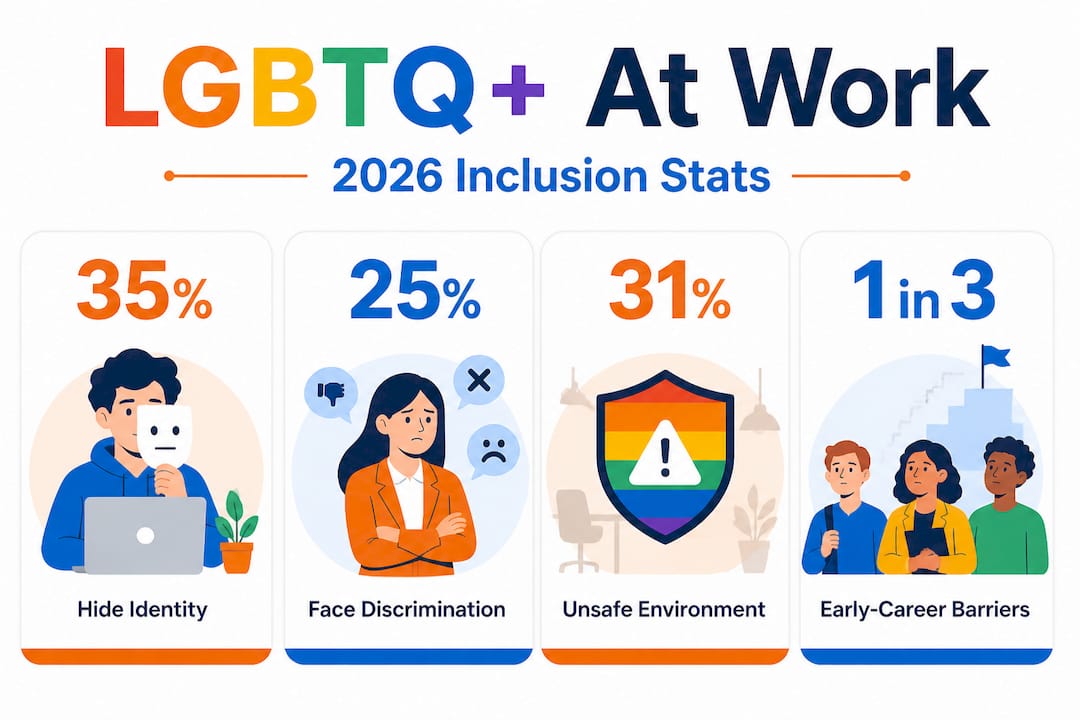
The data is stark. Despite clear progress, 25% of LGBTQ+ workers still report workplace discrimination, and 31% describe feeling unhappy or depressed. These are not abstract statistics. Behind each number is a professional who is less likely to speak up in meetings, less likely to apply for a promotion, and more likely to quietly look for another job.

This connects directly to the experience of early-career LGBTQ+ professionals. Recent graduate experiences show that 1 in 3 LGBTQ+ graduates have reconsidered their career path entirely because of political and social shifts, which means organizations risk losing talented people before those employees even fully commit to a career path.
So what does recognition actually do to change this? Meaningful, visible acknowledgment of LGBTQ+ History Month builds psychological safety, which is the sense that you can show up at work as yourself without fear of judgment or retaliation. When an organization creates space for LGBTQ+ history and stories, it signals to every employee that LGBTQ+ identities are valued, not merely tolerated. That signal is powerful. A well-designed support program for retention can boost retention by as much as 35%, and positive workplace outcomes follow when teams feel genuinely safe and included.
Here is a practical numbered list of what improves when organizations take History Month seriously:
- Psychological safety increases: Employees feel less pressure to hide who they are.
- Engagement rises: Included employees are more creative and more willing to contribute ideas.
- Mental health improves: Reduced concealment directly lowers stress and anxiety.
- Retention strengthens: Teams that feel safe stay longer, cutting costly turnover.
- Talent attraction grows: LGBTQ+ professionals actively seek employers who demonstrate genuine commitment.
Pro Tip: One of the most effective ways to use History Month is to create optional, voluntary story-sharing opportunities for LGBTQ+ employees. These must be truly voluntary, with zero pressure to participate. When done right, they build community, educate colleagues, and demonstrate leadership’s genuine commitment. When done badly, they put LGBTQ+ employees in an uncomfortable spotlight. Always let employees lead these conversations, not management.
Beyond rainbows: Recognizing authentically without performative pitfalls
Now that you understand the impact, it is time to talk about the elephant in the room: rainbow-washing. The term refers to organizations that deploy LGBTQ+ imagery, primarily rainbow branding, during awareness months without making any meaningful internal changes. It is common, it is visible, and a lot of people are not buying it.
64% of people criticize rainbow-washing as insincere, making it one of the more damaging moves an organization can make. Employees who already feel marginalized see through cosmetic gestures instantly, and a rainbow logo on social media paired with a workplace where discrimination goes unchecked actually makes trust worse, not better.
So what does authentic recognition look like? Here is what moves the needle:
- Internal education first: Host talks, panels, and learning sessions for all staff, not just public-facing campaigns.
- Policy audits: Use the month as a trigger to review whether policies genuinely protect LGBTQ+ employees, from transition support to inclusive parental leave.
- Leadership accountability: Require senior leaders to visibly participate in History Month activities, not just send an email.
- Intersectionality focus: Acknowledge that LGBTQ+ experience is not monolithic. Race, class, disability, and other identities shape how people experience inclusion.
- Year-round follow-through: Any commitment made during History Month must be followed by measurable action in the months after.
The gap in acceptance across LGBTQ+ identities also matters enormously here. Pew Research shows that 61% see fair acceptance for gay and lesbian people, but only 13% say the same for transgender individuals. That gap is vast, and it reflects a genuine disparity in how different members of the LGBTQ+ community experience workplace safety.
Trans and non-binary inclusion requires specific, targeted effort. This means gender-inclusive bathrooms, correct pronoun practices embedded in culture rather than policy alone, and managers trained to handle trans-related needs with sensitivity and discretion. These are not optional extras for truly inclusive organizations.
“Authentic allyship is not wearing a pin. It is being the person in the room who pushes back when an exclusionary comment goes unchallenged.”
Bias training strategies that combine data, storytelling, and practical skill-building consistently outperform one-off diversity sessions. The organizations seeing real change invest in training that helps managers recognize their own biases and gives all employees the language and confidence to act as effective allies.
Pro Tip: After each History Month, send a brief, anonymous survey to all staff asking whether they felt the organization’s recognition was meaningful. Ask specifically whether LGBTQ+ employees felt seen versus spotlighted, and whether non-LGBTQ+ staff learned something new. This feedback loop turns a single-month event into continuous improvement.
Practical steps for organizations and allies
Awareness without action is just performance. The goal is to leave LGBTQ+ History Month with real commitments and a clear plan for the rest of the year. Here is a practical toolkit for managers, DEI professionals, and individual allies.
The month acts as a structured checkpoint for auditing inclusion through surveys and listening sessions, training managers on LGBTQ+ issues, and creating spaces for voluntary story-sharing. Think of it less as a celebration and more as an annual review of your inclusion work.
For managers and organizational leaders:
- Run an inclusion audit: Survey your team anonymously to understand whether LGBTQ+ employees feel safe, valued, and heard. Use the results to set specific goals.
- Book manager training sessions: Equip your leaders with the skills to handle disclosures, advocate for policy changes, and respond to discrimination appropriately.
- Review and update policies: Look at everything from parental leave and healthcare benefits to anti-harassment policies through an LGBTQ+ lens.
- Feature visible LGBTQ+ leaders in your communication: 84% of LGBTQ+ graduates say diverse leadership influences their job choices. Leadership visibility is not vanity; it is talent strategy.
- Set year-round accountability markers: Do not let History Month commitments evaporate in November. Build follow-up into quarterly team reviews.
For individual allies:
- Take the initiative to learn about LGBTQ+ history without waiting to be taught.
- Use inclusive language consistently, not just during awareness months.
- Speak up when you witness exclusionary comments or behavior, even when it is uncomfortable.
- Support LGBTQ+ colleagues by listening and following their lead on what they need.
- Advocate for policy changes within your sphere of influence, even if your role is not in HR or leadership.
Sustainable actions that outlast the month:
- Create a standing LGBTQ+ employee resource group (ERG) with genuine leadership support and budget.
- Build LGBTQ+ history and inclusion content into onboarding for all new employees.
- Recognize LGBTQ+ milestones and advocacy moments throughout the year, not just in October or February.
- Partner with LGBTQ+ organizations and experts to keep your approach informed and current.
The difference between organizations that simply observe the month and those that genuinely advance inclusion is the commitment to internal, sustained action over external, seasonal marketing.
Why genuine recognition matters more than ever in 2026
Here is the honest take: the political and social climate in 2026 has made visible, authentic LGBTQ+ inclusion more important, and also more complicated. Anti-LGBTQ+ legislation has accelerated in several US states. Globally, progress is uneven. For many LGBTQ+ professionals, the workplace is one of the few environments where they feel some control over their safety, and that makes employer commitment more significant than ever before.
What most guides miss is that recognition without infrastructure is hollow. The organizations making a real difference are not the ones with the loudest social media presence during History Month. They are the ones running annual inclusion audits, updating language in company-wide documentation, building psychological safety into performance reviews, and holding leaders accountable for specific DEI outcomes. They are the ones investing in a genuine culture of support that is visible in day-to-day decisions, not just awareness campaigns.
We also need to be honest about who is still most at risk. Trans and non-binary employees face a disproportionate share of barriers, and a History Month that focuses only on gay and lesbian visibility while overlooking those communities is not doing the full job. Every commitment to inclusion must specifically address the needs of the most marginalized within the LGBTQ+ umbrella.
The organizations that are genuinely thriving in 2026 understand that LGBTQ+ History Month is a lever, not a label. It is a structured opportunity to push the conversation further, do the internal work that is easy to postpone, and ensure that every person on the team feels genuinely welcome, not just theoretically included. That distinction matters, and the employees who need it most can always tell the difference.
Advance true inclusion with myGwork’s resources
Understanding why LGBTQ+ History Month matters is the first step. The next step is acting on that understanding, and that is where having the right resources makes all the difference.
myGwork is built for exactly this moment. Whether you are an LGBTQ+ professional looking for employers who walk the talk, an ally ready to deepen your commitment, or an organizational leader building a genuinely inclusive workplace, myGwork connects you to the tools, networks, and knowledge you need. From DEI resources and ongoing LGBTQ+ workplace news to job listings with inclusive workplace resources and a community of professionals who share your commitment to equality, myGwork keeps inclusion work moving all year long, not just in October or February.
Frequently asked questions
When is LGBTQ+ History Month observed in the US and UK?
In the US, LGBTQ+ History Month falls in October; in the UK, it is observed in February.
How is LGBTQ+ History Month different from Pride Month?
History Month emphasizes education and year-round reflection, while Pride Month in June is a celebration focused on visibility and community.
What are practical ways organizations can observe LGBTQ+ History Month?
Organizations can host educational sessions, audit inclusion policies, support voluntary story-sharing, and focus on internal allyship training to make recognition meaningful.
Why is performative allyship criticized during LGBTQ+ History Month?
Rainbow-washing is seen as insincere by 64% of people, meaning cosmetic gestures without policy changes actively damage trust with LGBTQ+ employees.
Which LGBTQ+ groups still face the most workplace barriers?
Trans and non-binary employees face the greatest challenges, with only 13% saying trans people experience fair acceptance, compared to 61% for gay and lesbian individuals.