
Why Partner With Diversity Employers: Business Benefits
July 1, 2026Partnering with diversity employers is defined as forming deliberate business relationships with organizations committed to inclusive hiring, equitable workplaces, and representation across race, gender, sexual orientation, and background. The business case is clear: companies with diverse leadership are up to 39% more likely to outperform their peers. That single statistic reframes why partner with diversity employers from a values question into a performance question. myGwork connects organizations to this advantage by linking businesses with LGBTQ+ professionals and inclusion-committed employers worldwide.

Why partner with diversity employers: the financial case
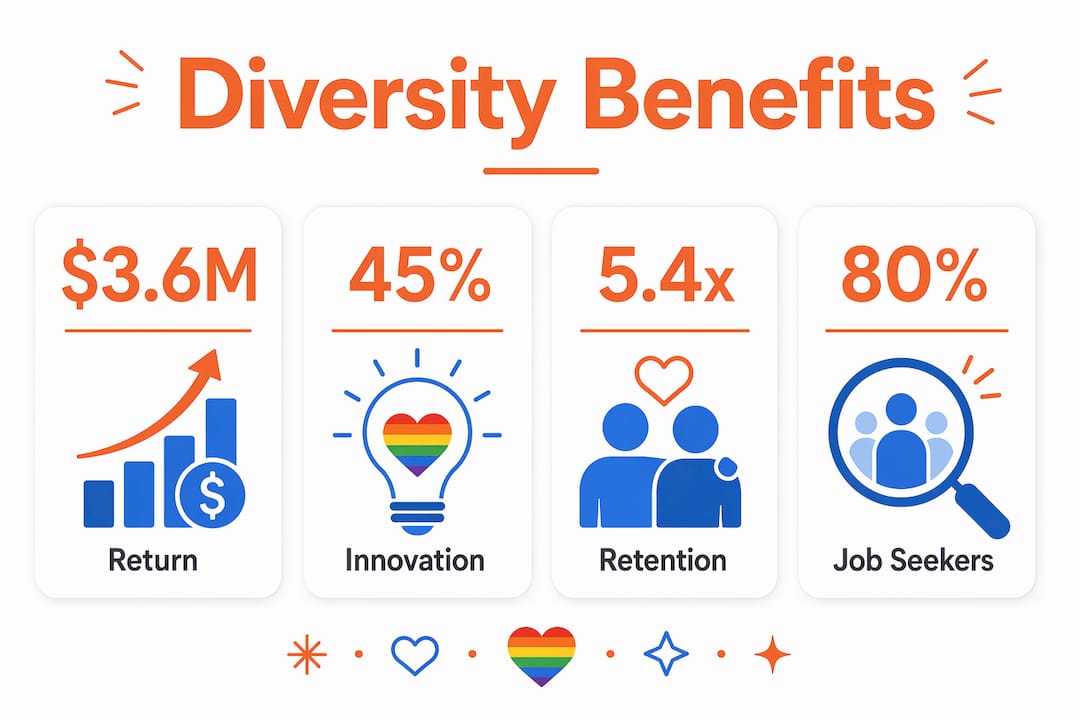
The financial returns from supplier diversity and inclusive hiring are measurable and well-documented. Every $1 million spent on supplier diversity adds approximately $3.6 million to a company’s bottom line. That multiplier effect means diversity spending is not a cost center. It is one of the highest-return investments a business can make.
The economic impact extends beyond the company itself. Supplier diversity programs generate $3 to $4 in local economic output for every dollar invested. That ripple effect builds goodwill with communities, strengthens brand reputation, and creates secondary networks that support long-term sourcing resilience.
Cost savings are another underappreciated benefit. Diverse supplier networks introduce competitive pricing pressure that larger, homogeneous vendor pools rarely generate. Supplier diversity programs also improve sourcing efficiency and broaden innovation by bringing in vendors with different problem-solving approaches.
Pro Tip: Track supplier diversity spending as a separate line item in your procurement reporting. Organizations that measure this metric consistently are better positioned to demonstrate ROI to leadership and justify program expansion.
ROI snapshot: diversity spending returns
How do diversity partnerships enhance innovation and decision-making?
Diverse teams produce better decisions. Research shows diverse teams make better decisions up to 87% of the time compared to homogeneous groups. That is not a marginal edge. It is a structural advantage in every meeting room, product sprint, and client pitch.

The revenue impact of that decision quality is equally striking. Diverse teams generate 45% of their revenue from innovation, compared to just 26% for less diverse organizations. That gap widens as markets shift faster and customer bases grow more varied.
Diverse suppliers and partners bring viewpoints that internal teams simply cannot replicate. A vendor founded by a woman of color in a mid-size city sees supply chain risk differently than a legacy firm headquartered in a financial hub. That difference in perspective is exactly what drives creative problem-solving.
Key innovation drivers linked to diversity partnerships include:
- Broader market insight: Diverse partners understand underserved customer segments firsthand.
- Faster problem identification: Teams with varied backgrounds spot blind spots earlier in the process.
- Higher creative output: Cognitive diversity produces more solution options per challenge.
- Reduced groupthink: Inclusion of dissenting perspectives prevents costly consensus errors.
“The biggest barrier to inclusive hiring is visibility, not talent shortage. Firms that source from niche communities outside traditional job boards consistently build stronger candidate pools.” — HR Annie Consulting
What impact do diversity partnerships have on talent attraction and retention?
Job seekers vote with their applications. Between 76% and 80% of job seekers consider a company’s commitment to diversity and inclusion before accepting a role. That means your partnerships signal your values before a single interview takes place.
Retention numbers are equally compelling. Inclusive cultures experience 5.4 times higher retention and 50% lower turnover risk. Replacing an employee costs between 50% and 200% of their annual salary, so lower turnover translates directly into budget savings.
Belonging drives satisfaction at a level most HR programs underestimate. Employees with a strong sense of belonging are 10 times more likely to be satisfied with their jobs. Belonging is not created by a policy document. It is built through day-to-day interactions, visible leadership diversity, and the cultural signals sent by who your organization partners with.
Partnerships with diversity-committed employers extend that cultural safety outward. When LGBTQ+ professionals, for example, see that your organization works with inclusion-focused partners, they read it as evidence that the workplace itself is safe. Mygwork’s LGBTQ+ inclusive job listings show that 84% of LGBTQ+ graduates say diverse leaders directly influence their job choices.
Pro Tip: Embed inclusive practices into onboarding, mentoring, and promotion cycles, not just hiring. Diversity partnerships that stop at recruitment miss the retention gains that come from sustained cultural integration.
Key talent benefits of inclusive employer partnerships:
- Broader candidate pools from underrepresented communities
- Stronger employer brand among diverse job seekers
- Higher employee satisfaction scores linked to belonging
- Reduced recruitment costs from lower voluntary turnover
- Access to diverse leadership pipelines that improve long-term succession planning
How to build effective and sustainable diversity employer partnerships
Most diversity partnerships fail not because of intent but because of scope. Limiting diversity partners to narrow contractual roles blocks both value creation and cultural integration. The fix is co-leadership: giving diversity partners a seat at the table during planning, not just execution.
Co-leadership models produce measurably better project outcomes. When a diversity partner contributes to scope definition, risk assessment, and delivery strategy, the relationship shifts from transactional to genuinely collaborative. That shift is where the deeper business benefits appear.
Capacity building is the second pillar of sustainable partnerships. Strategic partnerships that include certifications and mentor-protégé programs yield stronger pipelines and deeper cultural integration over time. Supporting a partner’s certification through bodies like the National Minority Supplier Development Council or the Women’s Business Enterprise National Council builds their credibility while strengthening your supplier network.
Niche diversity organizations also offer something large firms cannot: agility. Smaller, specialized diversity partners can pivot faster during market disruptions and reduce your dependency on single-source suppliers. That operational resilience is a concrete risk management benefit, not just a social good.
Steps to build lasting inclusive partnerships:
- Audit your current supplier and employer network for diversity gaps before setting targets.
- Invite diversity partners into planning phases, not just delivery phases, of major projects.
- Support certification programs for partners through recognized bodies and internal mentoring.
- Set measurable partnership goals tied to innovation output, retention rates, and community impact.
- Review and expand partner scopes annually to prevent relationships from becoming purely transactional.
- Use platforms like Mygwork to source LGBTQ+ inclusive employers and build your inclusive talent pipeline with purpose.
Pro Tip: Assign an internal champion for each diversity partnership. Organizations with a named relationship owner see higher engagement, faster issue resolution, and stronger long-term outcomes than those managing partnerships through procurement alone.
Key takeaways
Partnering with diversity employers delivers measurable financial returns, stronger innovation output, and lower employee turnover, making inclusion a direct driver of business performance.
What I’ve learned from watching diversity partnerships succeed and fail
I’ve watched organizations announce supplier diversity programs with real fanfare, then quietly let them stagnate because no one owned the relationship past the contract signing. The pattern is consistent. The intent is genuine. The follow-through is where it breaks down.
The most effective partnerships I’ve seen share one trait: the diversity partner is treated as a peer, not a vendor. That means being included in strategy conversations, not just asked to deliver a scope. It means getting feedback on what is working and what is not. It means the relationship has a future, not just a contract end date.
The visibility problem is also more serious than most organizations admit. The talent and the suppliers exist. The barrier is that traditional sourcing channels, job boards built for the mainstream, and procurement networks built on legacy relationships, systematically exclude them. Mygwork exists precisely because LGBTQ+ professionals needed a space where their identity was not a liability. The same logic applies to supplier diversity: you will not find what you are not looking for.
One more thing I’d push back on: the idea that diversity partnerships are primarily about optics. The data does not support that framing. A 39% performance advantage and a 45% innovation revenue share are not PR metrics. They are competitive facts. Organizations that treat inclusion as a checkbox will keep getting checkbox results. Those that treat it as a business model will keep outperforming.
How myGwork supports your diversity employer partnerships
Building genuine partnerships with diversity-committed employers requires access to the right networks, not just the right intentions.
myGwork is a global platform purpose-built for LGBTQ+ inclusive hiring, networking, and employer partnerships. Organizations that partner with myGwork gain direct access to a community of LGBTQ+ professionals and allies, tools to showcase their inclusive workplace culture, and resources to attract and retain diverse talent at scale. Whether you are building your first supplier diversity program or expanding an existing one, myGwork connects you to the people and organizations that make inclusion real. Explore how your organization can measure and grow its diversity impact through the platform today.
FAQ
What does it mean to partner with a diversity employer?
Partnering with a diversity employer means forming a deliberate business relationship with an organization that actively practices inclusive hiring and equitable workplace policies. These partnerships can include supplier agreements, co-recruitment programs, or shared inclusion initiatives.
What are the financial benefits of diversity partnerships?
Every $1 million spent on supplier diversity returns approximately $3.6 million to a company’s bottom line, while also generating $3 to $4 in local economic output per dollar invested.
How do diversity partnerships affect employee retention?
Inclusive cultures experience 5.4 times higher retention and 50% lower turnover risk. Employees with a strong sense of belonging are 10 times more likely to report job satisfaction.
Why do job seekers care about diversity employer partnerships?
Between 76% and 80% of job seekers consider a company’s diversity and inclusion commitment when choosing an employer. Visible partnerships with diversity-focused organizations signal cultural safety to candidates from underrepresented groups.
How does Mygwork help businesses build diversity partnerships?
Mygwork connects organizations with LGBTQ+ professionals, allies, and inclusion-committed employers through job listings, networking events, and mentoring resources. The platform helps businesses attract diverse talent and demonstrate their commitment to workplace equality.