
Belonging-Focused Recruitment: A 2026 HR Guide
July 22, 2026What is belonging-focused recruitment?
Belonging-focused recruitment is a talent acquisition approach that prioritizes a candidate’s emotional experience of feeling seen, valued, and respected from the very first interaction, rather than merely evaluating technical skills or checking diversity metrics. The term is gaining traction in HR circles, though the underlying practice aligns closely with what researchers and practitioners call inclusive hiring. Both describe the same core commitment: designing every stage of the hiring process so that candidates from all backgrounds can genuinely picture themselves thriving at your organization.

The concept marks a deliberate departure from “cultural fit,” which too often functions as a filter for sameness. Cultural fit vs. cultural add is the defining shift: instead of screening for candidates who mirror existing team norms, belonging-focused recruitment actively seeks people who expand perspectives and strengthen the team through difference.
Key elements that define this approach:
- Emotional candidate experience: Every touchpoint, from the job posting to the offer call, is designed to make candidates feel welcomed rather than evaluated.
- Dismantling traditional hiring biases: Blind screening, structured interviews, and bias training replace gut-feel assessments.
- Cultural add over cultural fit: The goal is contribution and authenticity, not conformity.
- Transparency and clear communication: Candidates receive timely updates, plain language, and honest expectations throughout the process.
- Systemic barrier removal: Unnecessary degree requirements, inaccessible application platforms, and jargon-heavy job descriptions are eliminated.
Why belonging matters more than inclusion alone
Belonging and inclusion are related but distinct. Inclusion is the deliberate effort to ensure people from varied backgrounds can participate. Belonging is what candidates and employees actually feel as a result. Equity and belonging operate differently too: equity removes barriers so diverse talent can enter; belonging determines whether, once inside, those individuals feel safe enough to perform and stay.
Organizations that get this distinction right see real gains. Research confirms that when people feel they belong, organizations see significant gains in productivity, retention, and innovation. Belonging can be measured and connected directly to business outcomes, which means it belongs in your talent strategy, not just your culture deck.
The candidate-side data reinforces the urgency. Six in ten job seekers now specifically research an organization’s commitment to diversity and inclusion before applying. For candidates from historically excluded groups, a recruitment process that feels cold or exclusionary doesn’t just lose them as applicants. It signals that the organization itself is unsafe.
Key reasons belonging-focused recruitment produces results:
- Higher offer acceptance rates from candidates who feel genuinely welcomed during the process.
- Reduced early attrition, since candidates who experience belonging during hiring are more likely to stay past the 90-day mark.
- Stronger employer brand, particularly among LGBTQ+ professionals, people of color, and candidates with disabilities.
- Better hiring decisions overall, because diverse panels using merit-based processes consistently outperform homogeneous ones.
Belonging is not a soft metric. Eric Knauf, founder of BelongHQ and author of The 56% Solution, argues that belonging can be measured against business outcomes and should reshape how talent acquisition defines its strategic value.
How to embed belonging in your recruitment process
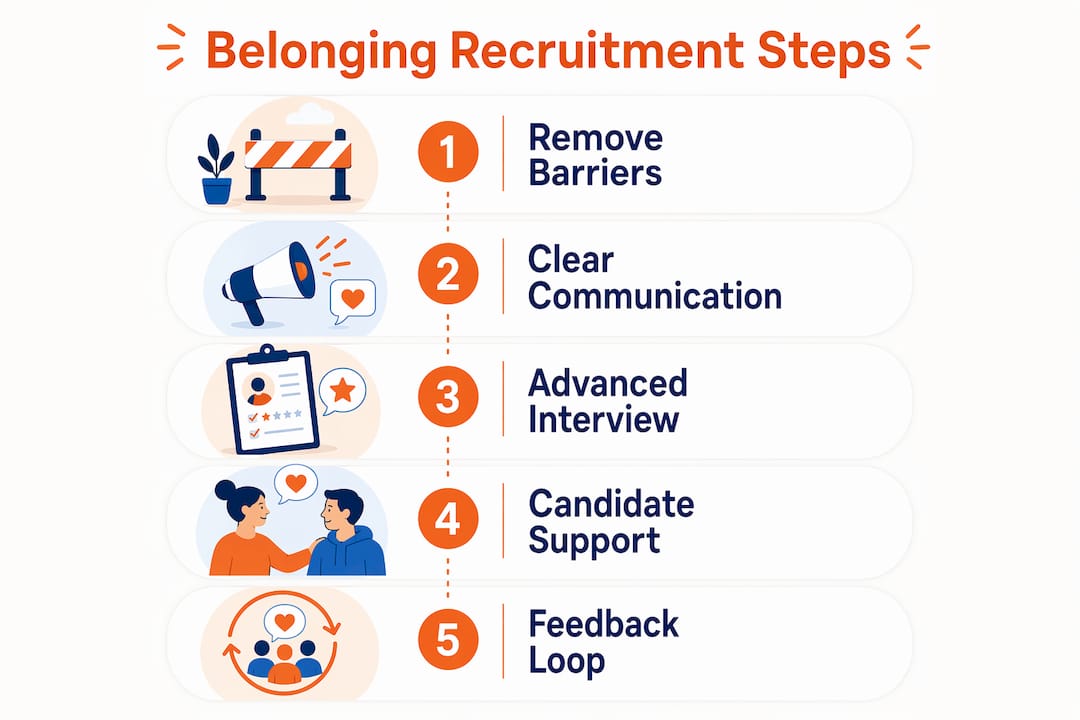
The structural foundation for belonging starts with removing systemic barriers: dropping unnecessary degree requirements, implementing blind screening to reduce unconscious bias, and auditing job descriptions for exclusionary language. These aren’t cosmetic changes. They determine who even reaches the first interview.

Communication is where belonging is won or lost at the candidate level. Jargon-free, clear communication dismantles the traditional employer-candidate power dynamic. Candidates from non-traditional backgrounds often read dense corporate language as a signal that they don’t belong before they’ve submitted a single application. Explaining acronyms, writing in plain English, and setting explicit expectations costs nothing and signals a great deal.
Sharing interview questions ahead of time and explaining hiring timelines builds early trust and levels the playing field, particularly for candidates who haven’t had access to professional coaching or insider networks. This one practice alone can meaningfully shift who shows up prepared and confident.
Concrete tactics for embedding belonging at every stage:
- Audit job postings for biased language using tools like Textio or the Gender Decoder.
- Implement structured interviews with standardized scoring rubrics so every candidate is assessed against the same criteria.
- Train all interviewers, not just HR, on recognizing and interrupting unconscious bias.
- Proactively ask all applicants whether they need reasonable adjustments, rather than waiting for them to request accommodations.
- Provide timely, specific feedback to all interviewees after each round.
- Encourage candidates who narrowly miss out to reapply, and follow up with a personal message explaining how close they came.
Pro Tip: Send interview questions 48 hours in advance. Candidates who’ve faced systemic disadvantages often perform far below their actual capability when surprised by questions. Advance sharing doesn’t reduce rigor; it shifts the advantage away from those who already have it.
Practical tips for making belonging-focused hiring sustainable
Belonging-focused recruitment must be a lived system, not a marketing campaign. Organizations that treat it as a branding exercise, posting inclusive language externally while running the same biased internal process, lose credibility fast. Candidates talk, and Glassdoor reviews reflect the gap between promise and reality.
Sustainability requires distributing ownership. Empowering all employees to speak up against bias, not just the DEI team or HR, is what aligns recruitment with actual company culture. When a hiring manager uses “culture fit” as a veto in a debrief, someone in the room needs to name it.
Practical best practices to build belonging into the long term:
- Run candidate experience surveys after every recruitment cycle and act on the results publicly.
- Set up feedback loops between recruiters and hiring managers so belonging signals from interviews inform onboarding plans.
- Extend belonging practices into the first 90 days: the recruitment experience should connect directly to how new hires are welcomed and integrated.
- Balance targeted outreach to underrepresented groups with transparent communication about why you’re doing it, so all candidates understand the rationale.
- Review your diversity progress metrics regularly and share findings with the broader organization, not just leadership.
How inclusive networks and platforms support belonging in recruitment
Reaching underrepresented talent requires going where that talent already gathers. Platforms built specifically for diverse professionals, like Mygwork, give HR teams direct access to LGBTQ+ candidates, allies, and organizations that have already self-selected into a community centered on workplace inclusion. That context matters: a job posting on a general board and the same posting on an LGBTQ±focused platform send fundamentally different signals about employer intent.

Mygwork connects LGBTQ+ professionals with employers who have demonstrated a commitment to inclusion, offering job listings, networking events, mentoring, and community resources in one place. For HR teams, partnering with inclusive platforms is one of the clearest ways to demonstrate that belonging isn’t just a value statement. It’s a sourcing decision.
Ways HR teams can use inclusive networks effectively:
- Post roles on LGBTQ±focused and other identity-centered job boards alongside general listings.
- Participate in community events and panels hosted by inclusive networks to build authentic employer brand presence.
- Use platform data to understand which employer behaviors and signals matter most to diverse candidates.
- Highlight employee resource groups (ERGs) and real employee stories in your employer profile, not just DEI policy language.
How do you measure the impact of belonging-focused recruitment?
Measurement is where many organizations stall. They launch belonging initiatives, then track only demographic headcount, which tells you who got hired but nothing about whether they feel they belong. Deloitte’s framework for inclusion identifies four measurable elements: feeling valued and respected, believing perspectives matter, feeling motivated and like you belong, and feeling supported in wellbeing. Each can be tracked through targeted survey questions and observable behaviors.
Metrics worth building into your recruitment reporting include candidate experience scores by demographic group, offer acceptance rates segmented by identity, 90-day retention rates for new hires from underrepresented groups, and interviewer bias audit results. The goal is to treat belonging as a business outcome, the way you’d treat time-to-fill or cost-per-hire, not as a sentiment that’s too fuzzy to quantify.
An inclusive talent pipeline approach tracks belonging signals at each stage of the funnel, so you can identify exactly where candidates from specific groups drop off and why.
Common challenges and how to overcome them
The most common failure mode is treating belonging-focused recruitment as a phase rather than a permanent operating model. Organizations implement new processes but don’t change the underlying culture, so exclusion reasserts itself the moment the initiative loses momentum. The fix is integration: belonging practices have to become standard procedure, not a special program.
A second pitfall is concentrating responsibility in one team. When belonging is owned exclusively by HR or the DEI function, it becomes easy for hiring managers to treat it as someone else’s job. Distributing accountability, through training, structured scoring, and clear expectations for every interviewer, prevents this.
Unconscious bias training alone rarely changes behavior. The CIPD’s guidance on inclusive recruitment is explicit: increasing awareness of bias is not enough to reduce its impact. Processes must be redesigned to structurally limit bias, through anonymized applications, standardized rubrics, and diverse interview panels, rather than relying on individuals to override their own instincts in the moment.
Examples of belonging-focused recruitment in practice
Organizations that have moved from intention to execution share a few common patterns. Companies that anonymize applications, removing names, schools, and addresses before screening, consistently report broader and more diverse shortlists. The practice works because it forces evaluators to focus on demonstrated skills rather than proxies for background.
Structured interview programs, where every candidate answers the same questions scored against the same rubric, have produced measurable reductions in panel disagreement and stronger inter-rater reliability. When panels include people at different seniority levels and from different backgrounds, the quality of hiring decisions improves further.
Outreach programs that go beyond posting jobs, visiting schools and universities, hosting events, offering internships, and providing career support, have been associated with increasing candidates from underrepresented groups who apply and eventually reach management. The social impact hiring model extends this logic by treating recruitment as a community investment, not just a pipeline exercise.
Tools and technology that support belonging-focused hiring
Several categories of technology directly support belonging in recruitment. Bias-detection writing tools like Textio analyze job descriptions for language patterns that deter specific groups from applying. Structured interview platforms, including Greenhouse and Lever, allow teams to build standardized scoring into the workflow rather than relying on post-hoc notes. Candidate experience survey tools like Starred collect real-time feedback from applicants at each stage, including those who were rejected.
Anonymization features, now available in most applicant tracking systems, remove identifying information from resumes before they reach reviewers. AI-assisted screening tools can expand sourcing reach, though they require regular auditing to confirm they aren’t replicating historical bias patterns from training data.
The technology is only as effective as the process it supports. A bias-detection tool won’t help if the hiring manager rewrites the job description after the audit. The human decisions surrounding the tools determine whether they produce belonging or just the appearance of it.
Training recruiters and hiring managers to build belonging
Recruiter training on belonging goes beyond a one-hour unconscious bias module. Effective programs cover how structural discrimination shapes hiring decisions, how to conduct structured interviews that give every candidate a fair platform, and how to give feedback that is specific, honest, and constructive rather than vague or legally hedged.
Manager-level training focuses on the everyday decisions that shape belonging: who gets shortlisted, who gets development opportunities, and how performance is assessed. Supervisor-level programs address frontline bias in team dynamics and hiring decisions. The CIPD’s manager behavioral framework identifies three key areas: being open, fair, and consistent; building and sustaining relationships with candidates as individuals; and providing clear knowledge and guidance throughout the process.
Training works best when it’s tied to accountability. Recruiters and managers who complete belonging-focused training should be evaluated on whether their hiring outcomes reflect it, not just whether they attended the session.
Key Takeaways
Belonging-focused recruitment treats the candidate’s emotional experience as a core hiring outcome, not an afterthought, and organizations that build it into their processes see measurable gains in retention, engagement, and innovation.
Mygwork connects HR teams and diversity officers with LGBTQ+ talent and inclusive employers through job listings, networking, mentoring, and community resources. If you’re building a recruitment process where belonging is real rather than aspirational, explore Mygwork to reach candidates who are actively looking for exactly that.