
Diversity benchmarks: impact, challenges & best practices
April 1, 2026
Nearly 47% of LGBTQ+ employees have experienced workplace discrimination in their lifetime, yet many organizations still treat diversity benchmarks as a compliance checkbox rather than a genuine driver of change. That gap between intention and impact is where real harm happens. Diversity benchmarks, when built with accountability and authentic alignment, do far more than track headcounts. They shape culture, protect talent, and create the conditions where every professional can grow. This guide breaks down what benchmarks actually are, what the evidence says about their effects, how to handle pushback, and how to build systems that work for everyone, including those most at risk.
Key Takeaways
What are diversity benchmarks and why do they matter?
Diversity benchmarks are measurable standards that organizations set to evaluate how inclusive their workplace actually is. Think of them as a GPS for your DEI strategy. Without them, you are driving blind, hoping you are heading in the right direction but with no way to confirm it. A benchmark might track the percentage of LGBTQ+ employees in leadership roles, promotion rates across identity groups, or pay equity across demographics.
But benchmarks are tools, not trophies. Their value lies in what you do with the data, not in the act of collecting it. When used well, they expose gaps that are invisible to the naked eye and give diversity officers the evidence they need to push for real structural change.
Here is what well-designed benchmarks can measure:
- Representation at every level of the organization, not just entry-level hiring
- Promotion and retention rates broken down by identity
- Pay equity across LGBTQ+ employees compared to non-LGBTQ+ peers
- Employee experience scores, including psychological safety and belonging
- Participation rates in ERGs (employee resource groups) and inclusion programs
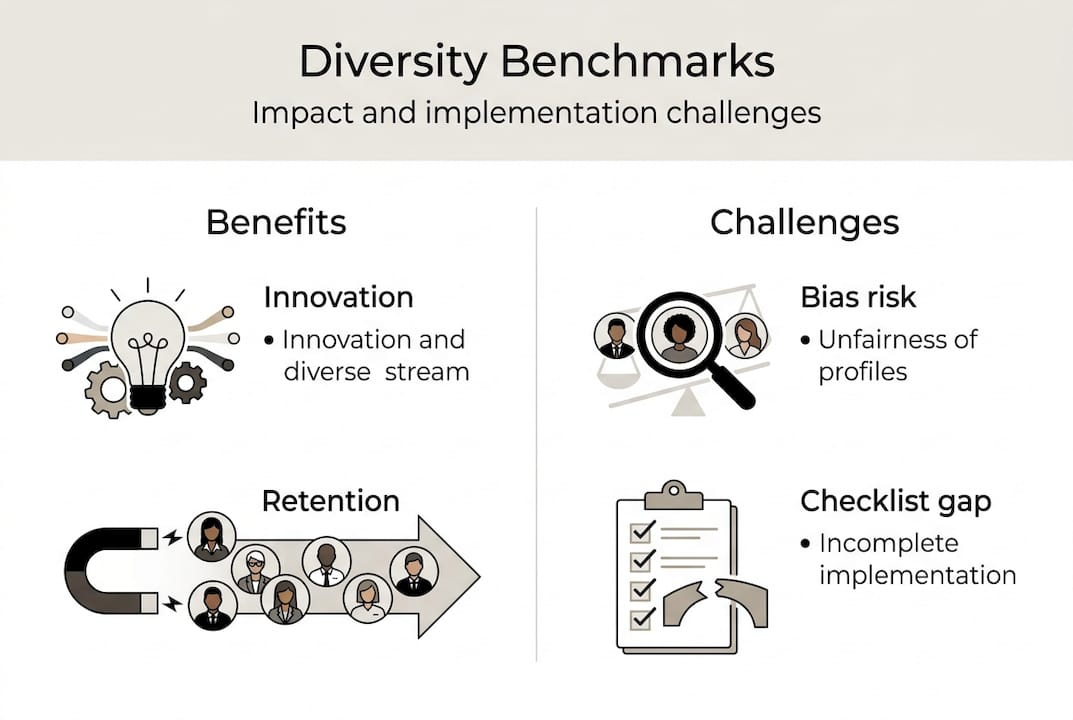
The business case is strong. Empirical data links benchmarks to measurable improvements in innovation, performance, and employee loyalty. Organizations that track inclusion metrics consistently outperform those that rely on gut instinct alone. And the stakes are personal. Pay transparency policies, for example, have already shown that LGBTQ+ wage gap cuts are achievable when data drives decisions. Similarly, research confirms the impact of diverse leadership on attracting and retaining LGBTQ+ talent.
“Benchmarks are only as powerful as the organizational will behind them. Data without action is just decoration.”
The shift from treating benchmarks as a checklist to treating them as a continuous feedback loop is what separates organizations that perform on inclusion from those that merely perform inclusion.
How diversity benchmarks drive measurable change
Once you understand what benchmarks are, the next question is: do they actually move the needle? The short answer is yes, but only when paired with rigorous measurement and follow-through.
HR measurement triples business improvement gains and customer loyalty compared to organizations that rely on informal observation. That is not a small margin. It means that the act of measuring inclusion, systematically and consistently, is itself a driver of better outcomes.
Here is a snapshot of what benchmarked organizations tend to see versus those without structured measurement:
For diversity officers, this table is your budget justification. When leadership asks why DEI programs deserve funding, data from benchmarks gives you a concrete answer. Programs that track LGBTQ+ support impact on workflow and retention have demonstrated up to 35% retention improvements, a figure no CFO can ignore.
Benchmarks also help identify where recent discrimination data reveals persistent gaps, so you can target interventions like bias training for inclusion where they will have the most effect.
Key outcomes benchmarked organizations report:
- Reduced turnover among LGBTQ+ employees
- Higher rates of internal promotion for underrepresented groups
- Stronger scores on belonging and psychological safety surveys
- Clearer accountability structures for managers
Pro Tip: Build a simple quarterly dashboard that tracks three to five core metrics. Present it to leadership with trend lines, not just snapshots. Trends tell the story of progress, and they make the case for sustained investment far more powerfully than a single data point.
Navigating critiques, legal challenges, and anti-DEI backlash
The landscape for DEI work has shifted sharply. DEI backlash and performative DEI critiques are surging, and diversity officers are increasingly navigating hostile environments where benchmarks are framed as unfair or legally risky. Understanding these critiques is not defeatist. It is strategic.
The most common objections fall into a few categories:
- Merit-only arguments: Critics claim benchmarks prioritize identity over qualifications. The counter is straightforward: benchmarks measure whether qualified people from all groups are getting equal access, not whether standards should be lowered.
- Legal risk concerns: Some organizations fear that tracking identity data creates liability. In reality, benchmarks focused on process fairness rather than rigid quotas are legally defensible in most jurisdictions.
- Identity-blind strategies: Some leaders advocate for treating everyone the same. But identity-blind approaches foster tolerance at best and often fail to produce genuine inclusion.
- Performative DEI fatigue: Employees and critics alike are frustrated by organizations that publish diversity reports without changing anything. This is a legitimate critique, and the answer is accountability, not abandonment.
Comparing two organizational approaches makes the stakes clear:
“Benchmarks only succeed when paired with accountability and genuine alignment with organizational values.”
For diversity officers facing pushback, the strongest defense is connecting benchmarks to business outcomes and framing them as fairness tools rather than preferential treatment. Resources on confronting workplace discrimination head-on can help build the internal case for why this work cannot be deprioritized.
Edge cases: Addressing intersectionality and higher-risk groups
One of the most common mistakes in benchmark design is treating “LGBTQ+” as a single, uniform category. It is not. The data is unambiguous on this point.
TNB professionals face 55% discrimination rates compared to 31% for cisgender LGBQ employees. Black LGBTQ+ professionals experience discrimination at 51%. These are not marginal differences. They represent profoundly different workplace realities that a single aggregate benchmark will completely miss.

Intersectionality is not a buzzword. It is a measurement problem. If your benchmarks only track broad LGBTQ+ representation without disaggregating by race, gender identity, disability status, or other factors, you are averaging out the people who need the most support.
Here is what intersectional benchmarking looks like in practice:
- Separate tracking for trans and nonbinary employees across hiring, promotion, and retention
- Disaggregated data for LGBTQ+ employees of color, not just combined diversity figures
- Pay equity analysis that crosses identity categories, not just one at a time
- Inclusion survey questions that capture experiences specific to multiply marginalized groups
Inclusive leadership plays a critical mediating role here. Inclusive leadership mediates outcomes and reduces discrimination rates, meaning that even the best-designed benchmarks need leaders who actively model and enforce inclusion.
Pro Tip: Review your benchmarks at least annually with an intersectional lens. Ask: who is this benchmark not capturing? Which groups are hidden inside our aggregate numbers? That question alone will surface gaps you did not know existed. Organizations recognized as a top ranked diversity employer consistently apply this kind of granular review.
Best practices for implementing effective diversity benchmarks
Knowing why benchmarks matter is one thing. Building them well is another. Here is a practical framework for diversity officers who want benchmarks that drive real change rather than generate impressive-looking reports.
Step-by-step implementation:
- Define your fairness case clearly. Success requires genuine fairness cases, accountability, and value alignment. Start by articulating why each benchmark exists and what fairness outcome it is designed to protect.
- Select metrics that connect to real experiences. Representation numbers matter, but so do promotion rates, pay equity, and belonging scores. Choose metrics that tell the full story.
- Establish a baseline before setting targets. You cannot measure progress without knowing where you started. Collect disaggregated data before announcing goals.
- Set realistic, time-bound targets. Avoid vague aspirations. “Increase LGBTQ+ representation in senior leadership by 10% over two years” is actionable. “Be more inclusive” is not.
- Build in regular review cycles. Quarterly check-ins with annual deep dives keep benchmarks relevant and allow for course correction.
- Assign accountability. Every benchmark needs an owner who is responsible for progress and empowered to act on findings.
Common pitfalls to avoid:
- Using quotas as a substitute for systemic change
- Treating benchmarks as a one-time exercise rather than an ongoing process
- Failing to communicate benchmark results transparently to employees
- Ignoring qualitative data alongside quantitative metrics
- Neglecting to use tools like diversity hiring tools that can streamline data collection and analysis
Organizations that celebrate milestones like Pride Month retention impact see 25% better retention, which shows that culture and measurement reinforce each other when both are taken seriously.
A fresh perspective: What most guides miss about diversity benchmarks
Most benchmark guides focus on the mechanics: what to measure, how to set targets, which tools to use. That is useful. But the piece most organizations miss is the trust problem.
When LGBTQ+ employees see a new diversity initiative launch, many feel cautious rather than hopeful. They have seen benchmarks come and go without changing their daily experience. That skepticism is rational, and it is the single biggest obstacle to making benchmarks work.
The solution is not better metrics. It is authentic alignment. Benchmarks paired with accountability drive true inclusion, but accountability means leaders face real consequences when benchmarks are missed, not just revised. It means LGBTQ+ employees are involved in designing the benchmarks that affect them, not just surveyed afterward.
It is also worth noting that 1 in 3 LGBTQ+ graduates have reconsidered their career path due to political and social shifts. Benchmarks that ignore this external context will always feel disconnected from the real pressures LGBTQ+ professionals face.
Pro Tip: Treat benchmarks as a starting point for conversation, not an endpoint. Share results with employees, invite feedback, and show what changed because of the data. That transparency is what converts skeptics into advocates.
Connect with resources to take diversity benchmarks further
Understanding benchmarks is the first step. Acting on them is where the real work begins.
myGwork connects LGBTQ+ professionals and diversity-focused employers through a platform built specifically for inclusive hiring and community building. Whether you are looking to strengthen your organization’s benchmarking strategy or connect with a network of LGBTQ+ talent, myGwork offers the tools and community to help you move forward. Explore diversity hiring tools reviewed for 2026, access employer resources, and join a growing network of organizations that are serious about turning inclusion data into inclusion action.
Frequently asked questions
How do diversity benchmarks improve workplace outcomes for LGBTQ+ professionals?
Benchmarks linked to innovation and performance improvements work by systematically identifying gaps and holding organizations accountable for closing them, which directly benefits LGBTQ+ employees through fairer promotion, pay, and retention outcomes.
What are some common pitfalls when implementing diversity benchmarks?
Relying on quotas for compliance, neglecting intersectional fairness, and failing to align benchmarks with genuine organizational values are the most common mistakes that undermine benchmark effectiveness.
How can diversity officers defend benchmarks against anti-DEI backlash?
Linking benchmarks to concrete business outcomes and using data-driven metrics gives diversity officers a defensible, evidence-based position, as anti-DEI pressures are most effectively countered with clear ROI data rather than values arguments alone.
Which groups face the highest workplace discrimination and how can benchmarks help?
Trans and nonbinary professionals and LGBTQ+ professionals of color face the highest discrimination rates; intersectional benchmarks that disaggregate data by race and gender identity can surface and address these specific gaps.
Are benchmarks a legal requirement for diversity or a voluntary best practice?
Benchmarks are typically voluntary best practices, but focusing on genuine inclusion rather than rigid quotas keeps them legally sound and far more effective at producing real organizational change.