
Why Set DEI Hiring Targets: A Guide for HR Leaders
July 31, 2026Set measurable DEI hiring targets because they convert diversity from a stated value into an accountable business priority that improves talent attraction, retention, and decision-making quality. Without a number, there is no baseline, no progress signal, and no organizational pressure to change anything.

TL;DR: Organizations that set specific, measurable diversity hiring goals attract broader candidate pools, build stronger leadership pipelines, and outperform peers on key financial metrics, according to research from McKinsey, the University of Chicago Booth School of Business, and Harvard Kennedy School.
Quick evidence snapshot:
- Advertising measurable hiring goals attracts a more diverse applicant pipeline than vague diversity statements alone.
- McKinsey’s research finds a persistent correlation between gender and ethnic diversity in leadership and improved business outcomes.
- Harvard researchers Bohnet and Chilazi warn that numerical goals must pair with culture and management investments to avoid hiring without support.
This guide covers: what DEI hiring targets are and how they differ from quotas; the business case; U.S. legal guardrails; a step-by-step process to set goals; which metrics to track; common mistakes; how to communicate targets; realistic timelines and costs; and what the research actually shows.
What DEI hiring targets are, and how they differ from quotas
A DEI hiring target is a specific, time-bound aspiration for improving workforce representation or the fairness of hiring processes. The key word is aspirational. Targets describe where an organization wants to go; they do not mandate that any individual hire must come from a protected class.
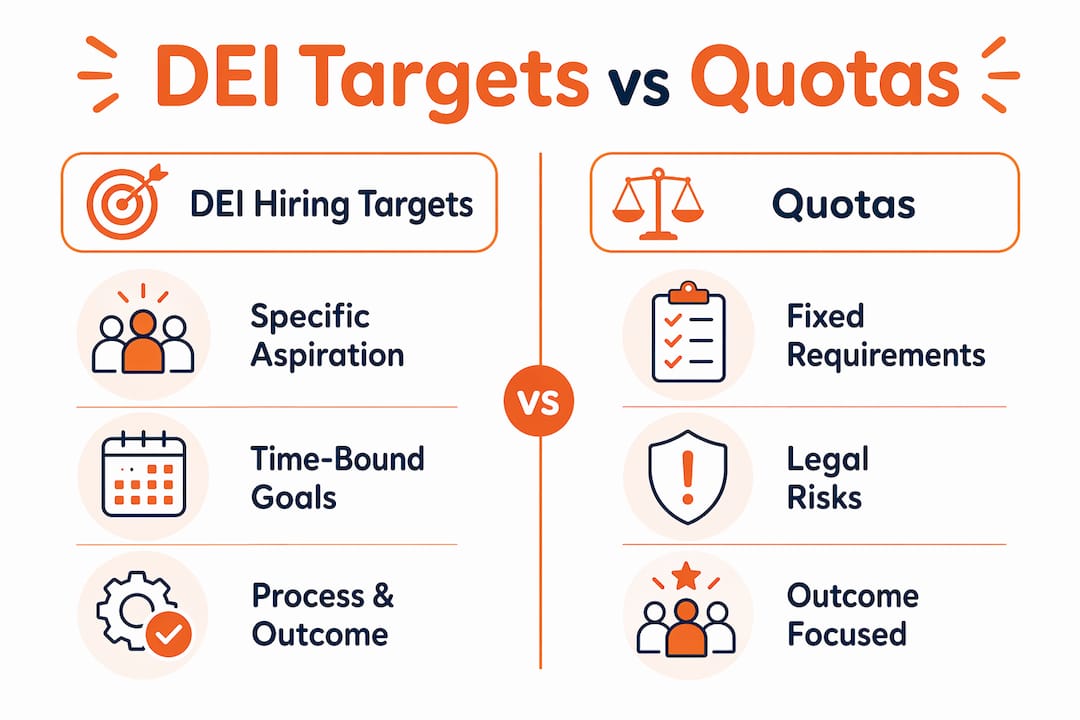
Quotas are different in a legally meaningful way. A quota requires a fixed number or percentage of hires from a specific group, often with consequences for non-compliance. In the United States, mandatory hiring quotas tied to protected characteristics carry significant legal risk and are generally not recommended outside of court-ordered remedies or narrow federal contractor contexts.
Common target types HR teams use:
- Representation targets: Increase the share of women in senior leadership from 28% to 35% within three years.
- Slate diversity targets: Require that every final interview panel includes at least two candidates from underrepresented groups.
- Conversion-rate targets: Close the gap between offer acceptance rates for majority and minority candidates within 18 months.
- Promotion and retention sub-goals: Match promotion rates for underrepresented employees to the company average within two years.
Academic research distinguishes between outcome goals (what representation looks like at the end) and process goals (how the hiring process runs). Both motivate different kinds of change and work best in combination. A representation target tells you where to land; a slate diversity target tells recruiters what to do today.
Pro Tip: When presenting targets to leadership, lead with process goals. Recruiters can directly control whether a slate is diverse; they cannot directly control who accepts an offer. Process goals reduce blame and build recruiter agency.
Why setting DEI hiring targets pays off for your organization
Targets convert strategy into measurable outcomes. That sounds obvious, but most DEI programs stall precisely because they skip this step: they articulate values, launch training, and then measure nothing. The result is activity without accountability.
The business case is well-documented. McKinsey’s research shows a persistent link between gender and ethnic diversity in leadership and stronger financial performance, and recommends embedding DEI into core business strategy rather than treating it as a standalone initiative. MIT Sloan research reinforces this: integrating DEI into strategy amplifies performance benefits compared to siloed programs.

On the talent side, the attraction effect is concrete. Research from the University of Chicago Booth School of Business found that advertising measurable hiring goals attracts a more diverse applicant pipeline than vague diversity statements. Candidates interpret specific, public commitments as a signal of genuine organizational intent. That signal matters especially to candidates from underrepresented groups who have learned to read employer messaging carefully.
There is also an internal accountability effect. When a hiring goal is written down, assigned an owner, and tracked on a dashboard, managers behave differently during sourcing and screening. The goal creates a feedback loop that vague aspirations never do.
Stakeholder pressure adds urgency. Institutional investors, large customers, and community partners increasingly expect organizations to publish measurable diversity commitments. For publicly traded companies, ESG frameworks and proxy advisory firms now scrutinize workforce diversity data. Mission-driven organizations face similar expectations from their donors and boards. A target is not just an internal management tool; it is a credibility signal to every external audience that watches how you hire.
Key attraction and retention benefits:
- Broader candidate pools from underrepresented communities
- Stronger employer brand among candidates who prioritize inclusive workplaces
- Higher retention when hiring targets are paired with belonging investments
- Reduced groupthink and improved decision quality in diverse teams
- Better customer understanding when workforce demographics reflect market demographics
For LGBTQ+ professionals specifically, visible diverse leadership directly influences job choice decisions, making measurable representation goals a recruitment tool as much as an equity one.
Legal considerations in the United States HR teams must know
Aspirational, voluntary DEI hiring targets are generally legal under U.S. law. The Supreme Court’s 1979 decision in Steelworkers v. Weber confirmed that affirmative action designed to correct existing structural inequalities is permissible under Title VII of the Civil Rights Act. What creates legal risk is converting a target into a mandatory quota tied to a protected characteristic.
Practices to avoid:
- Rigid set-asides that reserve a specific number of positions for candidates from a protected class
- Hiring decisions where protected-class membership is a decisive factor rather than one of many considerations
- Documented policies that instruct managers to hire or reject based on demographic characteristics
- Publishing goals in language that implies a guarantee rather than an aspiration
Practices that reduce legal risk:
- Use aspirational, process-oriented language: “affirmatively seeking diverse slates” rather than “will hire X candidates from group Y”
- Document the rationale for targets, including the benchmarks and data sources used
- Train hiring managers on nondiscriminatory evaluation criteria
- Apply consistent selection criteria across all candidates
- Retain records of the decision process for compliance review purposes
The ACLU’s guidance on inclusion targets emphasizes that process-oriented goals, such as diverse interview slates and expanded outreach, carry far less legal exposure than outcome quotas. The distinction is whether the goal changes who you look for or who you must hire.
Pro Tip: Before publishing any DEI hiring target externally, have internal or external employment counsel review the language. A one-paragraph legal review can prevent years of exposure. State-specific rules vary, and some states have additional restrictions on affirmative action in public-sector hiring.
This article provides general information, not legal advice. Confirm current rules with qualified employment counsel for your specific situation.
How to set measurable DEI hiring goals step by step
The most common reason DEI targets fail is that they are set before anyone has looked at the data. Here is a sequence that works.
1. Run a baseline workforce audit
Pull your current headcount by role, level, function, and demographic group. Map your hiring funnel: applications, screens, interviews, offers, acceptances. Identify where underrepresented candidates drop out. Without this map, any target you set is a guess.

2. Choose your metric types
Decide which combination of outcome and process metrics fits your organization’s maturity. Early-stage programs often start with slate diversity targets because recruiters can act on them immediately. More mature programs add representation and conversion-rate targets.
3. Apply the SMART framework to DEI
Every target should be Specific (which role, level, or function), Measurable (a percentage or count), Achievable (grounded in your pipeline and attrition data), Relevant (tied to a business driver), and Time-bound (a clear deadline). “Increase diversity” is not a target. “Increase the share of women in director-level roles from 22% to 30% by December 2027” is.
4. Translate percentages into hire counts
A 5% representation increase sounds manageable until you calculate that it requires 14 specific hires given your current headcount and attrition rate. Translating percentage goals into absolute hire counts reveals feasibility issues quickly and keeps recruiters grounded in reality.
5. Validate against market benchmarks
Compare your targets to labor market availability data for each role and geography. The EEOC’s workforce data and the Bureau of Labor Statistics provide demographic breakdowns by occupation. A target that exceeds labor market availability for a given group is a moonshot, not a goal.
6. Assign ownership and resource initiatives
Every target needs a named owner, a budget line, and a set of initiatives that will actually move the number. Ownership without resources produces frustration. Common initiatives include partnerships with HBCU and minority-serving institutions, expanded sourcing channels, structured interview training, and referral program audits.
7. Align stakeholders before you launch
Bottom-up approaches, where managers help set the targets for their own teams, generate more buy-in but take longer. Top-down approaches move faster but risk manager resistance. A hybrid works best: leadership sets the overall ambition, managers propose the specific targets for their functions, and HR validates against the data.
Operational checklist:
- Workforce audit complete with funnel data by demographic group
- Metric types selected (outcome, process, or both)
- SMART targets drafted for each scope (org-wide, function, level)
- Percentage goals translated into hire counts
- Market benchmarks reviewed
- Owners assigned with budget confirmed
- Initiatives identified and resourced
- Legal review completed before external publication
Pro Tip: Set targets in 12-month increments even when your overall ambition is three years out. Annual targets keep teams motivated and give you a natural review point to adjust if the pipeline or business changes.
Which metrics to track and how to report progress
Metrics fall into two categories, and confusing them is one of the most common reporting mistakes.
Process metrics are leading indicators: diverse slate percentage, application funnel drop-off by demographic group, interview-to-offer conversion rates by group, and time-to-fill for roles with active diversity sourcing. Recruiters can influence these directly, which makes them motivating to track weekly or biweekly.
Outcome metrics are lagging indicators: representation by level and function, hires as a share of total hiring, promotion rates, retention rates, and pay equity ratios. These move slowly and are best reviewed monthly or quarterly.
Sample DEI hiring dashboard:
Reporting cadence should match the audience. Weekly pipeline signals go to TA leads and hiring managers. Monthly outcome summaries go to HR leadership. Quarterly board-level reports cover representation trends and pay equity.
A note on data hygiene: collect demographic data through voluntary self-identification, store it separately from hiring decision records, and aggregate before sharing with managers. Individual-level demographic data should never be visible to hiring managers during the evaluation process.
For teams building out their inclusive talent pipeline, pairing these metrics with structured sourcing processes gives the dashboard real predictive power.
Common mistakes when setting DEI hiring targets and how to avoid them
Moonshot numerical goals. Setting a target that requires tripling representation in 18 months signals ambition but destroys credibility when it is missed. Use your baseline data and hire-count translation to set goals that stretch the organization without breaking recruiter morale. Incremental targets, reviewed annually, outperform dramatic pledges that quietly disappear.
Treating targets as a PR exercise. A target announced in a press release but not connected to sourcing budgets, manager training, or accountability reviews is theater. The operational infrastructure has to exist before the public commitment goes out.
Measuring only headcount. Hiring someone from an underrepresented group and then losing them within 12 months because the culture does not support them is not progress. Track retention and promotion rates alongside hiring numbers. Sponsorship programs for underrepresented employees are one of the most effective ways to close the gap between hiring and advancement.
Relying solely on referrals. Employee referral programs are efficient but tend to replicate existing demographic patterns. Audit your referral pipeline annually and supplement it with targeted sourcing through professional networks, affinity organizations, and platforms built for underrepresented talent.
Ignoring inclusion after the hire. Hiring targets without belonging investments create tokenism risk. New hires from underrepresented groups who feel isolated or unsupported are more likely to leave, which erodes the representation gains the target was meant to build.
Corrective tactics at a glance:
- Replace moonshots with 12-month incremental targets grounded in hire-count math
- Pair every hiring target with a retention and promotion sub-goal
- Audit referral pipelines annually for demographic concentration
- Budget for inclusion programming alongside sourcing spend
- Review targets quarterly and adjust when progress stalls for two consecutive periods
What the evidence shows about DEI hiring targets
The research base is stronger than the political noise around DEI suggests.
The University of Chicago Booth School of Business found that advertising measurable hiring goals attracts a more diverse applicant pipeline. Vague diversity statements do not produce the same effect. Candidates from marginalized groups respond to specificity because it signals that the organization has actually committed to something it can be held accountable for.
McKinsey’s Delivering Through Diversity research documents a persistent correlation between gender and ethnic diversity in leadership and improved financial performance. The recommendation is consistent across their research cycles: embed DEI into core business strategy, not a separate function.
Harvard Kennedy School researchers Iris Bohnet and Siri Chilazi offer the most nuanced framing. Their work shows that outcome goals and process goals influence behavior differently, and that both are necessary. Outcome goals set direction; process goals give recruiters something to act on today. Critically, they also warn that numerical goals without accompanying culture investment can backfire, producing hires who are not set up to succeed.
The evidence also has limits worth acknowledging. Most studies measure correlation, not causation. Diversity training alone shows little evidence of improving outcomes. What works is structural: changing who sees the job posting, who sits on the interview panel, and how candidates are evaluated. Where possible, run pilot programs or A/B tests on sourcing channels and interview processes to build your own evidence base.
Gem’s DEI&B director guidance reinforces the process-first approach: track slate diversity and conversion rates as actionable process targets rather than relying solely on static headcount goals. Recruiters who can see their slate diversity score in real time make different decisions than those who only see a year-end representation report.
How to communicate and operationalize DEI hiring targets
Internal communication comes first. Before any external announcement, managers need to understand what the targets mean for their teams, how they will be measured, and what support they will receive. Frame targets around opportunity expansion, not demographic replacement. The message is: “We are widening the pool so we find the best candidates we have been missing.”
Internal talking points HR can adapt:
- “These goals reflect our commitment to building teams that reflect the markets and communities we serve.”
- “We are investing in sourcing, training, and process changes to make this achievable.”
- “Your role is to evaluate every candidate on the same criteria, applied consistently.”
- “We will review progress quarterly and adjust our approach based on what the data shows.”
External communication requires more care. Publish targets when you have the operational infrastructure to back them up. A public commitment without a plan is a liability. Coordinate with legal and communications before releasing any specific numbers externally. Use aspirational language and describe the process investments alongside the goals.
Roles and accountability (RACI):
- Executive sponsor: Sets overall ambition, removes resource barriers, owns board-level reporting.
- CHRO / VP of People: Translates ambition into specific targets, coordinates legal review, owns quarterly progress reviews.
- People Analytics lead: Owns the dashboard, data hygiene, and reporting cadence.
- TA lead: Owns process metrics, sourcing initiatives, and hiring manager training.
- Hiring managers: Accountable for slate diversity within their requisitions; receive training and support.
- ERG / affinity group leaders: Provide input on target-setting, candidate experience feedback, and onboarding support.
ERG involvement in target-setting is often underused. Affinity group leaders have direct insight into where the organization’s culture falls short and which sourcing channels actually reach their communities. Bringing them into the goal-setting process, not just the celebration afterward, produces better targets and stronger buy-in.
myGwork's employer branding tools help organizations communicate their DEI commitments to LGBTQ+ professionals specifically, connecting public targets to the candidate audiences most likely to respond to them.
Realistic timeline and resourcing expectations
Visible progress on representation targets typically takes 12–36 months, depending on hiring volume, attrition rates, and the size of the gap being closed. Organizations with high hiring velocity can move faster; those with low turnover and small teams will see slower shifts in representation percentages even with strong process improvements.
Typical phase timeline:
- Months 1–3: Baseline audit, target-setting, legal review, dashboard build, manager training launch.
- Months 4–12: Pilot sourcing initiatives, track process metrics weekly, first quarterly outcome review.
- Months 13–24: Scale what worked, adjust what did not, publish first annual progress report.
- Months 25–36: Assess representation shifts, revise targets for the next cycle, expand to additional functions or levels.
Resourcing areas to budget:
- People analytics capacity (internal hire or vendor tool)
- Expanded sourcing channels and partnerships with affinity organizations and platforms
- Structured interview training for hiring managers
- ERG programming and sponsorship support
- Employer brand spend on diversity-focused job boards and events
- Legal review for external communications
ROI tends to appear first in hiring efficiency (shorter time-to-fill when sourcing channels are diversified) and later in retention (reduced early attrition when inclusion investments accompany hiring targets). Funding LGBTQ+ career programs alongside hiring targets is one concrete way to resource the inclusion side of the equation.
Budget incrementally. Start with the audit and dashboard, then fund sourcing initiatives as the baseline data reveals where the pipeline gaps are largest. Avoid committing large budgets to initiatives before you know which levers actually move your specific pipeline.
Key Takeaways
Measurable DEI hiring targets work because they turn diversity from a stated value into a tracked, owned, and resourced business priority with clear accountability at every level.
30–90 day action checklist:
- Complete a workforce audit covering headcount, hiring funnel, and demographic breakdowns by role and level.
- Draft SMART targets for at least one function, translate them into hire counts, and validate against market benchmarks.
- Schedule a legal review of target language before any external publication and assign a People Analytics owner to the dashboard.
Coordinate with employment counsel before publishing any target externally, and track both process and outcome metrics from day one.
A practitioner’s perspective on living with DEI targets
The hardest lesson I have seen organizations learn is that the target is not the strategy. It is the measurement of the strategy. Teams that set a representation goal and then wait for it to happen are always disappointed. The ones that move the number are the ones that changed something structural first: the sourcing channels, the interview panel composition, the evaluation criteria.
The trade-off I see most often is scope versus depth. Organizations want to set targets across every function and level simultaneously. That spreads resources thin and produces mediocre progress everywhere instead of real progress somewhere. Starting with one or two functions, building the process discipline, and then scaling is slower on paper but faster in practice.
Small, achievable targets paired with genuine inclusion investment also reduce early attrition in ways that moonshot goals never do. A new hire from an underrepresented group who joins because the organization hit a number, but finds no sponsorship, no community, and no manager equipped to support them, is gone within a year. The target gets hit and then immediately reversed. Treat the process as iterative: set, measure, learn, adjust. The organizations that make real progress are the ones that stay curious about why the number moved, not just whether it did.
Authoritative sources and further reading
The research and practitioner sources cited in this article, for readers who want to go deeper:
- McKinsey, Delivering Through Diversity: The foundational business-case research linking leadership diversity to financial performance and recommending DEI as a strategic lever.
- Bohnet & Chilazi, Harvard Kennedy School, DEI Goals: The most rigorous academic treatment of how outcome and process goals work differently and why inclusion investment must accompany numerical targets.
- University of Chicago Booth School of Business: Research showing that advertising measurable hiring goals attracts a more diverse applicant pipeline compared to vague diversity statements.
- Gem, How to Set Inclusive Hiring Goals: 9 Tips from a DEI&B Director: Practitioner guidance on slate diversity tracking, hire-count translation, and avoiding moonshot targets.
- MIT Sloan Management Review, How Integrating DEI into Strategy Lifts Performance: Evidence that DEI integrated into core business processes outperforms siloed diversity programs.
- ACLU SoCal, Inclusion Targets: What’s Legal?: Plain-language legal guidance on the distinction between aspirational targets and quotas under U.S. law.
- Science.org, On the Economic Costs of Ending DEI: Economic analysis of talent misallocation and the GDP-level costs of structural barriers in hiring.
- myGwork, Why Measure DEI Progress: A practical guide for organizations on designing data-driven diversity targets and tracking progress over time.