
How Employers Can Drive LGBTQ+ Equality & Inclusion
April 15, 2026
Companies scoring highest on equality benchmarks outperform peers financially by a factor of eight in net income growth, yet most workplaces still stumble on the basics of LGBTQ+ inclusion. That gap between intention and action costs organizations real money, real talent, and real trust. This guide cuts through the noise and gives you concrete, evidence-backed strategies to build a workplace where every LGBTQ+ employee genuinely belongs. Whether you’re starting from scratch or refining existing programs, you’ll leave with a clear picture of what works, what doesn’t, and why the difference matters more than ever.
Key Takeaways
Why LGBTQ+ workplace equality matters
The business case for LGBTQ+ inclusion is no longer a soft argument. It’s backed by hard numbers that should get any executive’s attention. 47% of LGBTQ+ employees report experiencing discrimination or harassment at work, and rates for trans and non-binary (TNB) employees run even higher. That’s not just a human rights issue. It’s a direct drain on productivity, morale, and retention.
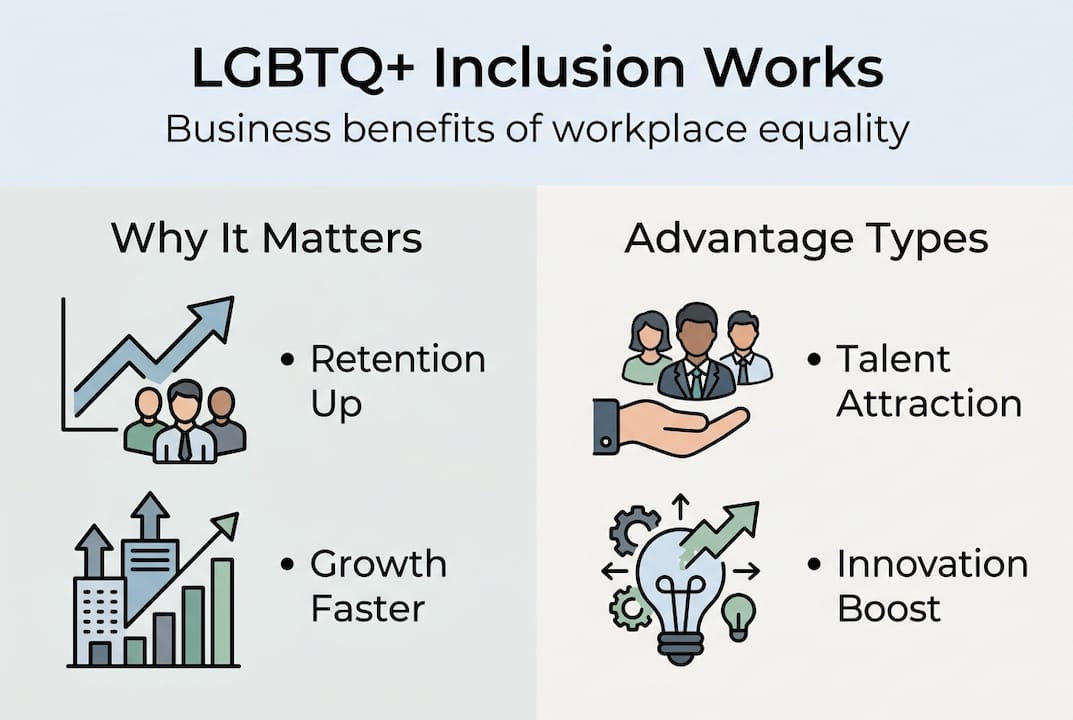
On the flip side, organizations that invest in equality see measurable returns. Companies that score highest on the Human Rights Campaign’s Corporate Equality Index (CEI) report eight times greater net income growth compared to low scorers. In 2026, 534 companies earned a perfect CEI score, signaling that rigorous inclusion is achievable at scale. These aren’t outliers. They’re a blueprint.
“Workplaces that actively support LGBTQ+ employees don’t just do the right thing. They consistently outperform those that don’t.”
Beyond the financials, confronting workplace discrimination head-on builds a reputation that attracts top talent. Job seekers, especially younger professionals, research employer values before applying. Visibility matters. Organizations that celebrate LGBTQ+ employees openly, including during Pride Month and retention initiatives, report 25% better staff retention compared to those that stay silent.
Key reasons equality drives business performance:
- Reduced turnover costs: Replacing an employee costs up to twice their annual salary. Inclusive firms lose fewer people.
- Higher engagement: Employees who feel seen and safe contribute more, collaborate better, and take fewer sick days.
- Stronger employer brand: LGBTQ±affirming workplaces attract a wider, more diverse talent pool.
- Lower legal risk: Proactive inclusion reduces exposure to discrimination claims and regulatory scrutiny.
The data is clear. Equality isn’t a checkbox. It’s a competitive advantage.
Employer responsibilities and legal frameworks
Understanding what you’re legally required to do is the foundation of any inclusion strategy. In the United States, the Equal Employment Opportunity Commission (EEOC) prohibits discrimination based on sexual orientation and gender identity under Title VII of the Civil Rights Act. Many states and cities layer additional protections on top of federal law, so your obligations may be broader depending on where you operate.
For global organizations, the complexity multiplies. Some countries criminalize same-sex relationships, which creates serious duty-of-care obligations for employers sending LGBTQ+ staff abroad. Conducting a risk assessment for international operations isn’t optional. It’s a legal and ethical necessity.
Beyond compliance, leading frameworks help you benchmark and improve:
- Corporate Equality Index (CEI): The CEI criteria provide clear, measurable benchmarks across non-discrimination policies, benefits, and organizational competency. Scoring well signals commitment to employees and investors alike.
- SHRM BEAM framework: The Society for Human Resource Management’s Belonging, Equity, Access, and Meaningful inclusion model offers HR teams a structured approach to audit and improve practices.
- Internal metrics: Track retention rates, promotion equity, engagement survey scores, and productivity by demographic segment to identify gaps.
Pro Tip: Pair pay transparency benefits with your equity audits. Pay transparency alone has been linked to a 7% reduction in the wage gap for LGBTQ+ workers, making it one of the highest-impact, lowest-cost policy changes available.
Looking at support programs for LGBTQ+ employees at organizations like Marsh shows what structured, scalable support looks like in practice. The lesson: compliance sets the floor, but culture sets the ceiling.
Identity-conscious vs identity-blind approaches
Here’s a distinction that trips up many well-meaning employers. An identity-blind approach treats everyone the same, ignoring demographic differences in the name of fairness. An identity-conscious approach acknowledges those differences and designs policies and culture to address them directly.
Research is unambiguous on this. Identity-blind policies can foster tolerance but rarely produce genuine belonging. When employees feel they must hide or minimize their identity to fit in, psychological safety drops, engagement suffers, and turnover rises. Tolerance is not inclusion.
Identity-conscious strategies that actually work:
- Visible leadership: When senior leaders openly support LGBTQ+ employees, it signals safety throughout the organization. 84% of LGBTQ+ graduates say diverse leaders directly influence their job choices.
- Tailored policies: Pronoun use guidelines, gender-neutral facilities, and transition support policies send a clear message that identity is respected.
- Active celebration: Recognizing LGBTQ+ events, including trans visibility initiatives, moves culture from passive acceptance to active affirmation.
- Structured feedback: Anonymous surveys and listening sessions give employees a safe channel to flag issues before they escalate.
“Belonging is not a feeling you can manufacture with a policy document. It’s built through consistent, visible action by people with power.”
The shift from identity-blind to identity-conscious thinking is often the single biggest lever employers have. It doesn’t require a massive budget. It requires intention and follow-through.
Practical steps for creating an inclusive workplace
Strategy without action is just aspiration. Here are concrete steps you can implement, ranked by impact and ease of execution.
- Establish employee resource groups (ERGs). LGBTQ+ ERGs create community, surface issues early, and give leadership direct insight into employee needs. Fund them properly and give them a seat at the table.
- Run bias training at every level. Bias training isn’t a one-time HR event. It’s an ongoing practice that shifts how managers make decisions about hiring, promotion, and day-to-day interactions.
- Make leadership visible. Executives who publicly champion LGBTQ+ inclusion change the cultural temperature of an entire organization. This costs nothing and signals everything.
- Audit and expand benefits. Review health plans, parental leave, and wellness programs for LGBTQ+ gaps. Gender-affirming care coverage and equal parental leave are baseline expectations for top talent in 2026.
- Build feedback loops. Run regular, anonymous engagement surveys segmented by demographic data. Act on what you find. Employees notice when feedback disappears into a void.
Retention is 70% higher in firms with strong inclusion practices, and structured LGBTQ+ support programs boost retention by an additional 35%. Those numbers compound over time into significant cost savings and cultural strength.

Pro Tip: Don’t underestimate the political climate’s effect on your workforce. 1 in 3 LGBTQ+ graduates have reconsidered their career path because of recent political and social shifts. Your internal culture can be a counterweight to external uncertainty, but only if it’s genuinely supportive.
Fostering workplace inclusion requires consistency. Programs that launch with fanfare and fade quietly do more damage than no program at all, because they signal that inclusion is performative rather than real.
What most employers miss about authentic inclusion
Most organizations approach LGBTQ+ inclusion the same way they approach compliance: do the minimum required, document it, and move on. The result is a workplace that tolerates difference without actually valuing it. Employees feel the gap immediately, even if they can’t always name it.
The research backs this up. Identity-blind approaches consistently fall short of producing belonging, and belonging is the variable that actually drives retention, engagement, and innovation. You can have every policy in place and still have LGBTQ+ employees quietly planning their exit.
What changes the equation is visible, sustained leadership commitment. Not a Pride Month email. Not a rainbow logo in June. We’re talking about leaders who speak up in meetings when bias surfaces, who sponsor LGBTQ+ talent for advancement, and who hold managers accountable for inclusion outcomes. The influence of LGBTQ+ leaders on recruitment and retention is documented and significant.
Authentic inclusion is an everyday practice, not an annual event. The employers who understand that are the ones building workplaces where LGBTQ+ employees don’t just survive. They thrive.
Take action: Connect with expert resources
Building an inclusive workplace is an ongoing process, and you don’t have to figure it out alone. The myGwork platform connects employers and HR professionals with a global community of LGBTQ+ professionals, allies, and inclusion experts.
Through myGwork, you can access real-world case studies from organizations that have successfully scaled LGBTQ+ inclusion programs, find support program guides tailored to your industry, and benchmark your practices against leading employers. Whether you’re looking to attract diverse talent, strengthen your ERGs, or develop leadership visibility strategies, myGwork provides the community and resources to help you move from intention to measurable impact. Your next step toward a more equal workplace starts here.
Frequently asked questions
What are the most impactful first steps employers can take to promote LGBTQ+ inclusion?
Start with bias training, visible leadership support, and establish resource groups to create safe spaces and meaningful engagement. Bias training and support programs are consistently linked to higher retention and stronger inclusion outcomes.
How do identity-blind approaches compare to identity-conscious ones for LGBTQ+ employees?
Identity-blind policies often produce tolerance rather than true belonging, while identity-conscious approaches create environments where employees feel genuinely seen and valued. Research confirms the gap between these two approaches is significant in terms of employee experience.
What are typical benchmarks and metrics for measuring inclusion success?
Common metrics include retention rates, promotion equity, engagement scores, and CEI benchmarking. Inclusive firms see up to 70% higher retention compared to organizations with weak inclusion practices.
What are the risks of not prioritizing LGBTQ+ equality in the workplace?
Employers risk financial underperformance, reputational damage, and elevated turnover when discrimination goes unaddressed. Discrimination drives turnover and weakens overall organizational performance over time.
How can employers support trans and non-binary (TNB) employees more effectively?
Implement tailored policies, provide targeted training, and ensure TNB employees have visible support from leadership. TNB employees face significantly higher rates of discrimination than other LGBTQ+ groups, making specific interventions essential.