
Inclusive Recruitment Step by Step: Proven LGBTQ+ Practices
April 29, 2026
Talented LGBTQ+ candidates face real barriers in hiring, even inside organizations that genuinely want to do better. Bias shows up in job descriptions, interview panels, and data collection processes, often before a single conversation takes place. The good news is that inclusive cultures hire 19% more LGBTQ+ talent and see 17% lower turnover, making this both an ethical priority and a measurable business win. This guide walks you through every stage of the recruitment journey, from policy review and training to measuring lasting impact, so you can build processes where every LGBTQ+ candidate has a real shot.
Key Takeaways
Preparing for inclusive recruitment: Laying the foundation
Before you post a single job listing, your organization needs to get its house in order. Inclusive recruitment does not start with a job ad. It starts with the policies, culture, and systems that shape every interaction a candidate has with your organization. Skipping this step is like painting over cracked walls. It looks fine for a moment, then the damage shows through.
Start with a full policy audit. Pull your anti-discrimination policies, code of conduct, and benefits documentation. Read them with fresh eyes. Do they explicitly name sexual orientation and gender identity as protected characteristics? Do they cover same-sex partners in benefits? Do they use gender-neutral language throughout? If the answer to any of these is “no” or “sort of,” that is your first item on the fix list.
Make bias training non-negotiable. Bias training for inclusivity is one of the fastest ways to shift recruiter behavior at scale. Cover unconscious bias, LGBTQ+ specific terminology, and what respectful pronoun practice looks like in professional settings. Do not make it a one-time checkbox. Quarterly refreshers and scenario-based learning sessions drive far better retention than a single annual module.
Activate your Employee Resource Groups (ERGs). ERGs serve as both internal advocates and external signals of inclusion. If your organization does not yet have an LGBTQ+ ERG, work with leadership to establish one. ERGs can review job descriptions, flag policy gaps, and mentor new hires from their community. They are also a powerful recruiting tool when candidates can see active, visible employee communities during their research phase.

Here is a quick comparison of organizations at different stages of inclusive recruitment readiness:
Build anonymous tracking systems. The Corporate Equality Index 2026 shows that 1,033 firms actively conduct LGBTQ+ outreach and track applicant diversity as a standard practice. The key word is anonymous. Candidates should never feel that sharing identity data puts them at risk. Use opt-in forms, strip identifying data before analysis, and be transparent with candidates about how you use the information.
For guidance on inclusive workplace tips beyond policy, additional frameworks can help HR teams think through physical space, communication norms, and team culture before the hiring process even begins.
Pro Tip: Assign a named inclusion lead or a small working group to own the recruitment audit. Shared accountability often means no accountability. One person or team with a clear mandate moves faster and creates real change.
Step-by-step process: Building an inclusive recruitment journey
With your foundation in place, it is time to build the actual recruitment process from the ground up. Each stage, from writing the job description to the final offer conversation, is an opportunity to either include or exclude LGBTQ+ candidates. Here is how to get each step right.
- Write gender-neutral, inclusive job descriptions. Audit every word. Replace “he/she” with “they.” Remove gendered coded language like “aggressive” or “nurturing” that research consistently links to applicant drop-off. State your commitment to LGBTQ+ inclusion explicitly, not buried in fine print, but in the opening section. Tools like Textio or Gender Decoder can flag problematic language automatically.
- Showcase visible LGBTQ+ leadership. Representation at the top sends the clearest signal of all. The impact of visible LGBTQ+ leaders is significant: 84% of LGBTQ+ graduates say diverse leaders directly influence their job choices. Feature LGBTQ+ leaders in your careers page content, recruitment videos, and employer brand materials. Authenticity matters here. Candidates can tell the difference between tokenism and genuine visibility.
- Connect candidates with ERG members early. Offer every candidate, especially those moving to final rounds, the chance to have an informal conversation with an ERG member. This is not about vetting the candidate. It is about giving them a safe, honest space to ask questions about culture, benefits, and day-to-day inclusion. This single step can be the deciding factor for LGBTQ+ candidates weighing multiple offers.
- Build diverse interview panels. A panel of people who all look and think the same sends a message, even when no one intends it. Include LGBTQ+ employees and allies on every panel where possible. Train all panelists on structured interviewing, so evaluation is based on competency, not comfort.
- Track metrics at every stage. According to the Corporate Equality Index 2026, top-performing organizations involve LGBTQ+ employees as candidate resources and track diversity metrics anonymously at each funnel stage. Use diversity hiring tools to automate data collection and build dashboards that make drop-off points visible.
Here is how key metrics should look across a well-designed inclusive recruitment funnel:
For teams building accessible workplace steps from scratch, a stage-by-stage framework helps prioritize where to start, especially for smaller HR teams with limited bandwidth.
Pro Tip: Do not wait for the end of a hiring cycle to review metrics. Build a mid-cycle check-in into your process. Catching a drop-off at the screening stage early lets you course-correct before you lose the candidate entirely.
Overcoming barriers: Addressing edge cases and privacy
Even the best-designed recruitment processes can fail LGBTQ+ candidates in specific, high-stakes moments. This is especially true for trans and non-binary applicants, who face structural barriers that most cisgender candidates never encounter. Recognizing these barriers clearly is the first step to removing them.
The data is stark. According to diversity hiring research, one in three UK employers is less likely to hire a trans candidate, only 43% of trans people can use a restroom that matches their gender identity at work, and 39% of LGBTQ+ applicants conceal their identity during interviews. Code-switching, the practice of adjusting language, behavior, or appearance to fit perceived norms, drains energy and masks authentic talent. When candidates are performing rather than presenting, you are not seeing the real person.
Here is what you can do to address these specific barriers:
- Update all communications to be gender-neutral. Use “they” as a default in candidate-facing correspondence. Offer a preferred name and pronoun field in your application system, and make sure those preferences are respected by every person the candidate interacts with.
- Audit physical spaces before in-person interviews. Confirm that gender-neutral restrooms are available and that reception and interview rooms are in locations where candidates feel comfortable. This is a baseline, not a bonus.
- Create a safe disclosure environment. Never require candidates to disclose gender identity or sexual orientation. Make it explicitly optional in any diversity form. Brief every recruiter on why this matters and how to respond if a candidate raises identity-related concerns.
- Develop specific support for trans and non-binary candidates. Consider assigning a dedicated inclusion contact that candidates can reach out to privately with questions or concerns before and during the process.
“Inclusive recruitment is not about making LGBTQ+ candidates feel special. It is about removing the additional labor they carry through processes that were never designed with them in mind.”
For a powerful example of what real trans inclusion in leadership looks like, the story of a trans woman leading NYC’s LGBTQ+ office illustrates how representation at the highest levels signals a genuine commitment to the community. On the pay side, pay transparency practices have been shown to cut the LGBTQ+ wage gap by 7%, making salary openness another concrete lever you can pull.
For broader structural guidance on building equitable workplace environments across all dimensions, additional frameworks can help teams think beyond recruitment into retention and advancement.
Verification and continuous improvement: Measuring impact
Implementing inclusive practices is only half the work. The other half is measuring whether those practices actually deliver for LGBTQ+ candidates and employees. Verification is not a one-time audit. It is an ongoing rhythm built into how your organization operates.
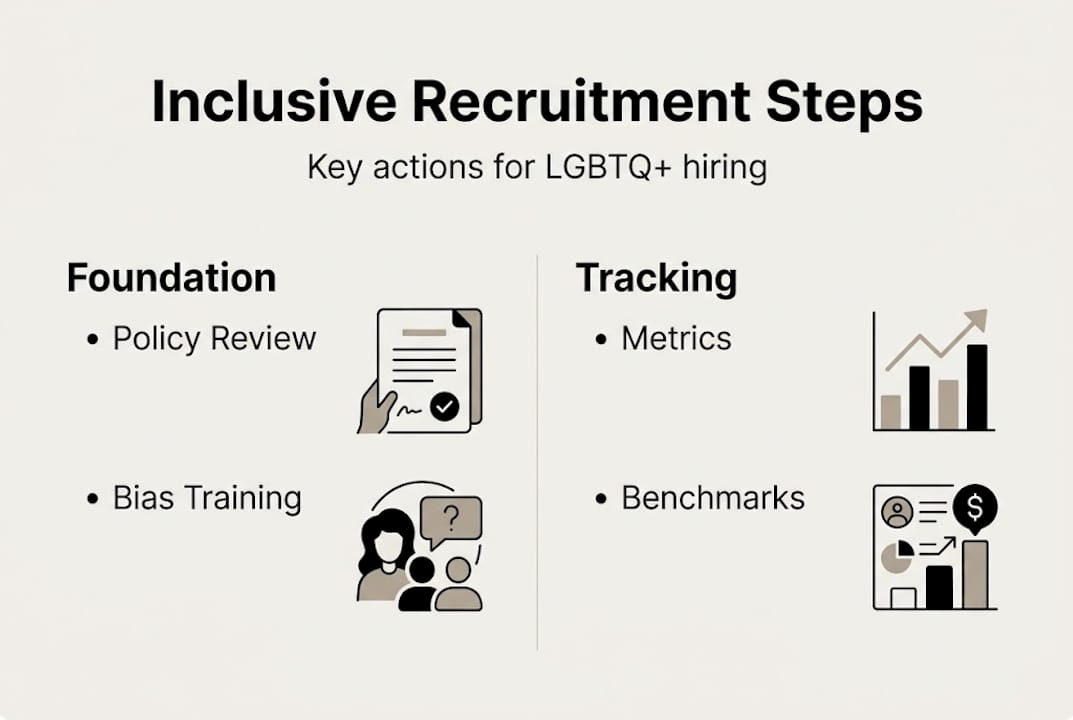
Set clear benchmarks before you start. If you do not know where you are, you cannot measure progress. Pull baseline data on LGBTQ+ representation at each funnel stage, time-to-offer rates, and first-year retention. Use these as your starting point and review them quarterly.
Use anonymous feedback loops. Candidates who did not get the job and employees who are thinking about leaving hold the most valuable feedback. Build anonymous survey touchpoints into the post-interview process and the onboarding experience. Ask specific questions: Did you feel the process respected your identity? Were you offered the chance to connect with an ERG? What would have made this experience better?
Here are the key areas to monitor for continuous improvement:
- Pipeline diversity: Is the proportion of LGBTQ+ applicants growing or stagnant?
- Stage-by-stage drop-off: Where are LGBTQ+ candidates exiting the process compared to non-LGBTQ+ candidates?
- Offer acceptance rates: Are LGBTQ+ candidates accepting at similar rates, or declining more often?
- Retention at 90 days and one year: Are new LGBTQ+ hires staying and thriving, or leaving quietly?
- ERG engagement: Are new hires connecting with ERGs and finding value there?
The business case for staying focused on these numbers is real. Inclusive hiring cultures hire 19% more LGBTQ+ talent on average, and LGBTQ+ inclusion is linked to 17% lower turnover. Those are not soft wins. They translate directly into reduced recruiting costs and stronger team stability.
Organizations that build a robust LGBTQ+ retention workflow around mentoring, ERG access, and regular inclusion check-ins see a 35% boost in retention. That is a number worth building toward. And as political and social shifts make LGBTQ+ professionals more selective about employers, the organizations that can demonstrate a genuine track record of inclusion will attract the best candidates.
Pro Tip: Share your diversity data internally with employees, not just leadership. Transparency builds trust, and LGBTQ+ employees who see that their organization is measuring and improving are far more likely to refer candidates from their networks.
The uncomfortable truth: Why inclusive recruitment is more than checking boxes
Here is what most guides on this topic do not say clearly enough: the mechanics of inclusive recruitment are the easy part. Writing gender-neutral job descriptions, adding pronoun fields, and launching an ERG are achievable in weeks. The harder work is cultural, and it starts at the top.
Organizations where senior leaders are visibly, actively engaged in inclusion see fundamentally different outcomes than those where inclusion is delegated to an HR team or a junior diversity officer. Leadership authenticity is not optional. Candidates research organizations carefully. They read Glassdoor reviews. They talk to current employees. They notice when the CEO shows up at Pride events and when they do not.
Surface-level fixes, ERGs without budget, metrics without accountability, bias training without follow-through, create a facade that experienced LGBTQ+ candidates see through immediately. Championing LGBTQ+ talent means giving marginalized voices real decision-making power, iterating based on what those voices actually report, and being willing to find out your process is failing and fix it publicly. The organizations making the most progress are the ones comfortable with discomfort.
Connect with more LGBTQ+ talent: Next steps
You have the roadmap. Now it is time to act on it at scale.
myGwork connects LGBTQ+ professionals and inclusive employers across the globe, making it one of the most direct channels for putting your inclusive recruitment practices in front of the right candidates. You can post jobs, join employer networks, and tap into a community of LGBTQ+ professionals and allies who are actively looking for workplaces like yours. Share your organization’s inclusion milestones, connect with global ERG networks, and access resources that help you refine your strategy as standards evolve. If you are serious about building a recruitment process that works for LGBTQ+ talent, myGwork is where that work gets amplified.
Frequently asked questions
What are the most effective first steps for inclusive recruitment?
Start by reviewing anti-discrimination policies to ensure LGBTQ+ identities are explicitly protected, then introduce bias training and set up an anonymous applicant tracking system. According to the Corporate Equality Index 2026, 1,033 firms already conduct structured LGBTQ+ outreach as part of their standard recruitment practice.
How can organizations ensure the privacy of LGBTQ+ applicants?
Collect diversity data through anonymous, optional forms, strip identifying information before analysis, and communicate clearly to candidates how their data is used. The Corporate Equality Index 2026 highlights anonymous tracking as a key practice among top-rated inclusive employers.
Why is visible LGBTQ+ leadership important in recruitment?
LGBTQ+ leaders on your careers page and recruitment materials signal psychological safety, directly influencing whether top candidates apply and accept offers.
What are unique barriers faced by trans and non-binary applicants?
Trans and non-binary candidates face compounding challenges including interview bias, lack of accessible restrooms, and pressure to conceal identity. Diversity hiring data shows that 39% of LGBTQ+ candidates conceal their identity during interviews, and one in three UK employers is less likely to hire a trans candidate.
How does inclusive recruitment affect retention?
Organizations with strong LGBTQ+ inclusion practices see 17% lower turnover and significantly higher retention rates, making inclusive recruitment one of the highest-return investments a hiring team can make.