
LGBTQ allyship training: step-by-step guide for inclusion
April 20, 2026
Allyship training that consists of a single annual workshop and a Pride Month email is not inclusion. It is theater. Many organizations invest in diversity programs that feel meaningful on the surface but lack follow-up and leadership buy-in, leaving LGBTQ+ employees no safer or more supported than before. The result is eroded trust, quiet exits, and a culture where performative gestures replace real change. This guide gives HR professionals and corporate leaders a practical, step-by-step roadmap for designing LGBTQ+ allyship training that drives measurable behavioral change, earns genuine buy-in, and builds the kind of inclusive workplace that retains talent and strengthens your organization.
Key Takeaways
Understanding the core challenges in allyship training
Before you can fix a broken program, you need to understand why it broke. Most allyship training fails not because people are unwilling, but because the design is fundamentally flawed from the start.
Performative vs. genuine allyship is the first distinction every HR leader must internalize. Performative allyship looks like rainbow logos in June, a one-hour sensitivity seminar, and a policy document no one reads. Genuine allyship is behavioral. It shows up in how managers respond to microaggressions in real time, how leaders advocate for LGBTQ+ promotions, and how teams normalize inclusive language every day.
The hard truth is that one-size-fits-all diversity training models are broken. A single session cannot account for the wide range of employee mindsets, organizational cultures, and lived experiences in any workplace. When training ignores these differences, it produces compliance, not commitment.
Common pitfalls to avoid in early program design:
- Treating training as a one-time event rather than an ongoing process
- Placing the burden of education entirely on LGBTQ+ employees
- Skipping a needs assessment and launching generic content
- Failing to secure visible, vocal executive sponsorship before launch
- Measuring success only by attendance or completion rates
Leadership buy-in is not a nice-to-have. When executives are visibly absent or passive, employees read the signal clearly: this does not matter. Checkbox approaches without leadership engagement breed cynicism and actively undermine psychological safety for LGBTQ+ staff.
Building effective bias training for LGBTQ inclusion means designing for behavior, not just awareness. Pair that with a visible trans rights commitment at the policy level, and your training gains credibility before the first session begins.
Pro Tip: Survey employees anonymously before designing any training. Ask specifically about psychological safety, witnessed microaggressions, and comfort raising concerns. This data shapes everything that follows.
Preparing your organization: prerequisites and stakeholder alignment
Effective allyship training does not begin in a training room. It begins weeks or months earlier, with honest organizational diagnosis and deliberate stakeholder alignment.

Start with a needs assessment. Review existing inclusion data: engagement survey results, LGBTQ+ representation at leadership levels, exit interview themes, and any reported incidents. This baseline tells you where the gaps are and what your training must address. Without it, you are guessing.
Next, map your stakeholders. Every organization contains a spectrum of employee mindsets:
- Champions: Already active allies who need tools and amplification
- Learners: Open and willing but lacking knowledge or confidence
- Skeptics: Resistant due to misunderstanding, discomfort, or competing values
- Passive bystanders: Uninvested but not opposed
Your training design must speak to each group differently. A skeptic will not respond to the same content as a champion. Ignoring this reality is one of the most common and costly mistakes in DEI (diversity, equity, and inclusion) program design.
Executive sponsorship is non-negotiable. Benchmarks show that organizations with active executive sponsors, functioning ally networks, and bias training coverage above 54% achieve meaningfully better inclusion outcomes. Sponsorship means more than a name on an email. It means leaders attending sessions, speaking publicly about inclusion, and holding managers accountable.
Set measurable goals before launch. Vague intentions like “improve culture” are not goals. Specific KPIs (key performance indicators) might include:
- 80% of managers completing advanced allyship modules within 90 days
- A 15% increase in LGBTQ+ employee engagement scores within 12 months
- A 20% reduction in reported microaggression incidents within 6 months
Research consistently shows that diverse leaders influence talent attraction, with 84% of LGBTQ+ graduates saying visible diverse leadership affects their job choices. Your preparation phase is where you start building that visible leadership pipeline. Learning from peers who are already championing LGBTQ talent can accelerate your own program design significantly.
Pro Tip: Create a small internal steering group that includes LGBTQ+ employees, senior leaders, and HR. This group owns the program, not just HR. Shared ownership drives sustained accountability.
Designing an action-focused LGBTQ allyship training
Once prerequisites are in place, the real work begins: building training that changes how people actually behave, not just what they know.
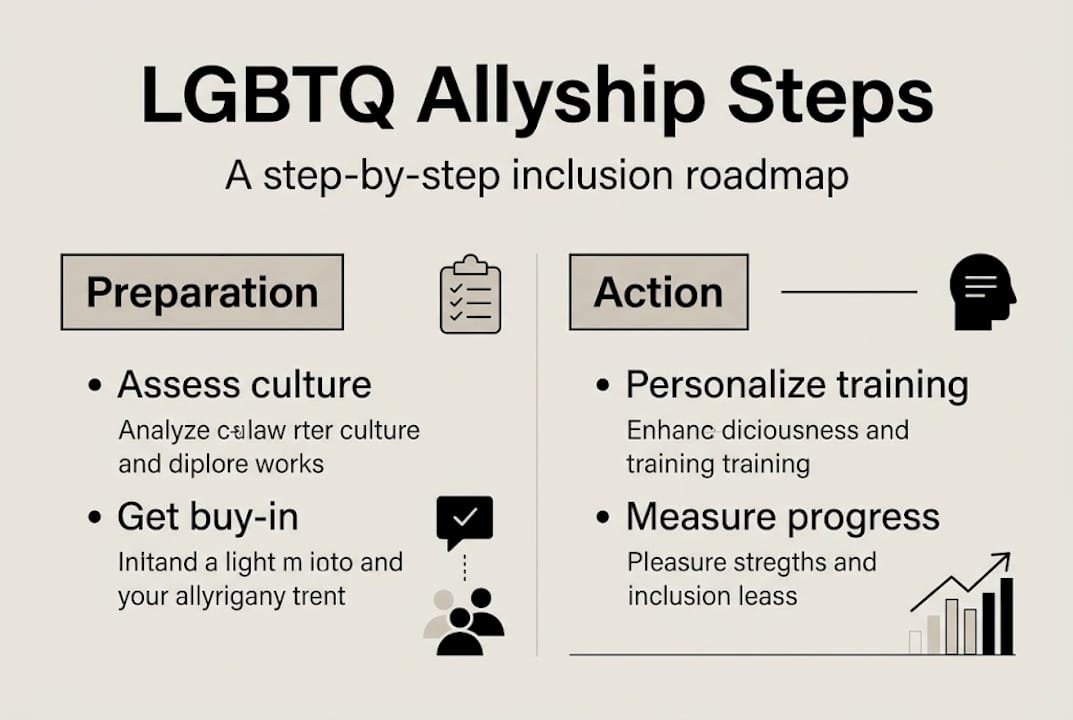
Action-focused frameworks consistently outperform awareness-only models. Frameworks that tie to leadership capabilities and include speaking up, amplifying marginalized voices, and seeking ongoing feedback have demonstrated a 424% ROI in organizational impact studies. That number should shift how you think about the business case for this investment.
Here is a step-by-step implementation sequence:
- Diagnostic phase (weeks 1 to 3): Analyze survey data, identify training personas, and set KPIs with leadership
- Content design phase (weeks 4 to 6): Build modular content tailored to champions, learners, skeptics, and bystanders
- Pilot phase (weeks 7 to 9): Run sessions with a cross-functional test group and gather structured feedback
- Full rollout (weeks 10 to 16): Deploy training with manager-led debrief sessions and peer coaching pairs
- Integration phase (ongoing): Embed ally behaviors into performance reviews, team norms, and leadership development
The most effective training components include:
- Role-plays: Simulate real workplace scenarios like misgendering, exclusion from meetings, and inappropriate jokes
- Microintervention grids: Give employees a menu of specific, low-risk responses to bias they can practice and memorize
- Peer coaching pairs: Match champions with learners for structured monthly check-ins
- Manager-specific modules: Address the unique power dynamics managers navigate when supporting LGBTQ+ team members
Personalization matters enormously. Skeptics need a business-case framing first, not a values lecture. Show them the data on retention, productivity, and brand reputation before asking them to examine their own behavior. Believers need tools, not motivation. Give them scripts, frameworks, and safe spaces to practice.
Connecting your training to a broader support program workflow can boost retention by up to 35%, making the ROI case even stronger when presenting to finance or executive stakeholders.
Pro Tip: Build a “microintervention library” specific to your industry and workplace culture. Generic scripts feel hollow. Scripts that reflect your actual office dynamics get used.
Ensuring sustainability: measurement, feedback, and continuous improvement
Designing great training is only half the job. The other half is making sure it sticks, evolves, and keeps producing results over time.
The most rigorous evaluation tool available is the Kirkpatrick model, a four-level framework that measures reaction, learning, behavior, and results. Research confirms that applying the Kirkpatrick model to sustained ally programs reduces social dominance orientation (SDO) and drives institutional change. SDO refers to a person’s preference for hierarchy and inequality between social groups. Reducing it is a meaningful marker of genuine culture shift.
Move beyond completion rates. Completion tells you who sat through the training. It tells you nothing about whether anything changed.
“The real test of allyship training is not whether employees finished the module. It is whether they intervened the next time they witnessed a microaggression.”
Metrics that actually matter:
- Retention rates for LGBTQ+ employees year over year
- Complaint and incident reports: Are bias-related complaints decreasing?
- Turnover reduction: Tracking turnover metrics among LGBTQ+ staff reveals whether the environment is genuinely improving
- Promotion parity: Are LGBTQ+ employees advancing at comparable rates?
- Engagement scores: Segment survey results by LGBTQ+ identity where possible
Building feedback loops into the program design keeps it relevant. Run quarterly pulse surveys. Hold open forums where LGBTQ+ employees can flag what is working and what is not. Treat the program as a living system, not a fixed curriculum. Retention data around Pride Month shows organizations with sustained inclusion programs see 25% better retention, which is a direct financial argument for continuous investment.
Reinforcement is where most programs collapse. Schedule structured reinforcement touchpoints: monthly team discussions, manager check-ins, and annual program refreshes that incorporate new scenarios and updated language.
Why most allyship training fails—and how to make it stick
Here is what most organizations will not admit: training alone cannot create an inclusive culture. It can inform, it can inspire, and it can equip. But without structural change, it fades.
The most common trap is treating training as the solution rather than the start. Organizations run a workshop, check the box, and move on. Checkbox trainings without leadership buy-in do not just fail to help. They actively breed skepticism among LGBTQ+ employees who have seen this pattern before.
Another overlooked trap is over-relying on LGBTQ+ staff to carry the emotional labor of education. Allies must do the work. That means sustained nudges, business-case framing for resistant stakeholders, and embedding ally behaviors into how performance is evaluated and rewarded.
What actually creates lasting change is a combination of systemic reinforcement and personal accountability. Look at how organizations like Marsh are reimagining support for colleagues by embedding inclusion into everyday workflows, not just training calendars. That is the model worth replicating.
Take your allyship program further with myGwork
Building a training program that genuinely moves the needle takes more than good intentions. It takes the right resources, peer connections, and ongoing support from people who understand the landscape.
myGwork is the global platform where HR leaders and DEI professionals connect with LGBTQ+ inclusive organizations, access practical tools, and stay ahead of best practices in workplace inclusion. Whether you are starting from scratch or refining an existing program, myGwork offers the community and resources to accelerate your impact. Explore the bias training guide to build on what you have learned here and connect with a network of professionals committed to making inclusion real, measurable, and lasting.
Frequently asked questions
What makes LGBTQ+ allyship training effective?
Effective training is actionable and sustained, tailored to different employee mindsets, and measured by behavioral outcomes rather than just completion rates. Leadership sponsorship and ongoing reinforcement are essential for real impact.
How do you address resistance or skepticism in training?
Skeptics respond better to business-case framing and ongoing nudges than to values-based appeals. Personalize their experience and give them data on retention, productivity, and organizational risk before asking for behavioral change.
Which metrics best demonstrate impact of allyship training?
Focus on retention rates, complaint reduction, and turnover trends rather than completion numbers. Tracking a 22% turnover reduction and bias incident reports gives you the evidence base to sustain investment and demonstrate ROI.
Who should own responsibility for allyship training?
Executive leaders must sponsor programs visibly, but broad employee participation is equally critical. Placing the entire burden on LGBTQ+ staff or HR alone guarantees the program will stall.