
What is invisible diversity? Improve workplace inclusion now
April 16, 2026
Workplace diversity conversations often center on what we can see: race, gender, age. But a large portion of diversity is invisible, and ignoring it has real consequences. LGBTQ+ veterans face compounding disadvantages, including higher rates of economic insecurity and mental health challenges, that go unnoticed when organizations only track visible traits. Invisible diversity shapes who feels safe, who stays, and who thrives at work. This article defines invisible diversity, explains its measurable impact on LGBTQ+ professionals, and gives you a practical framework to build workplaces where every identity is genuinely supported.
Key Takeaways
Defining invisible diversity: More than meets the eye
Visible diversity is easy to spot. Race, age, and physical appearance are apparent the moment someone walks into a room. Invisible diversity works differently. It includes characteristics that are not immediately apparent to others, characteristics that a person may choose to disclose, hide, or navigate carefully depending on how safe they feel.
Some of the most significant examples of invisible diversity in professional settings include:
- Sexual orientation and gender identity (LGBTQ+ status)
- Neurodiversity, including ADHD, autism, and dyslexia
- Mental health conditions such as anxiety, depression, or PTSD
- Veteran status, including combat-related trauma
- Non-apparent physical disabilities, such as chronic pain or hearing loss
- Religious beliefs that differ from a workplace’s dominant culture
- Socioeconomic background and first-generation professional status
The reason invisible diversity gets overlooked is partly structural. Most diversity, equity, and inclusion (DEI) metrics track what’s measurable at a glance. When organizations report on representation, they often focus on visible categories. That leaves entire populations of employees uncounted and unsupported.
There’s also a psychological dimension. Employees with invisible identities frequently engage in “covering,” a term for downplaying or concealing an identity to fit in. This is exhausting, and it signals that the workplace is not truly safe.
42% of LGBTQ+ public sector employees experienced discrimination or harassment based on their sexual orientation or gender identity, showing that invisible diversity carries very visible risks.
The misconception that “if we can’t see it, it’s not a problem” is exactly what allows discrimination to persist. Invisible does not mean insignificant.
How invisible diversity affects workplace experiences
Knowing what invisible diversity is matters less than understanding what happens when organizations fail to address it. The data is striking.

Discrimination and harassment by SOGI (sexual orientation and gender identity) research shows that 42% of LGBTQ+ public sector employees experienced discrimination or harassment, and 30% left their jobs because of how they were treated. That’s not a retention problem. That’s a failure of inclusion.
Here’s what typically unfolds when invisible identities go unsupported:
- Concealment begins. Employees hide their identity to avoid judgment, adjusting pronouns, omitting partners from conversation, or avoiding certain colleagues.
- Engagement drops. The mental energy spent on concealment pulls focus from actual work. Creativity and collaboration suffer.
- Trust erodes. When employees see colleagues face discrimination without consequence, they stop believing the organization is safe.
- Turnover accelerates. Without visible leadership and workplace inclusion, LGBTQ+ employees quietly exit, taking institutional knowledge with them.
Pro Tip: If you manage a team, normalize conversations about workplace wellbeing without requiring anyone to disclose personal details. Simply asking “What would make this team feel safer for everyone?” opens the door without pressure. Pair this with LGBTQ+ inclusion training to give your whole team a shared language.
The cost of inaction is not abstract. It shows up in turnover rates, sick days, and teams that never reach their potential.
Identity-blind vs. identity-conscious strategies: What actually works?
Once you understand the impact, the next question is: what do you actually do about it? Two broad approaches exist, and they produce very different results.
Identity-blind strategies treat everyone the same, regardless of background. The idea sounds fair. In practice, it erases the specific challenges that LGBTQ+ employees and others with invisible identities face. Research confirms that identity-blind approaches increase LGBTQ+ employees’ feelings of being “merely tolerated” rather than genuinely included.
Identity-conscious strategies acknowledge that different employees have different needs and design support accordingly. They don’t require anyone to disclose anything, but they create structures that make disclosure safe when someone chooses it.
Identity-conscious approaches improve belonging for several reasons:
- They signal that leadership has thought specifically about invisible identities
- They reduce the burden on individuals to educate their colleagues
- They create accountability structures that identity-blind policies lack
- They make pay transparency for inclusion and equitable benefits more achievable
A common pitfall of identity-blindness is that it conflates equality with equity. Giving everyone the same thing is not the same as giving everyone what they need. A policy that works for a cisgender, heterosexual employee may leave an LGBTQ+ colleague without the specific support that would actually help them.
Pro Tip: You don’t have to choose between privacy and support. Identity-conscious programs can be designed so that participation is always voluntary. The goal is to make support available and visible, not to pressure anyone into disclosure.
Framework for supporting invisible diversity in your organization
Understanding the problem is step one. Here’s how to move into action.
Step-by-step framework for leaders and allies:
- Audit your current policies. Review benefits, reporting channels, and ERG (employee resource group) structures for gaps that affect employees with invisible identities.
- Create confidential reporting mechanisms. Employees need a way to flag discrimination without fear of retaliation or forced disclosure.
- Establish and fund ERGs. LGBTQ+ ERGs, veteran groups, and neurodiversity networks give employees community and give leadership direct feedback.
- Train managers specifically. General diversity training is not enough. Managers need skills to support invisible diversity without inadvertently pressuring disclosure.
- Measure what matters. Use anonymous surveys to track belonging, covering behaviors, and inclusion sentiment over time.
Policies and practices that consistently show results include:
- Inclusive healthcare benefits covering gender-affirming care and mental health
- Pronoun options in company directories and email systems
- A support program for better retention that addresses LGBTQ+ employee needs directly
- Flexible leave policies that accommodate diverse family structures
- Celebrating Pride Month for inclusion as part of a year-round commitment, not a one-month effort
Ongoing measurement is non-negotiable. Policies without feedback loops drift. Schedule regular reviews and act on what employees tell you.
LGBTQ+ veterans illustrate why specificity matters. They are 4x more likely to be unbanked and face PTSD rates 5x higher than non-LGB veterans. Generic inclusion programs will never reach them. Targeted, identity-conscious support does.
Looking beyond the surface: Why invisible diversity is the missing key
Most organizations treat diversity as a visibility exercise. They count what they can see, report what they can measure, and call it progress. But the employees most at risk of discrimination, burnout, and departure are often the ones who never show up in those counts.
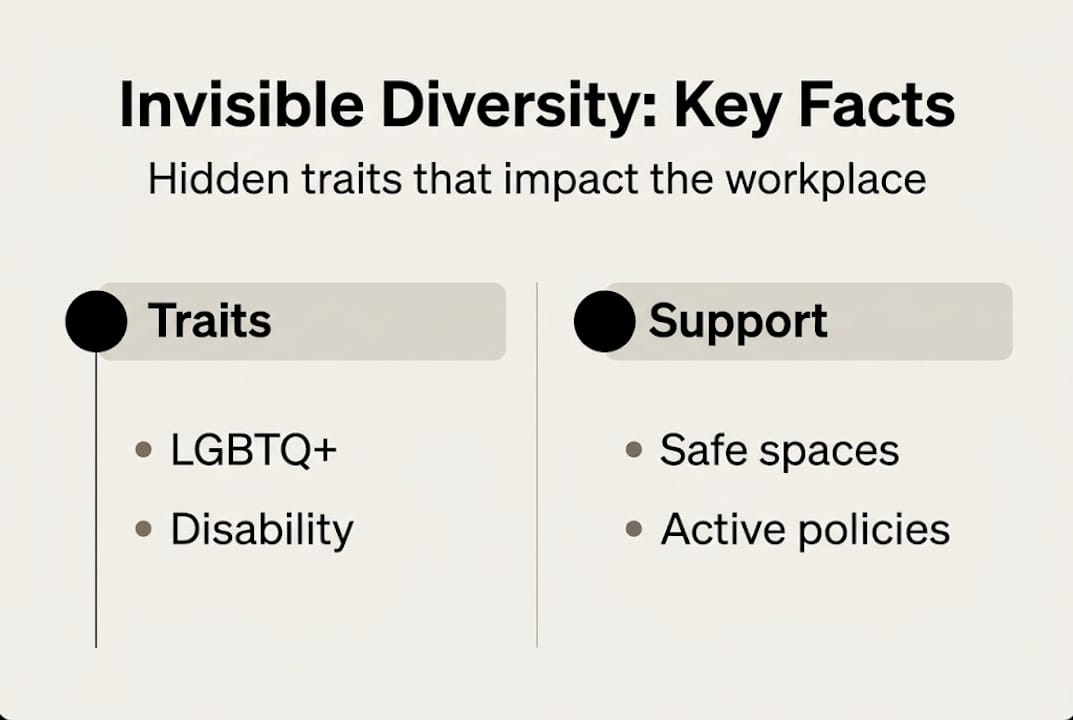
Here’s the uncomfortable truth: surface-level diversity efforts can actually make things worse for people with invisible identities. When an organization celebrates visible representation while ignoring LGBTQ+ discrimination or veteran mental health, it sends a message that only certain kinds of difference are worth protecting.
What we’ve seen across the LGBTQ+ professional community is that real inclusion starts with psychological safety, not policy documents. When employees with invisible identities feel safe enough to stop covering, something measurable happens. Engagement rises. Ideas surface. Retention improves. The research on LGBTQ+ veterans’ rights and advocacy shows how much energy is spent fighting for basic recognition, energy that could go toward contribution and growth.
The organizations that get this right don’t treat invisible diversity as a checkbox. They treat it as a signal that their inclusion work is not finished yet.
Find support and resources for invisible diversity
Building a truly inclusive workplace takes more than good intentions. It takes community, tools, and ongoing learning.
myGwork inclusion resources are designed for exactly this purpose. Whether you’re an LGBTQ+ professional navigating invisible identity at work, an ally looking to build better practices, or an organization ready to move beyond surface-level diversity, myGwork connects you to a global network of professionals, employers, and resources. From job listings at LGBTQ±friendly organizations to mentorship programs and educational content, the platform offers practical support at every stage of your inclusion journey. Explore what’s available and take your next step toward a workplace where every identity counts.
Frequently asked questions
What is invisible diversity in the workplace?
Invisible diversity refers to aspects of identity that are not immediately apparent, such as sexual orientation, gender identity, veteran status, or neurodiversity. Veteran status is one example that carries significant but often overlooked workplace implications.
Why do employees hide invisible diversity characteristics?
Many fear discrimination, exclusion, or lack of support, leading to covering behaviors or choosing not to disclose their identities at work. In fact, 66% of LGBTQ+ public sector employees engage in some form of covering behavior.
How can organizations support invisible diversity?
Organizations can implement identity-conscious inclusion practices, support networks, and confidential reporting to create truly welcoming spaces. Identity-conscious strategies are proven to reduce feelings of being merely tolerated among LGBTQ+ employees.
What is the impact of not addressing invisible diversity in the workplace?
Failure to support invisible diversity increases turnover, discrimination, and reduces morale and productivity. Research shows 30% left jobs due to their treatment, and 42% faced harassment or discrimination based on sexual orientation or gender identity.
Recommended
- Top 6 Diversity Hiring Tools Comparison 2026 for Hiring Managers
- Trans inclusion in the workplace: Updated guidance following UK Supreme Court Ruling
- Top 5 ways we can support and empower neurodiverse people in the workplace and promote inclusivity
- Bias Training: Fostering LGBTQ+ Workplace Inclusion