
Spot Rainbow Washing in Minutes: 7 Quick Checks to Verify Pride Claims
September 3, 2026
Rainbow washing is when a company slaps Pride colors on its logo, ads, or merchandise without backing that imagery with real policy, funding, or protection for LGBTQ+ people. It matters because the mismatch between symbolic support and substantive action erodes trust, damages employee well-being, and slows the broader push for workplace equality. The checklist and detection steps later in this article give you a way to tell the difference in minutes.
TL;DR:
- Companies that only update branding for June and do not implement internal policies or support systems are likely engaging in rainbow washing.
- Public disclosures of donations, policy details, and active employee resource groups are strong indicators of genuine LGBTQ+ support.
- Timing of campaigns concentrated solely in June, especially with no year-round activity, often signals insincerity to consumers and employees alike.
- Contradictions such as supporting Pride publicly while funding anti-LGBTQ+ legislation, or sponsorship withdrawals after PR gains, highlight superficial efforts.
- Checking political donation records, benefits policies, and leadership diversity provides the most reliable way to evaluate a company’s true level of inclusion.
What Is Rainbow Washing, and Where Did the Term Come From?
The word borrows its structure from “greenwashing,” the practice of marketing a product as environmentally responsible while doing little to reduce actual harm. “Pinkwashing” came first in LGBTQ+ contexts, originally describing how some governments and companies used gay-friendly messaging to distract from other policy failures. Rainbow washing is the broader, more modern version: any use of rainbow branding as a substitute for, rather than a signal of, real institutional commitment.
The term picked up steam as Pride Month became a marketing fixture rather than a protest anniversary. What started as a handful of companies changing their logos every June turned into an entire seasonal industry. Somewhere in that shift, LGBTQ+ advocates and researchers started asking a harder question: is this actually helping, or is it just borrowing our imagery for engagement?
Rainbow washing shows up on a spectrum, not as one uniform behavior. It helps to think of it in four rough categories:
- Symbolic visibility only. A company changes its social media avatar or storefront window for June and nothing else changes internally.
- Campaign-only support. Marketing runs a Pride-themed ad or product line, but the effort has no connection to ongoing company policy or funding.
- Contradictory practice. The company markets Pride support publicly while its internal policies, benefits, or political donations actively work against LGBTQ+ interests.
- Decoupled HR systems. Non-discrimination policies exist on paper, but there’s no training, enforcement, or accountability behind them, so they do nothing for the employees they’re supposed to protect.
That last category is the one researchers find most concerning, because it looks legitimate from the outside. A written policy sitting in an employee handbook is not the same as a workplace where LGBTQ+ employees feel safe reporting harassment or asking for accommodations. Systematic reviews of the research describe this pattern as a self-perpetuating cycle: symbolic gestures substitute for structural change, employees notice the gap, and organizational trust erodes further with each passing Pride season.
Why Rainbow Washing Actually Hurts People and Organizations
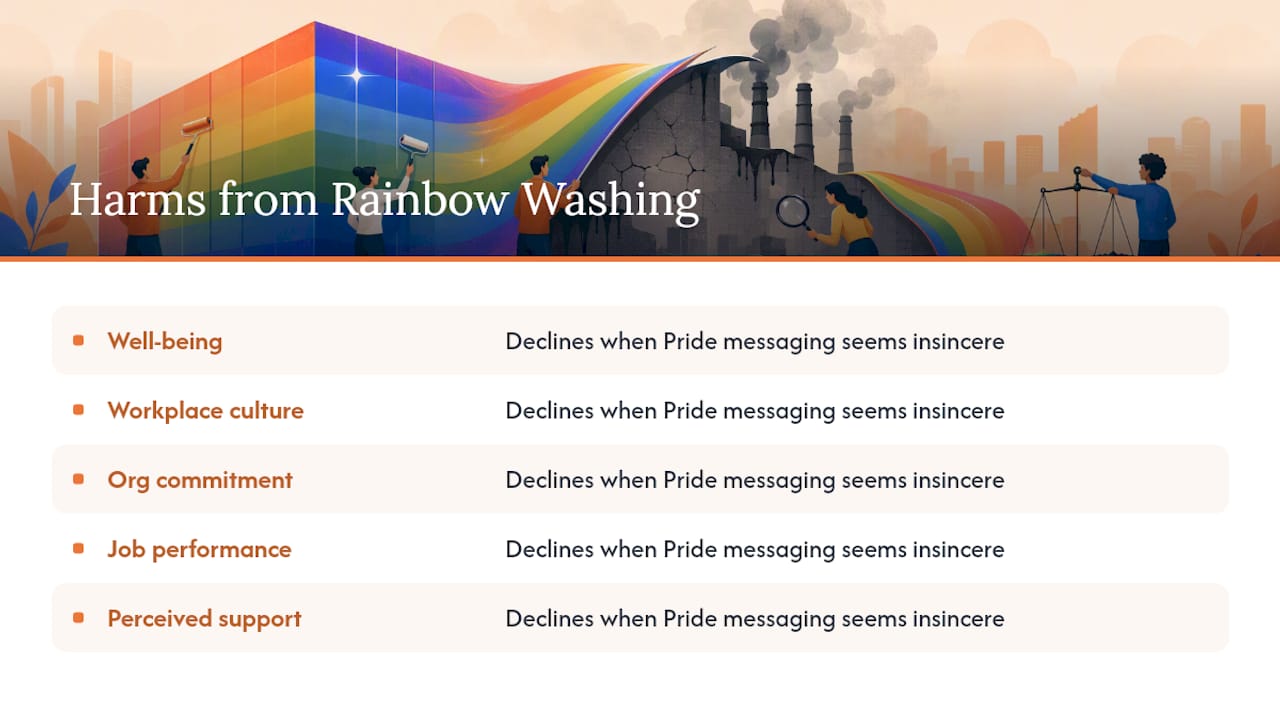
The consequences of rainbow washing aren’t abstract or limited to bad press. A 2025 study on the topic found that when employees perceive a company’s diversity messaging as insincere, it produces measurable harm across several dimensions: employee well-being, workplace culture, organizational commitment, job performance, and perceived organizational support all decline. That’s not a marketing problem. It’s a retention and productivity problem dressed up as a branding issue.
Employee well-being, workplace culture, organizational commitment, job performance, and perceived organizational support tend to be lower where LGBTQ+ employees perceive Pride messaging as insincere, according to peer-reviewed research.
The mechanism behind this is fairly intuitive once you see it laid out. Employees who work inside a company that markets rainbow-friendly values but doesn’t practice them internally experience a kind of dissonance. They see the ad campaign, then they see the manager who never enforces the harassment policy, or the benefits package that excludes a same-sex partner, or the HR team that has no idea what a gender-affirming care benefit even is. That gap between the public story and the lived experience breeds cynicism, and cynicism spreads. Coworkers talk. Reviews get posted on Glassdoor. New hires ask pointed questions in interviews that HR wasn’t prepared for.
Perceived insincerity in diversity messaging doesn’t just fail to help LGBTQ+ employees. It actively erodes their sense of organizational support, their commitment to the company, and their day-to-day performance.
There’s also a public-facing version of this same feedback loop. When a company’s rainbow branding collides publicly with a contradictory action, such as a political donation that surfaces in the press, the backlash tends to be swift and largely negative across social platforms. Consumers with strong ties to LGBTQ+ identity are especially likely to notice and respond, and research on stakeholder perception shows these consumers use more evaluation cues than casual observers, including donation history, company size, and how long the company has supported the cause. They’re also the group most likely to act on what they find, whether that means a boycott, a public callout, or simply withdrawing their support quietly.
The organizational cost compounds over time. Companies that get caught rainbow washing once don’t just lose a news cycle. They set a baseline of suspicion that follows every future campaign, making genuine efforts harder to communicate credibly even when the company later invests in real change.
Common Signs and Real Examples of Rainbow Washing in Marketing
Spotting rainbow washing gets easier once you know the specific patterns advocacy groups and researchers point to again and again. Here are the markers that show up most consistently across investigative reporting and academic literature:
- Timing-only branding. The logo, packaging, or ads go rainbow in June and revert immediately after, with no connection to the rest of the year.
- Geographic inconsistency. A brand promotes Pride campaigns in markets where it’s socially popular but stays silent, or even sponsors anti-LGBTQ+ policy, in regions where the messaging carries a real cost.
- Product-cause mismatch. A company sells rainbow merchandise, sneakers, coffee cups, T-shirts, with no percentage of proceeds going anywhere, and no public statement of where the money goes if it does.
- Tokenized philanthropy. A one-time donation gets announced with a press release and never appears again in the company’s giving history.
- Silence on policy specifics. The company talks about “supporting the community” in vague terms but avoids specifics on non-discrimination protections, healthcare coverage, or family leave for same-sex couples.
Beyond these individual signals, there’s a bigger structural tell worth watching for: the absence of anything measurable. Genuine allyship tends to leave a paper trail, matching donation records, benefits documentation, ERG (employee resource group) activity, public policy statements. Rainbow washing tends to leave only marketing assets.
A few patterns recur often enough in media coverage and consumer research that they’re worth naming directly, without pointing at specific brands:
- Retailers pulling Pride merchandise from shelves under political pressure while keeping the marketing campaign running elsewhere.
- Companies donating to political candidates or PACs with records of opposing LGBTQ+ rights while simultaneously running Pride ad campaigns, a contradiction investigative reporting has documented repeatedly.
- Corporate sponsors dropping out of Pride parades quietly once the immediate PR value declines, without any public explanation.
Advertising researchers have also found that timing alone functions as a strong signal to consumers. Campaigns concentrated exclusively in June, with no visible activity the rest of the year, are one of the most reliable cues people use to judge a brand’s sincerity, even before they check any financial or policy details.
How to Evaluate If a Company’s Pride Messaging Is Genuine
You don’t need insider access to check most of this. Most of the evidence is public if you know where to look, and the difference between rainbow washing and inclusion usually comes down to whether a company can back its imagery with a paper trail.
Start with these checks:
- Year-round policy presence. Search the company’s careers page or public policy documents for non-discrimination language, gender-affirming healthcare coverage, and equal benefits for same-sex partners, outside of June.
- ERG and internal support structures. Genuine employers typically have active employee resource groups with budgets, not just a Slack channel that exists on paper.
- Manager and staff training. Look for evidence of ongoing bias training rather than a one-time onboarding module. Consistent training programs tend to correlate with lower turnover among LGBTQ+ staff.
- Financial commitments. Check whether donations to LGBTQ+ organizations are disclosed, recurring, and sized proportionally to the company’s revenue, not a one-time press release amount.
- Political giving and lobbying records. Nonprofit trackers and campaign finance databases can reveal whether a company’s PAC or executives have funded candidates or legislation opposing LGBTQ+ rights.
- Representation data. Ask whether the company publishes leadership diversity numbers, and whether LGBTQ+ representation shows up above entry level, not just in marketing photos.
- Third-party verification. Independent workplace equality indexes and third-party audits carry more weight than a company’s own self-reported claims.
Pro Tip: If a company’s Pride campaign page doesn’t link out to a policy page, a giving report, or an ERG description, that absence is itself a signal. Genuine commitments are usually easy to document because the company wants you to find them.
If your research turns up a contradiction, such as a company publicly celebrating Pride while its PAC funds anti-LGBTQ+ legislation, that’s a clear red flag worth escalating. Document what you find with dates and sources, share it with advocacy organizations that track corporate accountability, and consider whether your dollars, your labor, or your application should go elsewhere. Consumers who hold strong ties to the LGBTQ+ community are statistically more likely to act on these contradictions rather than let them slide, and that collective pressure is often what actually changes corporate behavior over time.
What You Can Actually Do About Rainbow Washing
Recognizing rainbow washing is only useful if it changes what you do next. Here’s where to focus depending on your role:
- As a consumer: Ask direct questions before you buy, where does the money from this rainbow product actually go, and is that answer published anywhere? Favor smaller, community-led organizations over companies whose “giving” consists mostly of press releases.
- As a jobseeker: Use an employer-evaluation checklist before applying, and search specifically through platforms that vet employers for LGBTQ+ inclusion rather than generic job boards. Ask interviewers pointed questions about benefits, ERGs, and non-discrimination enforcement, not just whether the company “supports diversity.”
- As an employee: If you notice a gap between external messaging and internal practice, raise it with HR using specific documentation, screenshots of the marketing, comparisons to actual policy language, and data on turnover or complaints if you have access to it. Propose measurable fixes rather than general criticism; a specific ask is harder to dismiss than a vague complaint.
- As an advocate: Support public accountability efforts, sign petitions, share investigative reporting, and back organizations that redirect funding toward LGBTQ+ community programs rather than corporate sponsorships. Funding community career programs directly tends to produce more durable change than pressuring a single company’s marketing department.
None of these actions require confrontation for its own sake. The goal is leverage, making it clear that visibility without substance carries a cost, and that substance without visibility still counts.
What Genuine Workplace Inclusion Looks Like in Practice
Rainbow imagery works as marketing because color itself carries psychological weight. Color psychology research shows warm, varied palettes signal energy and openness, which is exactly why the rainbow flag translates so easily into a logo refresh. The problem isn’t the color. It’s when the color is the entire strategy.
Mygwork exists because visibility and structure have to travel together to mean anything. The platform connects LGBTQ+ professionals and allies with employers that back their Pride messaging with job listings, employer branding tools, mentorship programs, and networking events that run all year, not just in June. Employer profiles on the platform include documented diversity initiatives, giving job seekers a way to check claims before applying rather than after accepting an offer.
The data backs up why this matters at the recruiting stage specifically. 84% of LGBTQ+ graduates say visible LGBTQ+ leaders influence where they choose to work, which means representation at the leadership level isn’t a nice detail, it’s a primary factor in whether talented candidates apply at all. Companies that show up on platforms built specifically for LGBTQ+ talent, rather than relying solely on general Pride marketing, tend to have already cleared a higher bar of scrutiny.
A few things worth checking when you use a platform like this to evaluate employers:
- Whether the employer profile lists specific benefits (gender-affirming care, partner benefits) rather than generic “inclusive culture” language.
- Whether the company participates in mentorship or ERG-support programs that extend beyond a single event.
- Whether leadership representation is visible in the company’s actual profile, not just its marketing photos.
An Editorial Take on Detecting Rainbow Washing
Most advice on this topic tells you to “look for authenticity,” which is useless because insincerity is designed to look authentic. The evidence actually points somewhere more specific: check the paper trail, not the tone. A company’s Instagram caption tells you nothing. Its donation disclosures, ERG budgets, and political giving records tell you almost everything.
The conventional wisdom overrates visibility and underrates boredom. The most trustworthy signal of real inclusion is often the least exciting one, a benefits policy that hasn’t changed its wording in three years because it didn’t need marketing help to justify itself. If I had to prioritize one check for readers pressed for time, it’s political donation records. Marketing is cheap to fake. A documented contribution to an anti-LGBTQ+ candidate is not something a PR team can spin away, and it tells you more about a company’s actual position than any campaign ever will.
Sources
- What Is Rainbow Washing? How Companies Get Pride Month Wrong
- Unveiling rainbow-washing: impacts on LGBT+ employees in the workplace
- Pride or Rainbow-Washing? Exploring LGBTQ+ Advertising from the Vested Stakeholder Perspective
- Genuine Pride or corporate rainbow washing?